
Fortune India 40 Under 40 2026: Young entrepreneurs will drive India’s journey to a developed economy, says Chirag Paswan
ADVERTISEMENT
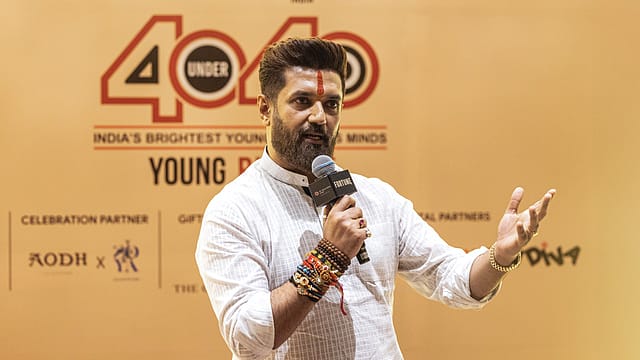
India’s young population is its biggest strength and can play a defining role in the country’s journey towards becoming a developed economy by 2047, Union Minister for Food Processing Industries Chirag Paswan said at the Fortune India 40 Under 40 2026 event.
Addressing the gathering, Paswan called on young entrepreneurs to move beyond being job seekers and become job creators while urging businesses to build globally recognised Indian brands.
India’s demographic dividend is its biggest strength
Paswan said India’s demographic advantage, with a large share of its population below the age of 35, gives the country the energy and talent needed to compete globally.
He asked young entrepreneurs to either carry forward established family legacies or build businesses from scratch across emerging sectors. “We should not only be job seekers; we should also be job creators and job providers,” Paswan said, stressing that the next generation has a responsibility to contribute to India’s economic growth.
He also said the younger generation should not view inherited businesses or family legacies as a limitation, but as an opportunity to build on what previous generations have created.
Food processing can help build Brand India
As the minister overseeing the food processing sector, Paswan highlighted the sector’s potential to make India a global food basket.
India, he said, has the agricultural base, consumer market and traditional expertise required to become a major global food-processing hub. “India has the potential to eventually present itself as a global food basket,” Paswan said, urging young entrepreneurs to consider food processing as an avenue for expansion and diversification. He mentioned the deep-rooted culture of food processing in Indian households, from pickles and curd to other traditional products, and said the opportunity lies in taking these practices to a modern, scalable and globally competitive level.
Quality key to building global Indian brands
Paswan stressed that Indian companies must focus on quality if they want to build lasting global brands.
Despite India’s large population and expanding economy, he said relatively few Indian brands feature among the world’s leading brands across sectors.
“How do we make sure that when you talk about ‘Made in India’, it comes with the utmost assurance of quality?” he asked. He said a quality issue involving one company can have implications for the broader perception of Brand India, particularly in international markets.
“Brand India” cannot afford to compromise on quality, Paswan said, adding that the long-term objective should be for Indian standards to be recognised as global standards.
Govt-industry partnership is crucial
Paswan said he sees his role as a bridge between the government and industry, particularly in helping businesses identify and address regulatory challenges.
He highlighted ongoing reforms aimed at improving the ease of doing business and enabling companies to expand both domestically and internationally. “Take me for granted as a bridge between the government and industry,” he said, urging entrepreneurs to communicate the reforms and policy changes needed to help their sectors grow.
He also pointed to production-linked incentive schemes and trade agreements as mechanisms that can help Indian companies expand their global footprint.
Young entrepreneurs must think beyond the present
With India targeting developed-economy status by 2047, Paswan said the next two decades will be critical. The younger generation, he said, will increasingly have to take the driving seat in India’s economic journey and think beyond short-term gains.
He urged entrepreneurs to ask where their businesses and India should be 10, 15 or 30 years from now, rather than simply measuring progress against the past. As global markets open up through trade agreements and FTAs, Paswan added Indian companies have an opportunity to establish themselves as global leaders across sectors.