
Fortune India Exclusive: Karnataka IT Minister Priyank Kharge explains how the state govt is looking to become the first adopter of startup tech solutions
ADVERTISEMENT
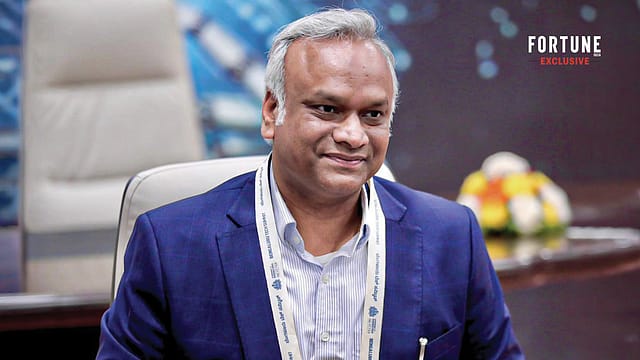
Minister for Electronics, IT/BT, and Rural Development & Panchayat Raj Priyank Kharge, in an exclusive interview with Fortune India, speaks on a variety of issues, including the state's latest Startup Policy and policy on social media access for young adults. Edited excerpts:
Fortune India: Given the Karnataka government’s latest Startup Policy (2025–2030), which seeks to establish up to 25,000 additional startups—including 10,000 from clusters beyond Bengaluru—how easy or difficult has it been to achieve this?
Priyank Kharge: It is easy to do it in Karnataka because we have built that ecosystem over a period of a few years. We have something called the New Age Innovation Network, where we give incubators money for incubation across engineering colleges that are outside Bengaluru. We also have the Technology Business Incubators (TBIs), where, if you have an idea, we give ₹10 crore per college, outside Bengaluru. And, we have Elevate Kalyana Karnataka, a region-wise programme, where we give grants of up to ₹50 lakh. That has worked out well for a lot of startups, and we are focussing heavily on grassroots innovations as well. That helps foster startups in the rural areas and more importantly, we have this huge mentorship network which people can access. The results are evident. More than 28% of the startups that register with us are from beyond Bengaluru. We have just declared the deeptech decade and already have more than 937 startups registered with us for just that cohort. So, you see the depth is there, the talent, the fire in the belly for innovation is huge in the demography and so that's what is working for us.
Fortune India: While there is a focus on AI and quantum tech in terms of policy, where do you see yourself making use of this tech?
Priyank Kharge: We have a public procurement policy where the startups that are funded by us—or have received a grant or solved any problem that is plaguing the government or governance—we take it. So, we allow them a proof of concept and if the proof of concept is good enough, then we scale it. The other method is the Grand Challenge method, for example, portability of water, chemical contamination, and biological contamination. We throw up challenges and startups come up with ideas; we experiment and we give them a pilot project to work on. The third one is where we are coming up with the Karnataka Innovation Authority that was already there. The new 2.0 version is coming out where we're looking at technologies where we don't have a policy yet but it's important for the government. So that will rest in a regulatory sandbox environment. The fourth thing is, we are now going to club most of these things into a government first project. We will be coming up with a policy where startups can access the government, and the government can be a first customer for these startups. We will be allowing them to use public data sets that are there with the government, public infrastructure, digital infrastructure for startups to build solutions for us. So, it's a multi-pronged thing. The public procurement policy, government first initiative, regulatory sandbox initiative, and Grand Challenges initiative. Now, we will be combining these to make some proper policy for the government.
Fortune India: Between grant and equity, what do you see as a more equitable approach when it comes to nurturing new startups?
Priyank Kharge: We do both. We have KITVEN (Karnataka Government's Venture Capital Fund), where we take stake, because we give out a lot of money there, which can go up to ₹5-10 crore, and is a Sidbi-registered fund. It works like a proper venture capital. Elevate works as a grant... We foster early-stage startups. That is where people don't get funding and the government is capable of taking those risks. We have funded more than 1,300 startups and more than 70% of them have raised another round. I'm not saying there are no failures, but the success is immense. More importantly, being the startup capital and being one of the biggest clusters in the world, it is important to accelerate the entire ecosystem and the only way to accelerate this is providing them capital, mentorship, access to incubators and accelerators. Hence, it is just not giving capital. We are not just throwing capital. We are giving them an ecosystem. We give them market-access programmes such as the US, Germany, and Australia. No other states do this. For the deeptech fund, we want to put in around ₹600 crore. That's an initial commitment by us. We're looking for commitments even from the private sector, and they have been extremely receptive. In fact, at the Future Makers Conclave that was held in November, they gave ₹400-500 crore. In totality, on stage we distributed ₹736 crores. And, this is exactly how disruptive the government in Karnataka has been, and we have done it along with the VCs. We are not working in silos. We are working with industry.
Fortune India: In the state budget there was a mention on restricting social media access for young adults. Given the legal challenges that you may face, how is the government looking at this from an implementation standpoint, what is the thought process?
Priyank Kharge: I have more than 1.8 crore people in the demographic below the age of 17, of whom over 70% are on one social media platform or another. Of these, more than 60% are exposed to inappropriate images, 34% experience cyberbullying, and over 56% are exposed to one form or another of cyber fraud. And when they are not supposed to be online—when social media platforms themselves say there is an age limit—why are we allowing children to be online and be exposed to things they should not be exposed to? We are trying to address this, and it is not about saying we are banning these platforms. We have to regulate them. It is the responsibility of the government, the social media platforms, educational institutions, as well as parents. It has to be a shared responsibility. As Minister for Technology while I promote digital learning and e-learning, especially in areas where teachers may not be readily available across rural regions, I cannot be seen as trying to ban these platforms. There is both good and bad—it is a very thin line. And algorithms, too, are designed to maximise engagement. We have set up a committee comprising members from the legal fraternity, social media, public policy, and technology sectors. We also have representatives from the Education Department, and we are engaging with parent groups and educational institutions to gather their feedback. It is going to be a consultative process.
Fortune India: What do you make of the new amendments that MeitY is proposing to regulate content creation, especially around news and current affairs?
Priyank Kharge: You should be asking the current dispensation this. This is some kind of a digital dictatorship that is going on wherein certain people get a free hand to do what they want while the others are asked to pull down [content]. It's nothing but weaponising these rules for censorship, and that's exactly what they're doing. And the worst part is the very architects of free speech, the people who own these platforms, who advocate free speech, like Elon Musk and everybody else there, they have succumbed to the government's diktats. For instance, they've muted community notes on X. I think the government seems to be afraid on narratives floated by citizens.
Fortune India: Given that Karnataka has seen the largest number of Global Capability Centres (GCCs) being set up, do you see this as a structural change taking place in the sector, or a cyclical trend driven by macroeconomic factors?
Priyank Kharge: The GCCs, I believe, will continue to play out strongly in the long run as well. People are finding it difficult to predict outcomes because of the disruption AI is bringing. But as I said earlier, these GCCs operating out of India, especially here in Bengaluru, are focussed on innovating for the world and inventing for the world through Bengaluru. So, with local talent creating global IPs, I believe they are here to stay. This is a structural shift, and the foundation is pretty solid. In one form or another, they will be there.