
Fortune India MPW 2026: Amid AI, geopolitical uncertainty, business leaders urge firms to stay agile, customer-focussed
ADVERTISEMENT
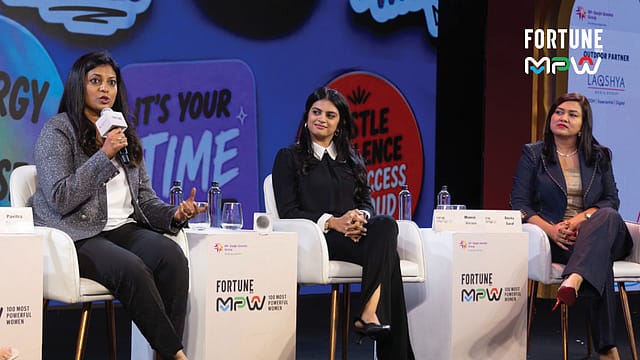
Amid geopolitical tensions, rapid advances in artificial intelligence (AI), shifting consumer preferences and economic uncertainty, businesses must remain agile while focussing on enduring customer needs instead of reacting to every disruption, industry leaders said at Fortune India's Most Powerful Women (MPW) 2026 event in Mumbai on Friday.
Speaking at the 16th edition of Fortune India's MPW, Pavitra Shankar, Managing Director of Brigade Group; Mansi Virani, Director at Balaji Wafers; and Devita Saraf, Founder, Chairperson and CEO of The Vu Group, said resilience, adaptability and a long-term approach will be critical for businesses navigating an increasingly uncertain global environment.
Shankar said leaders should resist the temptation to make fear-driven decisions during periods of uncertainty and instead focus on the fundamentals that remain unchanged.
"I focus on what isn't changing, not so much on what's changing constantly," she said.
Referring to the impact of AI and geopolitical developments on businesses, she said the underlying demand for real estate would continue to evolve rather than disappear.
"People are still going to need physical space to live somewhere or to work. If not offices, we'll need data centres. If you keep looking at what's not going to change, you'll continue to find opportunities," she said.
Shankar added that companies should focus on creating competitive advantages that are difficult to replicate instead of reacting to every macroeconomic development.
Virani said uncertainty had been central to Balaji Wafers' growth story, noting that the business itself emerged after her family transitioned from farming following a severe drought. "Our business itself was born out of uncertainty," she said.
She said the company has strengthened its supply chain by developing multiple sourcing channels for key raw materials, allowing it to withstand disruptions while maintaining customer satisfaction.
Virani also highlighted the growing role of artificial intelligence and data analytics in the FMCG sector, saying the company is looking to automate processes and improve decision-making through technology.
Speaking about workplace dynamics, she said younger employees are increasingly challenging conventional thinking and encouraging organisations to rethink established practices.
Saraf described AI as one of the biggest opportunities for businesses rather than a threat. "There are so many new jobs, new industries and new economies that AI will create," she said, adding that India's entrepreneurial ecosystem positions the country well to benefit from the technological shift.
She said Indian businesses have historically demonstrated resilience in navigating uncertainty and should view the current environment as an opportunity to innovate and expand.
"We should look at this uncertain world as an opportunity. We, as Indians, are already resilient and know how to make the best of difficult situations," she said.
The discussion also touched on managing an increasingly Gen Z workforce. While Shankar said younger professionals are more willing to advocate for themselves and seek opportunities proactively, Virani said organisations should encourage employees to question assumptions and challenge stereotypes.
Saraf said leadership in the AI era requires empowering rather than controlling younger talent.
"You cannot control Gen Z. The only thing you can do is give them a great vision and let them execute it with their own passion and drive," she said.
The panellists agreed that while technology, business models and global risks will continue to evolve rapidly, companies that remain agile, build resilience and stay focussed on long-term customer needs will be better placed to navigate future disruptions.