
Google backs AI in classrooms with ₹85 crore grant, JEE Main tools on Gemini
ADVERTISEMENT
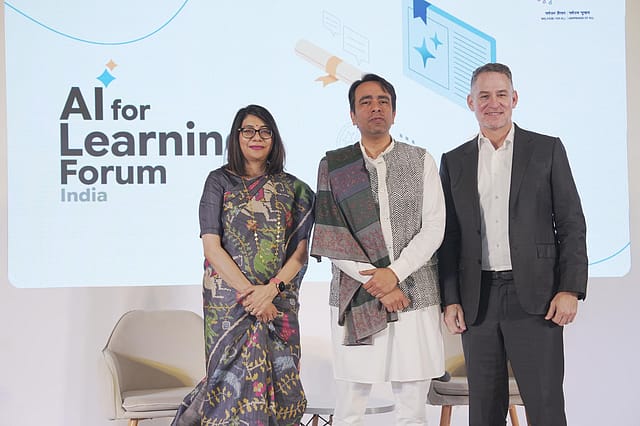
Google has sharpened its push to embed artificial intelligence deeper into India’s education system, announcing a series of initiatives that span funding, exam preparation and institutional transformation. The announcements were made at Google’s AI for Learning Forum, held under the IndiaAI Impact Summit.
At the centre of the push is an ₹85 crore (nearly $10 million) grant committed by Google.org to Wadhwani AI to help scale AI-powered education solutions across the country. The funding is part of the AI for Education collaborative and is aimed at supporting teachers and students at scale over the long term.
“We have infused a tutor’s mindset into our AI tools so they act as thought partners for students and educators alike,” said Preeti Lobana, vice president and country manager, Google India. She added that the initiative over the next decade aims to reach 10 million teachers and educators, empower 75 million students and ultimately impact over 1.8 billion learners.
Alongside funding, Google also unveiled product-led interventions focused on high-stakes exams. The company announced the launch of full-length JEE Main mock tests on Gemini, developed in partnership with edtech platforms PhysicsWallah and Careers360. The tests are designed to provide students with immediate feedback and personalised study plans.
“It’s important that our tools be truly helpful for local learning needs,” said Chris Phillips, vice president, education, Google. Highlighting the role of exams in India’s education ecosystem, he said, “We know that for millions of students, standardised tests are critical to their educational journey.”
Phillips said the JEE Main practice tests have been grounded in content from local partners, allowing students to identify knowledge gaps and use Gemini to customise their preparation. “Students will get immediate feedback on knowledge gaps and can use Gemini to create custom study plans,” he said, adding that Google plans to expand to more competitive exams in the near future.
Moreover, Google India has signed a MoU with the Ministry of Skill Development and Chaudhary Charan Singh University. The university will become India’s first AI-native university pilot, marking a shift towards embedding AI across teaching, learning and administration from the ground up.
Phillips also stressed that scale would be matched with safeguards. “In education, the ability to distinguish between what is real and what is AI-generated is vital,” he said, pointing to Google’s digital watermarking tool, SynthID, which helps detect AI-generated or edited images, audio and video. He added that Google’s goal is to expand such verification beyond its own models so that the wider education community can navigate AI with confidence.
Framing India as a bellwether market, Phillips said, “India is the home of one of the world’s largest educational ecosystems. You are shaping the future of learning for the entire globe.”