
HCLTech widens FY27 outlook amid soft discretionary spending
ADVERTISEMENT
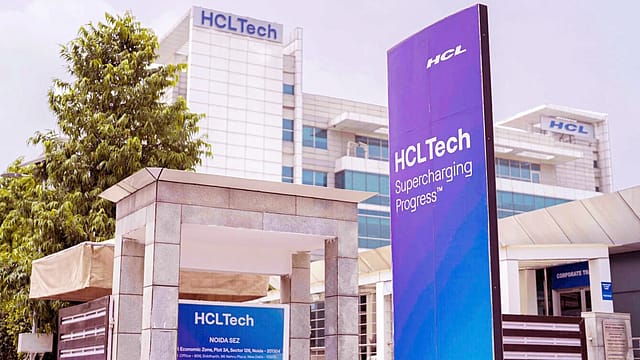
A cautious outlook from HCLTech , completing its fifth decade, is in line with the uncertainty clouding the IT services sector, with the company offering a wide revenue guidance band for FY27 even as it flagged a strong deal pipeline and rising AI traction.
For FY27, the company has guided for revenue growth of 1% to 4% in constant currency, a spread that reflects multiple possible demand scenarios rather than a clear line of sight. It's lower than last year at 2% to 5%. Chief executive officer C. Vijayakumar said the band captures both downside risks and potential upside from deal conversions and improved client spending.
“The business environment remains highly fluid making it difficult to form a definitive view of how the next 12 months will unfold,” Vijayakumar told Fortune India during the press conference. Tariff-related volatility and a slowdown in discretionary spending across traditional segments continue to weigh on demand.
The company has explicitly built three scenarios into its outlook. At the lower end, it assumes continued weakness in discretionary spending and further pressure from two large clients in the US that have scaled back technology budgets. “Our lower end assumes similar discretionary spending, which has been soft, especially since March… and we are assuming that might get even worse during the year,” Vijayakumar added.
The midpoint assumes no further deterioration, while the upper end factors in a recovery in discretionary spending along with strong deal wins translating into revenue, particularly in the first half of the year.
Shubham Rathore, principal analyst at Gartner, said the company’s growth came “amidst a cautious global market,” supported by demand for new technologies and a steady deal pipeline. “HCLTech faces industry-wide hurdles, notably a 14.1% year-over-year decline in software revenue and tightening discretionary budgets that pressure overall margins,” he added.
Demand uncertainty shapes outlook
The cautious stance comes after a quarter where execution fell short of expectations. In Q4, revenue declined 3.3% sequentially in constant currency, with Vijayakumar attributing the miss to “delay in procurement decisions in the month of March” and reduced discretionary spending in segments such as telecom.
For the full year, HCLTech reported 3.9% constant currency growth, supported by its services business, which grew 4.8%. However, the software segment remained a drag, declining 4.1% year-on-year, while margins also came under pressure. EBIT margin for FY26 stood at 17.2%, or 17.9% excluding restructuring costs.
Chief financial officer Shiv Walia said profitability remained stable despite quarterly volatility. “Our EBIT came in at ₹22,397 crore at 17.2% of revenue… net income for the year is at ₹17,361 crore,” he said.
The March quarter was weaker on margins, with EBIT at 16.5%, reflecting both seasonality in the software business and the impact of softer revenue.
Even so, the company’s deal pipeline remains strong. Total contract value of new deal wins stood at $9.3 billion for the year, in line with the previous year.
AI-led traction
Rathore noted that future growth will hinge on how effectively companies integrate artificial intelligence into broader enterprise workflows. “Information technology organisations that seamlessly embed indirect Artificial Intelligence capabilities to enhance workflow redesign and enterprise productivity will be optimally positioned to capture future technology investments,” he said.
Vijayakumar pointed to AI as a key driver of future growth, with advanced AI revenue reaching an annualised $620 million. But management also acknowledged that AI is causing a deflation of 2-3% per year in traditional segments.
Yet, the translation of this pipeline into near-term growth remains uncertain. “Some of this impact is likely to carry into the next quarter and we have factored that into the guidance,” he said, referring to delayed decisions and client-specific headwinds.
The company is also dealing with changes in client behaviour. Cost optimisation remains a priority for clients, while discretionary spending continues to be uneven across sectors and geographies. Europe, in particular, is seeing pressure from macroeconomic factors such as energy prices and supply chain disruptions, while North America remains relatively stable.
At the same time, HCLTech is investing behind its AI strategy, even if it weighs on near-term visibility. “We intend to reinvest the benefits of currency depreciation into strengthening our AI capabilities and our sales engine,” Vijayakumar said.
On profitability of AI-led work, the company struck a cautious note. “It’s a little premature to call out the margins,” Vijayakumar said, indicating that the business is still evolving.