
If you solve India’s problems, you are relevant globally: Sarvam Kaze CEO Pawan Gandhi
ADVERTISEMENT
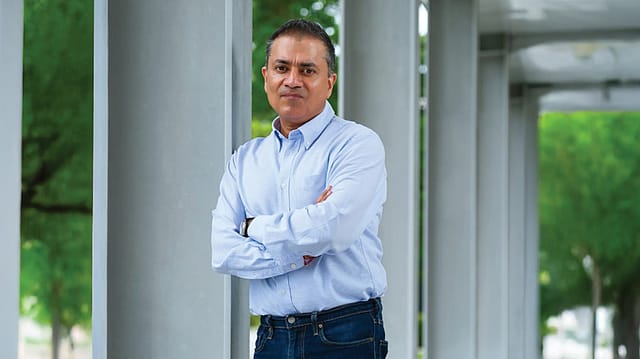
Sarvam AI emerged as one of the most-discussed companies at the India AI Summit 2026. While the company, founded by Vivek Raghavan and Pratyush Kumar, introduced India’s first sovereign indigenous large language models, its hardware arm, Sarvam Kaze, also drew attention with its AI-powered smart glasses, which were donned by Prime Minister Narendra Modi at the summit.
In conversation with Fortune India, Sarvam Kaze CEO Pawan Gandhi outlined why the company is investing in capital-heavy AI hardware at a time when many startups prefer software-led SaaS or API models.
“The world will be far richer with more AI-powered hardware devices,” Gandhi said, defending the decision to manufacture AI smart glasses despite the high capex involved.
Sarvam AI, which began with a focus on foundational models, is now positioning itself as a full-stack AI company spanning models, voice AI and hardware.
Hardware as a strategic bet
Gandhi acknowledged that hardware development is complex and expensive but said it is essential if India wants to compete in AI.
“If we want to move ahead in the AI world, we have to take that challenge,” he said. “We’ve decided to keep hardware, AI, voice-AI first, and fully sovereign — completely made in India.”
On whether the company has adequate runway to meet its May 2026 timeline, Gandhi avoided discussing funding specifics, stressing that execution remains the immediate focus. Capital, he noted, is only one part of scaling a business. Pawan Gandhi confirmed that the smart glasses remain on track for a second-quarter 2026 launch.
For the record, Sarvam AI has raised a total of $53.8 million over one seed and two early-stage rounds. Separately, the company has also received around ₹98.7 crore in government subsidy under the IndiaAI Mission.
Sovereignty beyond components
Responding to questions about domestic sourcing — given India’s evolving optics and hardware supply chain — Gandhi argued that sovereignty should not be judged solely by component origin.
“If you’re making a world-class device, you pick up world-class components,” he said, adding that real technological control lies in design, system architecture, firmware, edge-to-cloud orchestration and AI integration.
“The core part of the secret sauce — that is all done by us in this house,” he said.
Pricing for mass adoption
India's smart glasses segment, though relatively new, has seen an influx of several local and global companies including Meta, Reliance Jio, and Lenskart, to name a few. In a price-sensitive market like India, Gandhi said Sarvam Kaze is targeting an “affordable price” to enable scale.
The device is being positioned for both enterprise use and consumers, combining workplace applications with features aimed at younger users.
“In an open marketplace, you will not have one moat,” Gandhi said. “You have to be competitive across several parameters.”
India-first, globally relevant
“If you solve India problems, if you solve India price point, you are relevant for the entire world,” he said, rejecting the idea that an India-focused strategy reduces global market potential.
Building for affordability, multilingual users and infrastructure constraints in India, he said, results in products that can scale internationally.