
India moving at very fast pace in quantum, AI; secures 1,000 km quantum communication in 3 years: Jitendra Singh
ADVERTISEMENT
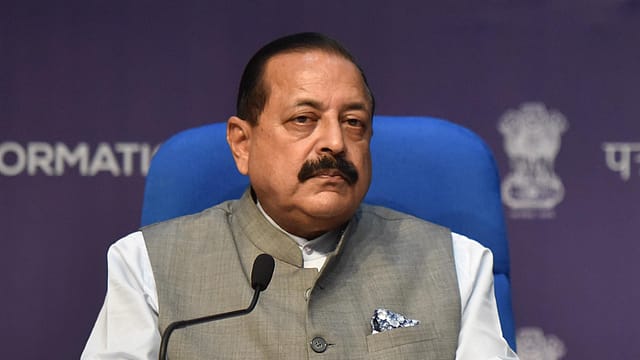
Union minister of state (Independent Charge) for science & technology Jitendra Singh said India is moving at a “very fast pace” in Quantum, AI and future technologies. Singh said India has already achieved 1,000 km secure quantum communication target in just three years.
During inauguration of “Lakshya 2047” Centre for Future Skills, Cadaveric Centre and Advanced Medical Simulation facilities at Parul University, Singh said India is moving at a “very fast pace” in emerging technologies including Quantum, Artificial Intelligence, Semiconductors and Deep-Tech, with the country’s youth set to play the central role in building a Viksit Bharat by 2047.
The minister outlined the government’s broader push to align higher education with emerging technologies such as artificial intelligence, semiconductors, cybersecurity and quantum technologies. “India has already completed 1,000 km of secure quantum communication within just three years, achieving the target in less than half the projected timeline. The eight-year Mission is advancing rapidly through four thematic hubs and collaborations with institutions across the country,” he said.
“India AI Mission launched in 2024 is creating a strong ecosystem around compute infrastructure, datasets, innovation and future skills. India today ranks third globally in the startup ecosystem and has crossed one lakh patents, a majority of them filed by Indian residents. India also ranks among the top nations globally in scientific publications, with Indian research increasingly receiving international citations and recognition,” Singh added.
Singh added that the pace of technological evolution has made continuous skilling and re-skilling essential, especially in areas such as AI, cybersecurity, quantum technologies and semiconductor design.
The minister said the government under Prime Minister Narendra Modi has adopted an integrated and collaborative approach towards innovation, research and skilling, moving beyond traditional silos and encouraging greater participation from academia, startups and the private sector.
On AI, the minister said India is pursuing an approach rooted in inclusion, responsibility and public good. Referring to the Global South AI Summit hosted by India earlier this year and the adoption of the Delhi Declaration on responsible AI, he said technology must serve the most vulnerable and underserved sections of society. “One has to be intelligent enough to use AI,” he remarked, adding that AI guided by ethics and equity can become a powerful force for healthcare, governance and social transformation.