
India office market logs highest-ever Q1 leasing at 21.5 million sq. ft.; GCCs, flex drive demand
ADVERTISEMENT
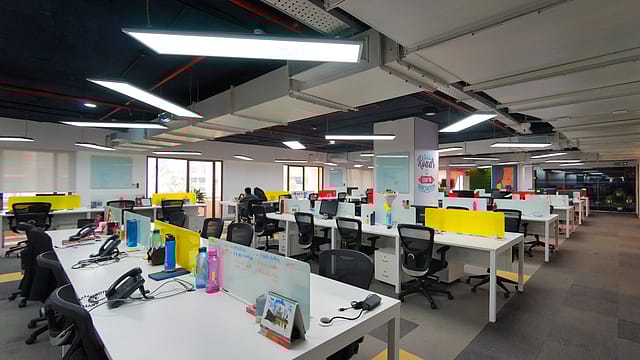
Despite ongoing uncertainties around West Asia crisis and anticipated AI-driven disruption headwinds across sector, India’s office market continued its record-setting momentum in the first quarter of 2026, with gross leasing touching an all-time high of 21.5 million square feet.
This is the strongest performance ever recorded in a January-March period, supported by strong GCC expansion, rising flex adoption, and sustained demand from global and domestic occupiers, JLL India said in a latest report.

As per the report, global capability centres (GCCs) and flex operators emerged as the key demand drivers during the quarter, accounting for 45.5% and 25.9% of total leasing activity, respectively.
“India’s office market has delivered its strongest-ever first quarter with 21.5 million sq. ft. of gross leasing, a 10.2% year-on-year increase that demonstrates remarkable resilience despite global headwinds,” said Rahul Arora, Head - Office Leasing & Retail Services, Senior Managing Director (Karnataka, Kerala), India, JLL.
At a city level, Bengaluru led the charts with a 24.8% share of total leasing volumes, followed by Mumbai (19.5%) and Hyderabad (16.8%). Pune accounted for 14.5% of activity, while Delhi NCR contributed 14.2%, the report noted.
GCCs remained the dominant force across major markets including Bengaluru, Chennai, Hyderabad, and Mumbai. In Bengaluru, GCCs accounted for 70% of quarterly leasing, the highest share in two years, indicating the city’s continued appeal as a hub for global firms setting up strategic operations. Mumbai saw GCCs contribute 46.3% to leasing volumes, while Hyderabad recorded a 42.9% share.
In contrast, flex operators led activity in Pune, where they accounted for 54.8% of leasing, and in Delhi NCR, where they held a 32.9% share.
Arora said that this growth has been driven by a fundamental transformation in how global enterprises leverage India, with GCCs expanding their footprint by 43% YoY to 10 million sq. ft. and now commanding 45.5% of total leasing activity.
“These are not traditional back-office operations, they are strategic innovation hubs focused on AI development, digital engineering, and core product development. Market fundamentals continue to strengthen, with pan-India vacancy dropping to a five-year low of 14.7% and net absorption reaching a record 13.7 million sq. ft. for the quarter,” he added.
He added that with nearly 200 new GCCs set up across India between 2024 and 2025, and current deal pipelines pointing toward the 100 million sq. ft. annual milestone over the next two years, India is transitioning from a cost centre to an innovation epicenter, led by Bengaluru at the forefront of this sustained, multi-year growth trajectory.
The report noted that flex space operators also continued their strong run, leasing 5.56 million sq. ft. across the top seven cities in Q1 2026, exceeding their average quarterly space take-up in the previous year.
Overall, GCCs leased around 9.8 million sq. ft. during the quarter, with global firms accounting for 57% of total leasing activity, broadly in line with last year. On the other hand, domestic demand was largely driven by flex operators, which held a 57.8% share of domestic leasing.
Sectorally, BFSI and IT/ITeS both recorded quarter-on-quarter growth, with BFSI registering its highest-ever quarterly leasing volume, supported by large deals and pre-commitments.
Net absorption for the quarter stood at 13.7 million sq. ft., up 7% YoY, with Bengaluru leading at a 36% share, followed by Hyderabad (22.6%), Mumbai (12%), and Delhi NCR (10.7%). Except for Delhi NCR, all major cities reported improved absorption compared to the year-ago period.
Vacancy levels continued to tighten, falling to a five-year low of 14.7%, down 50 basis points quarter-on-quarter. Core sub-markets across cities reported single-digit vacancies, with Mumbai and Delhi NCR hitting multi-year lows, alongside historically low vacancy levels in Kolkata and a two-year low in Hyderabad, the report highlighted.