
India prepared to deal with situations such as tariff threats: CII president Mukundan
ADVERTISEMENT
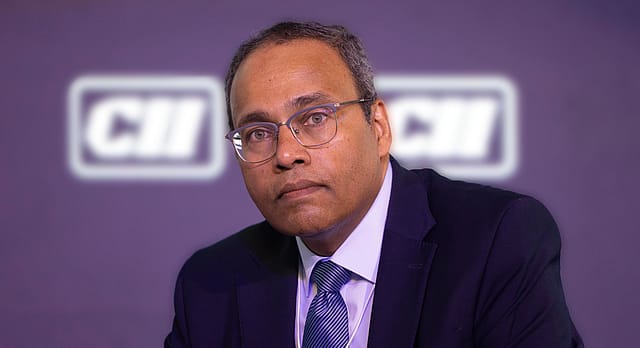
India is prepared to deal with situations like these [100% US tariff threats] but we need to diversify our resources and market access, besides building our resilience internally in a competitive manner, CII president R. Mukundan told Fortune India.
The US House of Representatives has on September 16 passed a legislation which will give US president Trump the power to impose tariffs of up to 100% on countries such as India and others, which buy oil and gas from Russia.
Mukundan said the solution is for a higher engagement and sensitisation of India's issues besides ensuring that there are short term measures to support specific industries. "India needs to find partnerships with like-minded sovereigns" in other areas, whether it be technology solutions and garnering talent," he said.
Mukundan said the focus on infrastructure, logistics (building out highway, ports, airports, railways and electrification) and renewable energy, had all ensured sustained economic growth, now pegged at 7.8% for the June-ended quarter. "We have to ensure that there is multi-modal infrastructure, so that transfer points do not act as friction points," he said.
Mukundan, who is also the MD and CEO of Tata Chemicals, was confident that India could continue to maintain this high pace of growth.
"If the external headwinds are very strong, India would still maintain a 7% GDP growth this fiscal year. But if the economic tailwinds assist, in the form of a fall in global oil prices and inflationary pressures, while ensuring that domestic growth and consumption demand improves, the growth could get to 10%, he said.
He highlighted that private capex has started to play a part in improving growth levels. Data shows that the private share of new project announcements has risen to 71% in the two years to FY26 compared to 49%, prior to the pandemic. The top 10 conglomerates now account for 61% of total listed private capex.
"There is also a geographical capex expansion, which is not limited to just 4-5 states. There is also diversification in the capex growth from core sectors, to include areas such as semiconductors and deep tech," he said.
The gap, however, which needs to be addressed is to provide high-quality jobs where there is a focus on industry-relevant skilling. The government has done the heavy lifting; now reforms need to take root at the state, district and city level. We have to start talking about not just the ease of doing business, but also the cost and speed of doing business," he said.
One of the structural problems which India could face is that while jobs are being created, there are not enough people who could be of the right age to take those jobs. India’s fertility rate has for the first time fallen below the level needed to stop the population from shrinking, data shows, raising concerns about future labour shortages and an ageing society.