
IndiGo has a new CEO. What’s Willie Walsh likely to focus on?
ADVERTISEMENT
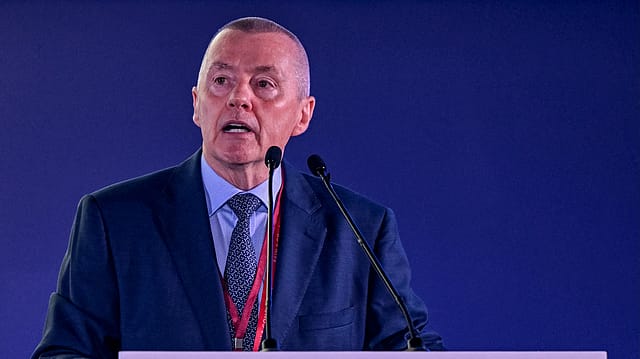
IndiGo, India’s largest airline, has a new CEO.
Four months after Pieter Elbers resigned from his role, rather unceremoniously, Willie Walsh, the former director general of the International Air Transport Association, took charge as the new CEO of the airline that flies 2/3rd of Indians within the country. And the 64-year-old seems rather stoked about the new role.
"With India becoming one of the world's fastest-growing aviation markets, the opportunities ahead for IndiGo are immense,” Walsh said in a statement. “There could not be a more exciting and opportune time for me to join IndiGo than now."
Walsh is the sixth CEO for IndiGo in the past twenty years, and perhaps the most high-profile to join the company. IndiGo’s CEOs over the past two decades have included the likes of Bruce Ashby, Aditya Ghosh, Gregory Taylor, Ronojoy Dutta, and, of course, Pieter Elbers. Elbers had been the chairman of the Netherlands-based KLM before he took charge at IndiGo.
Walsh, until last month, served as the director general of the International Air Travel Association (IATA), a trade body that represents 85 percent of the airlines across the world. That means, in Walsh, IndiGo now has one of the world’s foremost airline executives, with a reputation for being a formidable negotiator, to lead the airline in its third decade of operations. “His extensive global experience in the aviation industry, combined with his operational and strategic expertise, will be instrumental as IndiGo accelerates its international expansion strategy,” Rahul Bhatia, IndiGo’s founder and managing director, said in a statement.
Walsh’s entry comes at a time when IndiGo is busy devising its next phase of growth, which would see more international expansions, especially long-haul flights, and staying out of the ire of the Indian government, after the fiasco last year. The airline had faced the wrath of the Indian government over its cancellation fiasco, with questions also raised about India’s duopolistic skies, and IndiGo’s might within that.
As CEO, Walsh, apart from focusing on the overall management and strategic direction, including accelerating its global growth trajectory and driving operational excellence, is also expected to help reinforce the airline’s leadership position in the domestic market, where Air India, backed by the might of the Tata Group, is taking steps to reclaim lost ground.
Walsh the Slasher
Walsh, a pilot by training, comes with the reputation for being a hard taskmaster.
In the early years, he sat across the negotiating table, fighting for the pilots and earning him a reputation as a formidable negotiator, before shifting to the other side of the table to represent management when he became the CEO of the Irish government-owned Aer Lingus.
As the CEO of Aer Lingus, Walsh slashed costs by 30 percent and cut 2,500 jobs, which earned him the nickname Slasher. Years later, Walsh was key to the formation of the €33.213 billion International Airlines Group, a British Spanish multinational airline holding company that comprises British Airways and Iberia, the flag carriers of the United Kingdom and Spain, respectively, along with Vueling and Aer Lingus.
At British Airways, Walsh also showed his mettle when he ruthlessly pushed through cost cuts, passenger benefits, and weakened the British Airways flight attendants union, albeit at the cost of what some would say is British Airways’ famed service excellence. After 15 years at the helm of British Airways, Walsh retired in 2020, before going on to take on the role of the director general of IATA, a role he held on to until July this year.
Last year, at the 81st AGM of the IATA held in New Delhi, coincidentally hosted by IndiGo, Walsh had spoken about the underlying potential in the Indian skies. “Throughout my career, I have been a keen observer of India’s aviation industry,” Walsh had said then. “The potential that everybody could see for decades is finally being realized. Part of the excitement is due to the remake of India’s airline sector. Air India’s rebirth with new ownership is placing renewed focus on its service with exciting developments in its fleet and product offering. And IndiGo has built up a very impressive footprint across India and regionally. With a world-leading market capitalization, there is enormous confidence in its prospects.”
What IndiGo needs now?
Walsh’s appointment comes at a critical time for the airline, especially as it firms up its global ambitions. IndiGo has been taking on an aggressive international expansion plan over the last five years.
The airline is aiming to grow its international capacity to 40%, with mid- and long-haul operations increasing to 10-15% from about 4% currently. These will be operated by the airline’s Airbus A321 XLR and A350 aircraft. Earlier this year, IndiGo had inducted the first of its 40 A321 XLR aircraft and has an order book of 60 A350-900 aircraft. The Airbus A321 XLR can fly up to 4,700 NM (8,000 miles) with a maximum seating capacity of 244 passengers, helping IndiGo expand its operations from nearby South Asia to longer routes, including the UK and Europe.
From 5 destinations and 12 routes in FY16, the international network has expanded to 44 destinations and over 150 routes in FY26. In all, the Rahul Bhatia-controlled airline plans to operate a fleet of over 550 aircraft, carry 200 million passengers annually, and run roughly 3,000 flights a day by financial year 2030.
“Indian airlines currently account for only 30-45% of international traffic, with Indigo contributing ~20%,” brokerage firm Emkay said in a report. “Moreover, Indian carriers remain concentrated in short-haul international markets served primarily by narrowbody aircraft, highlighting substantial growth potential in long-haul operations.”
IndiGo is also planning to increase the proportion of owned aircraft in its fleet to 30-40% from about 20% currently. As of FY26, 75% of the fleet was under operating lease, 12% under finance lease, 8% owned, and 5% under damp lease arrangements.
“Aviation today faces evolving airspace challenges, supply chain constraints and changing global conditions, and these realities require us to remain agile, disciplined and resilient,” Walsh is reported to have said in his first address to IndiGo’s employees. “Yet they do not change our direction. If anything, they reinforce the qualities that have always defined IndiGo — our unwavering commitment to safety, operational excellence and delivering consistency to our customers.”
The airline is also now planning to offer its Stretch seats to 105 aircraft by FY27-end, up from 53 aircraft at present. That means the airline will quickly ramp up from about 2,700 business-class seats per day to 4,300 by the end of the current fiscal year.
“Stretch has received encouraging customer response and is now available across ~4750 aircraft. Deployment is expected to expand to ~65 aircraft compared with the earlier target of >40 aircraft,” brokerage firm Emkay said in a report. “Indigo has also mutated meal boxes for its Stretch service, transitioning from meal boxes to lower-cost tray-based meal service. The Stretch NPS has increased to 75 compared with the earlier target range of 40-45. Utilization remains particularly strong during the mornings and evenings, and the product continues to generate profitable operations.”
The hybrid offerings also put it in direct competition with Air India in India’s duopolistic airline market. Air India itself has been in the midst of a $75 billion makeover, with changes including revamped cabins and the in-flight experience, as well as new aircraft and crew. Together, Air India and IndiGo have as many as 1,000 aircraft on order to cater to the growing demand in the world’s third-largest aviation market. By 2040, India’s passenger traffic is expected to grow sixfold to around 1.1 billion, with India’s commercial airline fleet predicted to grow from 400 in 2014 to around 2,359 in March 2040. The number of airports is also expected to grow to 400 by 2047.
But perhaps the biggest challenge for Walsh could come in the domestic market, where rumors are rife that the country’s largest airport operator, Adani, is firming up plans for a foray into the aviation space. The company had reportedly approached the government, seeking a dilution in policy that restricts airport operators from holding stakes in scheduled airlines.
“There could be issues such as the conflict of interest, where the airport operator controls all key resources like slots, stands, maintenance areas, allocation, and commercial facilities,” Alok Anand, the chairman of Acumen Aviation, an aircraft asset management and leasing company, had told Fortune India. “There could be discrimination against other airlines, which is difficult to prove but commercially significant. Even Dubai, which has government-owned airlines, is not spared from such allegations.”
Perhaps that might be the biggest fight awaiting Walsh.