
Industry, govt need to think beyond protectionism, build strategic positioning for India: Uday Kotak
ADVERTISEMENT
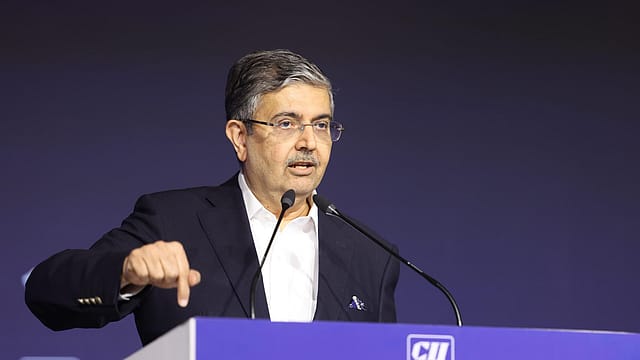
Kotak Mahindra bank founder and director Uday Kotak today said the Indian government and the businesses need to build strategic positioning for the country amid a global order that is increasingly getting “tribal” in its approach. Drawing from mythology, Kotak said the mindset of protectionism needs to change amid the changing world order, with “raw power” and “control over assets” at its core.
“The biggest danger in our country is that we have too much (Lord) Vishnu in total. What we need is the creator and the destroyer much more in the mix. And that is what will create the true powerful strategic positioning for our country. We, in India, need to significantly increase our Brahma quotient and the Mahesh quotient,” Kotak said at the CII Annual Business Summit in New Delhi.
“Businesses in India and the people and consumers in India had a great comforting Vishnu the preserver. Let us change that mindset. We need (Lord) Maheshwar and we need (Lord) Brahma,” Kotak said.
“We need to be real, strategic and smart. In a tribal world, what matters is control over assets, a strong balance sheet, supported by a P&L. The balance sheet and the P&L of the country needs to get much stronger. And the ability to generate resources by a country through its resources or its companies will determine the destiny of each country,” he said.
“Who would have thought that the control of a Strait in the Middle East will make the east of the Middle East so vulnerable? A little strait in the Middle East! And now the people are figuring out who next is going to control the Strait of Malacca? How power in the future is going to determine our destiny”
“In many cases, we are seeing raw power becoming the rule of life. That’s back to tribalism and a world that none of us have seen in the last 80 years,” he said.
He said the global world order is increasingly drifting towards the “tribalism” witnessed before 1945. “There are two scenarios in the world today. One is the recent history of the world from 1945 to 2026 in which the world has gone through crisis and reversed to the mean and normalised. Most of the time, there has been no structural change in the world order in the last eighty years. Prior to 1945, every time there was a crisis, there was a structural change. Maps changed, world order in countries changed, geographies changed,” Kotak said.
Kotak said even now most of the people believe that the world will go back to normalcy, but some parts of the world will structurally change and urged the industry to take into consideration the emerging scenario and factor in upcoming structural changes.
“The tribal mindset of the pre-1945 era is coming back in our lives. We are talking about territory, ownership, seeking rents and the AI revolution, which is changing the non-tangible side. We are living in a world in which the tangible and intangible assets are getting concentrated in few hands,” Kotak added.
“We need to ask ourselves the question that even if the probability of structural change is 5-15%, what and how are we going to see that structural change. This time it is different and we are spending little time on it,” he said.
Stressing his point he said the US is powerful not just because of its reserve currency but because it has extremely powerful companies. “We cannot live our lives without Microsoft, or Whatsapp. It was the same US which was horridly dependent on energy from the Middle East. The US fixed it in 50 years,” he said.