
JioStar bets on AI, commerce and fandom to turn live sports into India’s next digital growth engine
ADVERTISEMENT
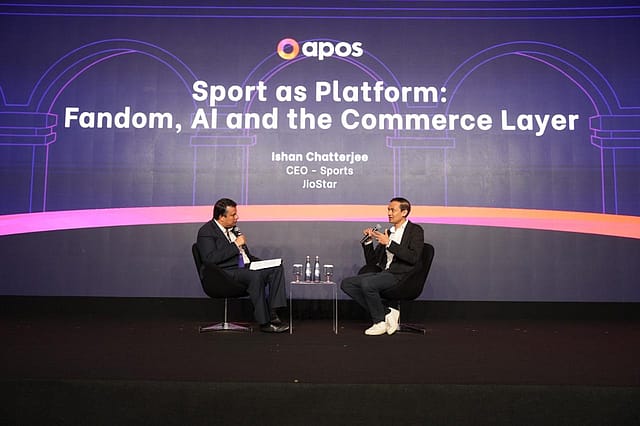
Live sports is no longer just a content category for broadcasters—it is becoming a platform for commerce, data and deeper consumer engagement. That shift was central to JioStar’s strategy articulation at APOS 2026, where Ishan Chatterjee, CEO – Sports, laid out how the company plans to convert scale into monetisation and long-term consumer relationships.
India’s sports streaming market has entered a new phase where the race is no longer only about acquiring rights but building experiences around fandom.
The scale numbers are already substantial. IPL 2026 crossed 1.2 billion viewers, while JioHotstar recorded a global digital concurrency peak of 72.5 million during the ICC Men’s T20 World Cup 2026 final. But Chatterjee argued that these milestones point to something larger: live sports remains one of the few formats capable of aggregating mass audiences at a time when consumer attention is increasingly fragmented.
For JioStar, that concentration of attention is becoming a strategic asset.
Unlike entertainment content, where supply continues to explode across platforms, marquee sports properties continue to command appointment viewing. Whether it is an IPL final or a high-stakes international cricket match, audiences continue to show up at scale—creating monetisation opportunities across advertising, subscriptions and now commerce.
But scale alone is not enough.
Chatterjee highlighted that serving over a billion viewers requires moving beyond a one-size-fits-all model. A connected-TV viewer in an urban market behaves differently from a mobile-first consumer in smaller towns, making personalisation increasingly important.
Language has emerged as a major differentiator.
JioStar streamed IPL in over 12 languages this season and revealed that English now contributes less than 10% of total IPL watch time. Regional language consumption—particularly outside Hindi—has become a key growth driver, reinforcing the idea that localisation, rather than uniform distribution, will define digital scale in India.
Can sports platforms unlock the next phase of digital monetisation?
The company is also attempting to broaden India’s sports consumption beyond cricket.
While IPL remains the biggest acquisition engine, JioStar now offers more than 350 days of live sports annually. International properties are gaining traction: the Premier League crossed 100 million viewers in India last season, while Wimbledon and the US Open reported strong growth in digital reach.
The broader ambition, however, extends beyond viewership.
JioStar’s integration with Swiggy reflects a push towards contextual commerce, allowing users to transact within the viewing experience instead of exiting the platform. The company sees such integrations as a way to unlock additional revenue streams while improving engagement.
Artificial intelligence is expected to deepen that shift further.
Through product integrations with OpenAI technologies, JioStar is enabling voice-led discovery and contextual fan engagement, allowing users to retrieve live statistics and interact with content in real time.
As competition intensifies across streaming, JioStar’s bet is that the next wave of growth will not come from content alone—but from turning sports into a full-stack consumer platform.