
PM Modi puts PLI gains, policy stability at centre of India growth pitch
ADVERTISEMENT
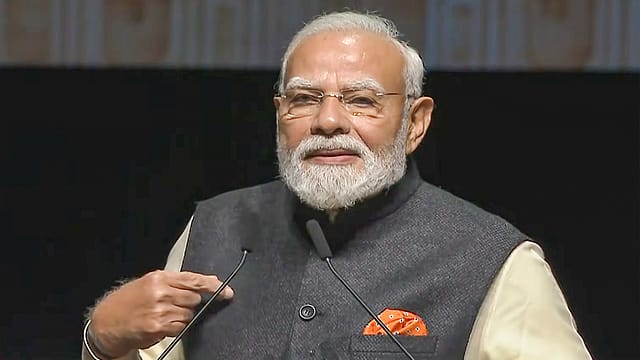
Prime Minister Narendra Modi on Friday said India’s push for next generation reforms, backed by policy stability and incentives for manufacturing, had made the country a global “bright spot for growth and hope”, as he also highlighted ₹22 lakh crore in production and sales under the production linked incentive scheme.
Addressing a business forum last evening, Modi said India was viewed internationally as “a bright spot for growth and hope” at a time of concerns over slowing growth, supply disruptions and distrust among nations.
He said the government’s focus was on “Saptadhara”, or seven priority sectors including manufacturing, technology and the green economy, alongside a new round of policy and governance reforms.
“Reforms are not a compulsion for us; this is our ultimate commitment and our absolute conviction,” Modi said.
The Prime Minister also pointed to the government’s claim of having lifted 25 crore people out of poverty, while describing India as the world’s fastest growing major economy. He said political stability and policy continuity had enabled the government to pursue reforms with a longer time horizon.
From production limits to incentives
Modi contrasted the present production linked incentive, or PLI, scheme with what he described as a “Production Linked Punishment” approach during the Licence Raj, when companies could face restrictions or penalties for producing beyond prescribed limits.
The PLI scheme, he said, has so far attracted ₹2.5 lakh crore in actual investments, generated ₹22 lakh crore in production and sales, contributed ₹15 lakh crore in exports and created more than 14 lakh jobs.
“Where the punishment model of the previous Licence Raj increased unemployment, today our incentive model is actively creating lakhs of new jobs,” he said.
Modi said the government was replacing an older system in which economic activity was “prohibited unless permitted” with one that is “permitted unless prohibited”. The principle, he said, was that the relationship between citizens and the government should rest on “deep trust, not suspicion”.
He cited the removal of more than 40,000 compliance requirements and the repeal of over 1,500 obsolete laws. The Jan Vishwas legislation, he said, had decriminalised several minor procedural violations by replacing jail provisions with monetary penalties.
The recent Bankers’ Books Evidence Bill, passed during the Monsoon session, would modernise a colonial era law and give greater legal recognition to digital banking records, he said. That change would reduce legal complications and improve transparency in the financial system.
What do reforms mean to daily life?
Modi sought to connect the government’s reform agenda to public services, citing railway safety measures, digital payments and renewable energy schemes.
He said electronic interlocking had been installed at more than 6,500 railway stations and 10,000 level crossings, while around 9,000 unmanned crossings had been eliminated. Train accidents had fallen by up to 90 per cent compared with the period before 2014, he said.
More than 3.6 lakh bio toilets had been fitted in trains since 2014, while the Delhi Meerut Namo Bharat service and the Delhi Metro were operating with 99.9 per cent punctuality, Modi said.
The Prime Minister cited nearly 50 crore tele consultations through the e-Sanjeevani platform and said Aadhaar linked digital services had made tasks such as opening bank accounts, completing e KYC and filing tax returns easier.
On clean energy, Modi said the PM Surya Ghar scheme had supported rooftop solar installations for more than 50 lakh families. The scheme, he said, was designed not only to reduce electricity bills but also to let households earn by selling surplus power to the grid.
“The more stable India is and the more secure its future, the more the power to give the world a sense of security will be generated from right here,” Modi said.