
Saatvik Green Energy plans ₹7,000-crore capex to expand solar cells, battery storage: CEO Prashant Mathur
ADVERTISEMENT
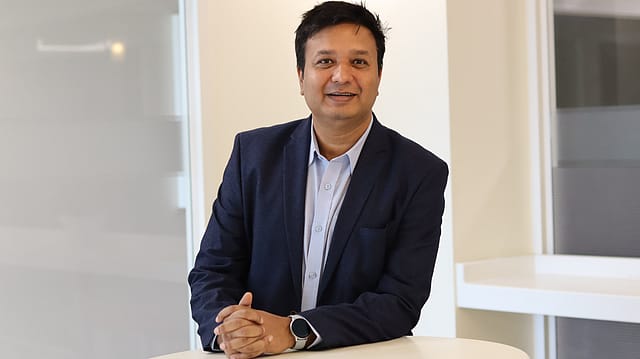
Solar module manufacturer Saatvik Green Energy aims to invest nearly ₹7,000 crore by 2028 as part of an ambitious expansion strategy to become a fully integrated clean energy company.
In an exclusive interview with Fortune India, Prashant Mathur, CEO of Saatvik Green Energy, said the company will prioritise backward integration into solar cells, ingots and wafers before entering the battery energy storage segment, which is expected to begin around 2027.
"This transaction is about building a fully integrated energy company. We are moving forward, backward and sideways in the renewable energy value chain while also entering the B2C segment," Mathur said.
₹7,000-crore investment roadmap
The first phase of the expansion involves setting up a fully integrated manufacturing complex in Odisha comprising a 6 GW ingot, wafer and solar cell facility, along with a 4 GW module manufacturing plant. Saatvik is also expanding its module manufacturing capacity at its Ambala facility to 4.8 GW.
Mathur said the first phase alone will require around ₹3,500 crore, while another ₹3,000-3,500 crore will be invested in ingot and wafer manufacturing, taking the company's total planned investment to nearly ₹7,000 crore. The entire capital expenditure is expected to be deployed by 2028.
"The first ₹1,700 crore is already being deployed through IPO proceeds. The second phase will be funded through internal accruals and debt, while the third phase will be financed through debt, internal accruals or, if required, another round of market fundraising," he explained.
Battery storage to be the next growth engine
While Saatvik has announced plans to build a 20 GW battery energy storage business, Mathur said the segment will form part of the company's second phase of expansion.
"Battery storage is currently under development, and market dynamics have changed over the last six months because of commodity price movements. We are targeting commercial operations in battery storage around 2027," he said.
He believes battery storage will emerge as a key growth driver as renewable energy projects increasingly combine solar generation with storage solutions.
"Solar generates electricity during the day, while batteries store that energy for use during non-solar hours. More projects are now moving towards integrated storage solutions," he said.
Building an integrated renewable energy ecosystem
Apart from solar modules and battery storage, Saatvik is expanding into transformers, inverters, solar kits, solar pumps and several ancillary businesses.
The company recently acquired transformer manufacturer Melcon and is scaling up its encapsulant manufacturing capacity from 2 GW to as much as 5 GW. It also plans to manufacture aluminium frames, ribbons and other components used in solar module production.
According to Mathur, the strategy is to capture a much larger share of the renewable energy value chain rather than diversify into unrelated businesses.
"A solar project costs around ₹3.5 crore per MW. Today, modules account for roughly half that value, but our value addition is only about 25% of the module cost. Our objective is to increase our participation from roughly one-fourth of that value to nearly three-fourths of the overall project value by manufacturing cells, ingots, wafers, transformers, batteries and inverters," he explained.
Saatvik expects backward integration to significantly reduce its reliance on imported components. Mathur said imported content in TOPCon modules has already fallen to just over 50%, compared with significantly higher dependence earlier.
Once solar cell manufacturing begins, imported content is expected to decline to around 20-25%, while manufacturing ingots and wafers could further reduce import dependence to 10-15%.
"The underlying theme is Atmanirbhar Bharat. We want to build the entire renewable energy ecosystem and value chain in India," he said.
Green hydrogen on the radar
Beyond batteries, Saatvik is also evaluating opportunities in green hydrogen and green ammonia, although Mathur said their commercial viability is still evolving.
"Green hydrogen is currently more of a future opportunity because the economics are still evolving. But just as solar and batteries scaled up rapidly, we believe green hydrogen will become a major opportunity over the next two to three years," he said.
With India's renewable energy transition gathering pace, Mathur remains optimistic about the sector's long-term growth prospects.
"India's energy transition has only just begun. Electric vehicles, data centres, AI, rising household consumption and the country's development ambitions will drive enormous energy demand over the next two decades. We see ourselves as one of the companies that will help bridge that demand gap," he said.
Saatvik reported strong growth in FY26, driven by higher utility-scale sales, retail expansion and increased adoption of advanced module technologies such as TOPCon. Revenue more than doubled to ₹4,548.4 crore from ₹2,158.4 crore in FY25, while profit after tax (PAT) rose nearly 30% to ₹357.1 crore from ₹275.1 crore a year earlier. The company currently has an order book of 5.89 GW.