
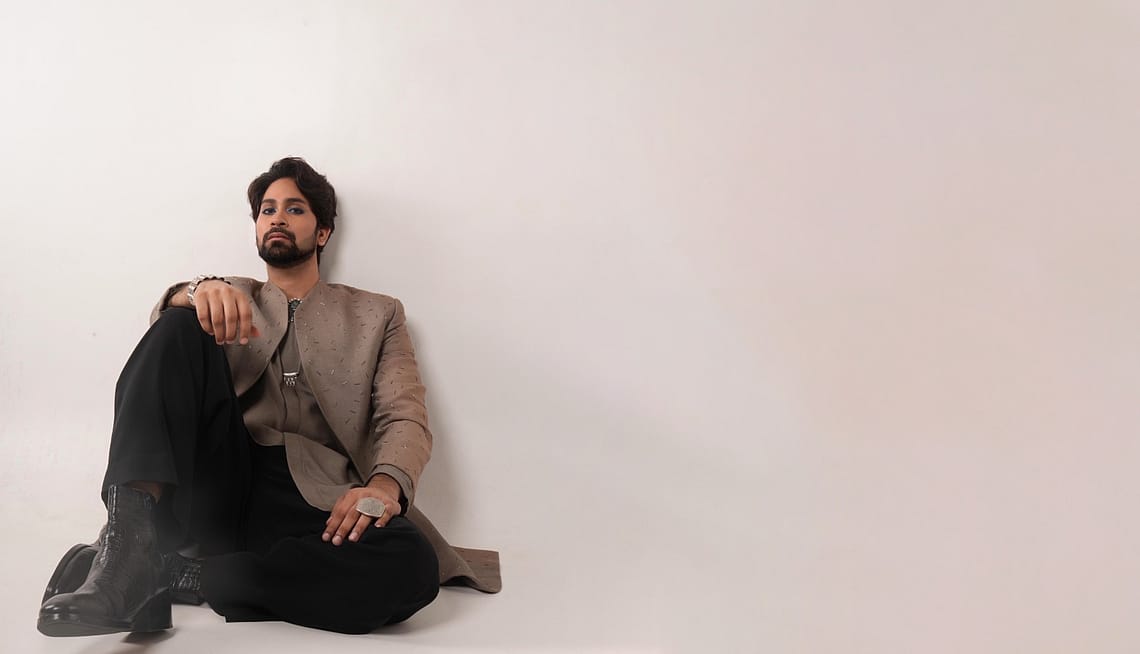
The unlikely beauty disruptor: Ankush Bahuguna’s rise
On most days, Ankush Bahuguna’s content looks deceptively simple: make-up tutorials, skincare routines, the occasional self-aware joke. But behind that ease lies a career built not on virality, but on slow, deliberate reinvention. In an ecosystem obsessed with overnight success, Bahuguna’s journey stands out precisely because it didn’t arrive overnight.
“I’ve been at it for nine years,” he says.
That timeline matters.
Because long before he became one of India’s most recognisable male beauty creators, Bahuguna was a quiet, underconfident child growing up in East Delhi’s Mayur Vihar—“an invisible kid,” as he puts it, shaped by bullying and self-doubt. Childhood, for him, is less a series of memories and more “a blur”, punctuated by a desire to perform that he never quite had the confidence to act on. Bahuguna often reflects on that phase as the starting point of his long journey towards self-acceptance.
It wasn’t until college that things began to shift.
Finding his voice beyond architecture
Bahuguna trained as an architect, completing a five-year degree at Sushant School of Art and Architecture. But the discipline never felt like home. “I knew I did not want to be an architect,” he says plainly.
Writing became his escape. What began as Facebook notes—funny, observational snippets about everyday life—quickly drew attention for their comic timing. Encouraged by friends who recognised his instinct for storytelling, Bahuguna leaned into content before “content creation” was even a defined career path.
He began experimenting with comedy content on Instagram around 2017, before steadily building a voice and audience through 2018.
A stint at a men’s lifestyle publication followed, where he wrote listicles, interviewed Bollywood actors, and eventually found himself in front of the camera. The transition—from writer to performer—was less strategic than organic. “I never planned it,” he says. “I just let go.”
That instinct—to follow curiosity rather than convention—would define his next pivot.
Lockdown to liftoff: The beauty pivot
If there is a discernible inflection point in Bahuguna’s career, it is the pandemic. Not because it transformed him overnight, but because it gave him the space to experiment.
Around 2020, he began exploring beauty content more seriously. While much of the internet was busy with sourdough and Dalgona coffee, Bahuguna picked up make-up. Initially, it was functional—learning how to look camera-ready for videos shot at home. But it quickly evolved into something more layered.
“Make-up is an art form,” he says, describing it as a play of light, shadow, and structure—an extension, perhaps, of his architectural training.
One video—where he spoke casually about men wearing make-up—struck a chord. It wasn’t positioned as activism. It wasn’t framed as disruption. It was simply presented as normal.
That, paradoxically, made it powerful.
Quietly redefining masculinity
Bahuguna resists the idea that he set out to challenge gender norms. “I’m just doing what I enjoy,” he says.
But intent and impact are rarely the same.
In a market where beauty has historically been coded as feminine, Bahuguna’s presence has helped broaden the category—not through confrontation, but through familiarity. His content doesn’t argue for inclusion; it assumes it.
At the heart of his philosophy is a simple idea: men should be allowed to exist beyond the rigid definitions of masculinity. “No two men are alike,” he says. “There are many ways of being a man.”
In that framing, skincare and make-up are not statements—they are choices.
From content to global beauty capital
As his audience grew, so did brand interest. Today, Bahuguna works across a spectrum of global and domestic beauty players, including Estée Lauder, Clinique, Dr. Jart+, The Ordinary, and d'Alba, alongside ongoing partnerships with Sephora and Rare Beauty.
His association with K-beauty, in particular, reflects a broader shift. “I’ve unlocked a market in Korean skincare,” he says, noting the growing audience for that segment in India.
That association has been both organic and strategic. Having experimented with Korean skincare early on, Bahuguna began reviewing products on his platform—eventually attracting attention from brands in South Korea. This led to collaborations with leading names such as Medicube, Beauty of Joseon, TIRTIR, Biodance, Celimax, and SKIN1004, alongside receiving PR packages from both K-beauty and global luxury labels like Chanel Beauty and Givenchy.
K-beauty itself has seen a sharp rise globally and in India, driven by its emphasis on gentle formulations, layered skincare routines, and ingredient-led innovation—think Centella asiatica, snail mucin, and fermented extracts. For Indian consumers, especially the Gen Z, it represents both efficacy and aspiration. Creators like Bahuguna have played a key role in translating that ecosystem for local audiences—demystifying routines while building trust.
His engagement with the category has extended beyond content. He has travelled to South Korea with a brand and also attended a brand trip to Japan with a Korean beauty label—experiences that have deepened both his credibility and global exposure.
Global recognition has followed. A defining moment came in 2025, when he attended a Rare Beauty launch and met Selena Gomez—an experience he describes as surreal, not just for the celebrity interaction, but for what it represented.
He was invited as a beauty creator, part of a curated group of about 30 from across the world, spanning beauty and fragrance. Notably, he was the only Indian attendee and the only male creator in the room—a detail that underscores both his uniqueness and the industry’s slow diversification.
Such global brand launches typically bring together top-tier beauty influencers, industry insiders, and select media voices—making them as much about community-building as product marketing. While he recalls several well-known creators being present, it is the larger symbolism of that moment that stayed with him.
“I was the only Indian and the only guy,” he reiterates.
But the real validation, he insists, came later—when his audience celebrated the moment as if it were their own.
Negotiating power in the creator economy
For all its perceived glamour, Bahuguna is candid about the structural challenges of the creator economy.
The biggest friction point lies in brand collaborations. Too often, he says, brands approach creators as distribution channels rather than creative partners—insisting on rigid briefs that ignore the nuances of audience engagement.
“Writing the script is my job,” he says. “You’re not just paying me to upload content.”
It’s a stance that has led him to turn down campaigns that feel misaligned or inauthentic—even when he likes the product. In an industry driven by monetisation, that kind of selectivity is both rare and strategic.
Because in the long run, credibility compounds.
Content creation is also his full-time profession. While brand partnerships and advertising form a significant part of his income, he has also explored acting projects and continues to look for opportunities in that space—expanding his creative portfolio beyond digital platforms.
The relentless pressure to stay relevant
If there is one constant in Bahuguna’s journey, it is uncertainty.
“The fear never goes away,” he admits.
The algorithm is fickle. Audience attention is fleeting. Relevance is temporary. Even after nearly a decade in the industry, the question persists: what if the content stops working?
It is this awareness that drives his approach to evolution. Repetition, he believes, is the fastest way to irrelevance. “If you keep doing the same thing, people get bored,” he says.
The challenge, then, is not just to create—but to keep creating, differently.
Part of that evolution has also meant structuring his digital identity more deliberately. He runs two Instagram handles—one focussed on comedy, and the other on beauty and fashion. The split was intentional. When he began, his primary audience followed him for humour. As beauty content grew, he recognised that not all viewers would overlap.
The second handle allowed him to build a more targeted community, while preserving the original voice of his comedy content. Over time, the beauty-focussed account grew steadily, effectively bifurcating his audience: those who come for humour, and those who stay for make-up, skincare, and style.
The next chapter: Beyond content
For Bahuguna, the future is less about scale and more about purpose.
“I want to make people feel beautiful,” he says—a goal that is deliberately open-ended. Whether that translates into a brand, a platform, or something entirely new remains undecided. Living independently in Mumbai while his parents remain in Delhi, and with an elder sister outside the creator ecosystem, Bahuguna continues to anchor himself in a close-knit family dynamic even as his professional world expands.
But the intent is clear: to build spaces—digital or physical—where people can find the confidence he once lacked.
Because, in many ways, his journey has come full circle.
From a child who felt invisible to a creator associated with beauty and self-expression, Bahuguna’s story is not just about success in the creator economy. It is about reclaiming identity—and, in the process, expanding what beauty itself can mean.
And in an industry that thrives on transformation, that may be the most powerful narrative of all.