
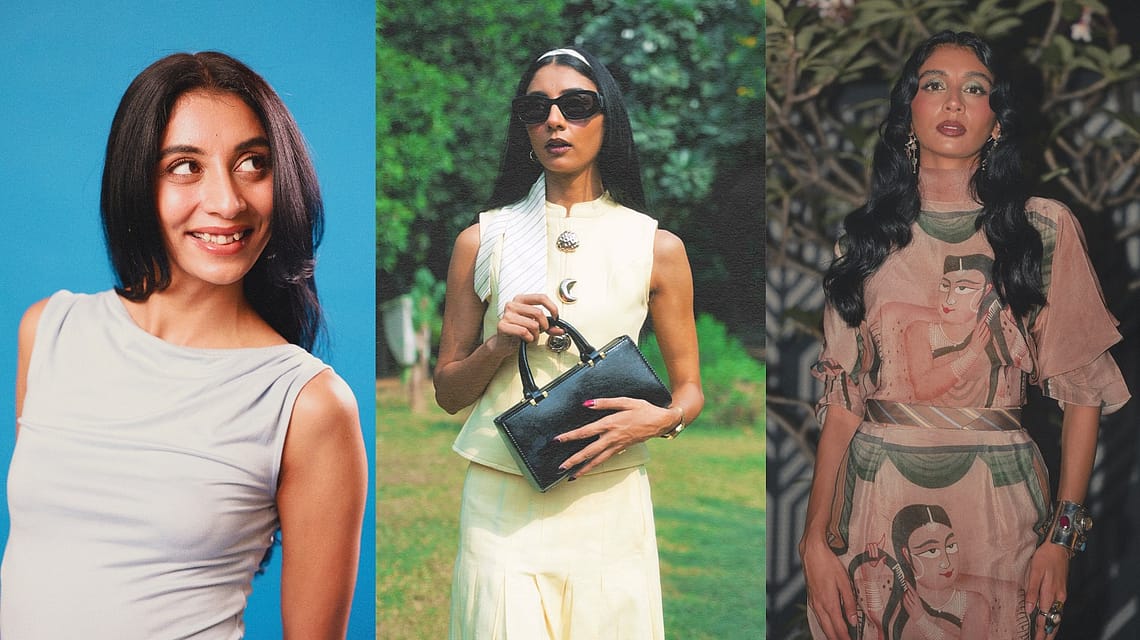
Dolly Singh: From Nainital’s quiet hills to a global creator stage
There was a time when the internet knew her simply as ‘Raju Ki Mummy’. Before that, she was the ‘South Delhi Girl’. Today, she is something far more layered: actor, filmmaker, producer, storyteller and one of only 25 global winners of Instagram’s inaugural Rings Award. But long before the spotlight, before the millions of views and film premieres, Dolly Singh was a self-conscious teenager growing up in Nainital, wondering if the world beyond the hills was where her real life would begin. As it turns out, it did. Just not in the way that she had imagined.
Now 33, Singh looks back at that uncertainty with clarity rather than doubt.
"I always knew I loved performing," Singh says. "I didn’t know what form it would take. I just knew I couldn’t imagine a life where I wasn’t creating something."
A hill town, a hungry mind
Singh’s childhood in Nainital was steeped in nature—lakes, forests, flowers, monkeys, and long afternoons of invented games with her younger brother. It was a deeply rooted upbringing, one she holds close now.
At the time, however, she felt restless. Small-town life came with a sense of limitation. There were fewer opportunities, fewer examples to follow. She compared, questioned and quietly built an ambition that had no clear roadmap.
"At 15, I thought I had to leave to become someone,” she recalls. "Now I realise Nainital made me who I am."
At home, she was shy. Outside, she performed. Teachers complained that she spoke too much in class; relatives saw a different, quieter version. She was observing everything—especially people. Their tones, their quirks, their hypocrisies. Without knowing it, she was collecting material.
"I was always watching people,” she says. “How they spoke, how they reacted, how they changed depending on who was in the room."
That instinct—to watch closely and recreate honestly—would later become her signature.
Delhi and the art of the detour
When Singh moved to Delhi to study Political Science at Delhi University's Kirori Mal College, she was searching for direction as much as a degree. A master’s at the National Institute of Fashion Technology followed. Fashion, styling, aesthetics—they drew her in. Structure and corporate pathways did not.
"I kept thinking there has to be something more creative for me," she says. "I just didn’t know what it was yet."
During this time, she started a fashion blog inspired by global bloggers such as Man Repeller. Living on a tight budget, she styled Sarojini Nagar finds and challenged Delhi’s culture of outfit repetition. Her brother shot her photos. She posted twice a week. No income, no strategy—just instinct.
"I didn’t have a plan,” she admits. "I just had the urge to put myself out there."
But blogging was only the beginning.
The accidental breakthrough
Singh’s entry into video content was less master plan, more circumstance. At her first media job, there were no actors on the team. If a script needed performing, someone had to step up. She did.
"I remember thinking, okay, I’ll just do this one video,” she reveals. “I had no idea it would change my life."
The result? Characters that became cultural touchstones.
'Raju Ki Mummy' was inspired by the universal Indian mother—the tonal shift when guests arrive, the silent glare that can end a sentence. ‘South Delhi Girl’ was satire sharpened by lived experience. These weren’t caricatures; they were recognisable truths.
"I wasn’t mocking anyone," she says. "I was holding up a mirror."
Videos uploaded at 1 AM would wake up to millions of views. Facebook shares exploded. Brands began calling.
Over the years, those brand partnerships have grown alongside her career. In 2025–26 alone, Singh has collaborated with a wide spectrum of companies including Crompton, Venus, Dove, Airtel and Uniqlo, alongside digital and beauty ecosystem partnerships with Meta and Tira—reflecting how creators today sit at the intersection of entertainment, culture and marketing.
Still, walking away from a stable job wasn’t simple. Coming from a middle-class family with responsibilities and loans, she hesitated.
"I was terrified," she admits. "Stability means a lot when you don’t come from money."
But eventually, she chose uncertainty over comfort.
It was the first of many reinventions.
From digital frames to film sets
The jump from a tripod in her room to a full-scale film set was jarring.
Suddenly there were 300 crew members. Lighting grids. Vanity vans. Long waiting hours for a single line. Singh appeared in films like Double XL (2022) and Thank You for Coming (2023), stepping into Bollywood with the curiosity of someone who had built her own stage from scratch.
"It’s a completely different ball game," she says of the transition.
The biggest adjustment? Letting go.
Online, she controlled everything—script, shoot, edit, tone. On a film set, she was part of a larger machinery. The learning curve was steep, but it expanded her creative appetite.
"I had to learn to trust other people's visions," she says. "That was new for me."
Acting, she realised, was only one piece of what she wanted.
Global recognition, new expectations
When Instagram named Singh among the 25 winners of its inaugural Rings Award—alongside creators such as Golloria, Zarna Garg and Tyshawn Jones—it felt like validation on a global scale.
The Instagram Rings Award is the platform’s first global honour for content creators. Instead of follower counts or viral trends, it recognises creators who shape culture through storytelling, innovation, and authenticity. Winners are selected by an international jury of global icons and receive a golden ring badge on their Instagram profiles, along with a custom feed colour theme and an upcoming personalised heart icon.
"I felt seen beyond just my own bubble," she says.
But recognition brought responsibility.
The stakes were different now. More eyeballs. More scrutiny. More expectations. Instead of retreating to safe, proven formats, Singh chose to experiment further.
"With every milestone, the fear also grows," she admits. "You wonder, what next?"
If anything, the award sharpened her commitment to evolving.
Dollywood Filums: Building her own universe
Out of that evolution came Dollywood Filums—her production house and creative playground.
"I didn’t want to wait for permission anymore," she says.
What began with Covid Love Story, a lockdown micro-drama, has grown into projects like Best Worst Date, now in its third season. Here, Singh doesn’t just act. She writes. Produces. Directs. Casts.
"I love building characters from scratch,” she says. “Even the smallest role deserves a full backstory."
She creates full backstories for characters audiences might see only briefly. She experiments with micro-dramas designed not to feed doomscrolling, but interrupt it.
"I want people to pause," she explains. "Not just scroll past."
Her aim is clear: make content that makes people pause. Instead of waiting for the "right" roles from the industry, she began building them herself.
Redefining success
Early in her career, success looked like numbers—views, followers, brand deals, premieres. Today, it looks different.
It looks like buying a home for her parents. Like returning to Nainital and feeling gratitude instead of restlessness.
Like choosing projects that excite her, even if they don’t break algorithms.
"For a long time, my mood depended on how a video performed," she says. "Now I try not to let numbers decide my worth.”
She still cares about engagement—content creation is a business—but it no longer defines her emotional weather.
She speaks openly about how the digital race can consume creators. There was a time when a poorly performing video could derail her entire day. Now, she treats it as data, not destiny.
"I’m still ambitious," she says. “But I’m trying to be kinder to myself in the process."
The shift is subtle but powerful.
The road ahead
Singh continues to audition. Acting remains a deep pull. But increasingly, her ambition leans towards filmmaking—longer formats, festival circuits, fully realised cinematic worlds.
"I want to direct a full-length film someday," she says. “That’s the dream."
She imagines Dollywood evolving into a distinct storytelling space—nostalgic, feminist, emotionally textured.
Her journey has never followed a straight line. It has curved, pivoted, and detoured. From political science to fashion management, from blogger to comedian, from influencer to actor, from performer to director.
"I’ve stopped trying to make my path look linear," she says. “It never was."
And perhaps that is the most defining trait of Dolly Singh: she refuses to stay still.
The girl who never stopped performing
Strip away the awards and the premieres, and you find the same child from Nainital—observing, inventing, performing.
Only now, the stage is bigger. The stakes are higher. The vision is clearer.
Dolly Singh is no longer just the woman behind viral characters. She is building worlds—one script, one set, one reinvention at a time.