
Adani Ports targets Europe’s deepwater offshore market with oceaneering pact, eyes ₹6,000 crore marine revenue by FY31
ADVERTISEMENT
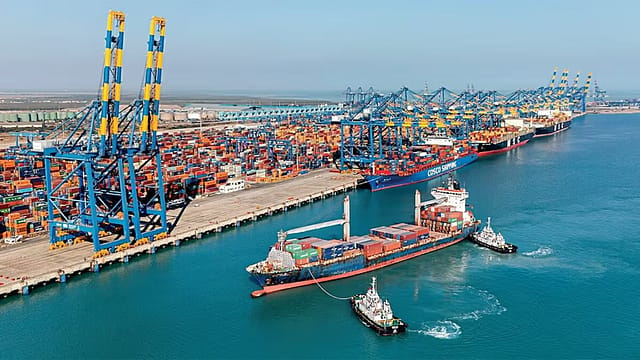
Adani Ports and Special Economic Zone Ltd. (APSEZ) has accelerated its push into the global offshore and subsea engineering market through a new partnership between its marine arm Astro Offshore and US-based Oceaneering International Inc., marking the company’s formal entry into specialised deepwater operations in Europe.
The agreement comes as APSEZ sharpens its focus on building a globally diversified marine business beyond traditional port operations, with plans to scale its fleet to 200 vessels and generate marine revenues of ₹6,000 crore by FY31. The company has earmarked ₹13,000 crore in capital expenditure for the segment over the next five years.
APSEZ expands beyond ports into specialised offshore engineering
As part of the expansion, Astro Offshore has added a 2021-built DP2 multipurpose support vessel, Energy Savanah — to be renamed Astro Atlas — to strengthen its deepwater execution capabilities. The 97-metre vessel is equipped with subsea construction systems, including a 150-tonne active heave compensated crane, moonpool facilities and accommodation for up to 100 personnel.
With the ability to operate in water depths exceeding 3,000 metres, the vessel will enable Astro Offshore to bid for complex offshore assignments such as subsea construction, pipeline installation and cable laying projects in international markets, particularly Europe.
“This development supports APSEZ’s ambition to build a globally diversified marine platform. By combining Astro Offshore’s expanding high-specification fleet with Oceaneering’s deepwater engineering and ROV expertise, we are enhancing our capabilities in complex offshore operations while expanding into Europe,” said Ashwani Gupta, Whole-time Director and Chief Executive Officer, APSEZ.
Mark Humphreys, CEO of Astro Offshore, said the addition of Astro Atlas significantly boosts the company’s offshore execution capabilities in ultra-deepwater environments.
“The introduction of Astro Atlas significantly enhances our operational capability and underscores our continued investment in a modern, high-spec fleet, particularly in ultra-deepwater environments,” Humphreys said.
“As our largest and most capable vessel to date, she enables us to support a broader range of complex offshore operations and respond more effectively to evolving client requirements.”
Adani Ports targets 200-vessel fleet, ₹6,000 crore marine revenue by FY31
The latest move underlines APSEZ’s strategy to diversify into offshore logistics, underwater engineering and marine infrastructure services amid rising global investments in offshore energy and subsea infrastructure. The company currently operates a marine fleet of 136 vessels and is targeting one billion tonnes of cargo throughput by 2030 as it strengthens its integrated transport and logistics ecosystem.