
BRICS’ dollar challenge: Why a common currency is still a distant dream
ADVERTISEMENT
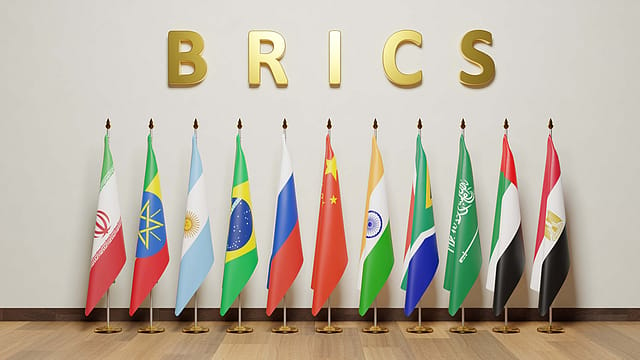
India is set to host the 18th BRICS Summit this week, bringing renewed attention to the grouping’s efforts to reshape global financial architecture. While preparations are in full swing in New Delhi, BRICS members are quietly working on another front: reducing their dependence on the US dollar and developing alternative channels for cross-border payments.
This has revived a long-standing question: Can BRICS create a common currency to challenge the dollar?
For now, the answer appears to be no. Instead of pursuing a euro-style common currency, BRICS is moving towards a more practical objective, building a parallel cross-border payments ecosystem that enables members to transact in their national currencies and reduces dependence on the dollar and Western-dominated financial infrastructure.
From common currency to common payment rails
The BRICS grouping has expanded from its original members—Brazil, Russia, India, China, and South Africa—to include the UAE, Iran, Egypt, and Ethiopia. Its growing economic and geopolitical influence has increased the urgency around financial cooperation among member countries.
The idea of reducing reliance on Western financial infrastructure is not new. However, geopolitical tensions, sanctions, financial-market volatility, and the cost of global transactions have accelerated the search for alternatives.
BRICS members are exploring ways to connect their fast-payment systems and central bank digital currencies (CBDCs). RBI Governor Sanjay Malhotra said in August that cross-border payments were an area of interest for BRICS, given the “a lot of scope for reducing cost”. He said several options, including CBDCs and linkages between fast-payment systems, were under discussion.
The distinction is important: a common payment system does not require a common currency. International payments typically involve correspondent banks and multiple currencies, resulting in conversion costs, intermediary fees, and settlement delays. Directly connecting national payment systems could slash these costs while making cross-border transactions faster.
India’s Unified Payments Interface (UPI) offers a potential model. UPI has demonstrated how a large payment ecosystem can process transactions almost instantly, and India has already linked or is working to link the system with payment platforms in several countries.
A similar architecture across BRICS economies could allow businesses and consumers to make payments directly through interconnected national systems.
Why a BRICS currency is difficult
Creating a common currency would be more complicated. A shared currency requires substantial economic and institutional integration. BRICS members have vastly different inflation rates, interest-rate regimes, fiscal policies, exchange-rate systems, and levels of capital-market development.
For example, China’s financial system is fundamentally different from India’s while Russia operates under sanctions and a markedly different geopolitical environment. Brazil, the UAE, Iran, Egypt, and Ethiopia also have distinct monetary and economic priorities.
The biggest challenge would be monetary sovereignty.
A common currency would require members to agree on who controls monetary policy, manages reserves, provides liquidity during financial crises, and determines interest rates. For India, giving up monetary-policy flexibility would be particularly difficult.
The RBI needs to retain the ability to manage inflation, liquidity, and financial stability according to domestic economic conditions. A common currency may constrain that flexibility.
Local currencies offer a practical alternative
A more achievable objective is to increase the use of national currencies in bilateral trade. Instead of converting every transaction into dollars, an Indian importer could settle directly with a supplier in another BRICS country using the rupee and the partner country’s currency. This may reduce transaction costs and limit exposure to dollar volatility.
However, this model comes with its own challenge. Countries must be willing to hold each other’s currencies. The dollar’s global dominance is supported not only by the size of the US economy but also by deep and liquid financial markets, convertibility, and widespread international acceptance. Replicating these advantages across multiple BRICS currencies will take time.
India-Russia trade offers a glimpse
The India-Russia trade relationship provides an example of how local-currency settlement can work when conventional financial channels face restrictions.
Russia said in September that its payment infrastructure with India now allows 96% of bilateral trade to be conducted using the rupee and rouble. Sberbank India’s head Ivan Nosov said around 90% of transactions are completed within 10 minutes, with more than half taking less than a minute.
The arrangement has gained importance as India remains a major buyer of Russian oil and Western sanctions have complicated conventional financial channels.
Russia’s trade with India reached a record $70 billion in 2024, tripling since the Russia-Ukraine war began in 2022, as India increased imports of discounted Russian oil. Bilateral trade declined in 2025 after sanctions were tightened but rebounded in the first half of 2026.
Trump’s warning
The push to reduce dollar dependence has also drawn a strong response from US President Donald Trump.
Earlier, Trump had criticised BRICS and warned that the group would be “dead” if it launched a rival currency to the dollar. He also threatened a 100% tariff on countries that moved ahead with such a plan. His comments came after he signed a memorandum on reciprocal tariffs, directing officials to propose tariffs matching those imposed on US goods by other countries.
What India stands to gain
For India, one of the biggest potential gains from a BRICS payment architecture would be greater international use of the rupee.
If more exporters and importers can settle transactions directly in rupees, demand for the currency could increase. Businesses could also reduce their reliance on the dollar for cross-border payments, lowering conversion costs, and limiting exposure to currency fluctuations.
Greater use of the rupee could strengthen India’s financial resilience and provide an extra channel for trade when geopolitical tensions disrupt conventional payment networks. However, wider internationalisation of the rupee would require deeper and more liquid financial markets, greater convertibility, and stronger confidence among overseas users.
The bigger BRICS experiment
BRICS may eventually revisit the idea of a common currency, but its immediate priority is likely to be more pragmatic.
A common currency would require BRICS members to surrender a major degree of monetary sovereignty and achieve far greater economic integration. Building a parallel payment architecture requires considerably less political and institutional alignment.
Therefore, the more realistic ambition is not to replace the dollar overnight, but to make it less necessary for intra-BRICS trade. That may be a slower process, but it could ultimately prove to be a more durable challenge to the dollar’s dominance.