
Budget 2026: Finance Minister outlines six key focus areas for economic growth, announces India Semiconductor Mission 2.0
ADVERTISEMENT
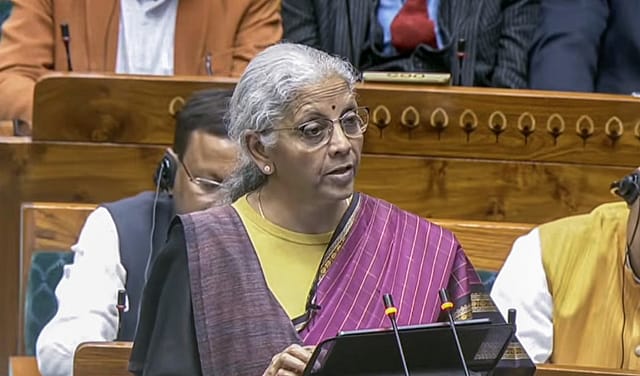
Presenting her ninth straight Budget in Parliament today, Finance Minister Nirmala Sitharaman said that “since we assumed office 12 years ago, the country's economic trajectory has been marked by stability, fiscal discipline, sustained growth and moderate inflation.” She credited this change as the “result of conscious choices we have made even in times of uncertainty and disruptions.”
Sitharaman said that this is the first Budget prepared in Kartavya Bhavan, inspired by three “Kartavya”: to accelerate and sustain economic growth by enhancing productivity and competitiveness and building resilience to volatile global dynamics; to fulfil the aspirations of our people and build their capacity, making them strong partners in India’s path to prosperity; and to ensure that every family, community, region and sector has access to resources, amenities and opportunities for meaningful participation.
Six focus areas for economic growth
Under the first Kartavya, which is to accelerate and sustain economic growth, the Finance Minister presented six key focus areas to achieve these goals.
Those six areas are:
Scaling up manufacturing in seven strategic sectors.
Rejuvenating legacy industrial sectors to boost productivity and competitiveness.
Creating champion MSMEs to strengthen the backbone of the economy.
Delivering a push for infrastructure development across the country.
Ensuring long-term security and stability in economic and financial systems.
Developing city economic regions to drive regional growth and urban development.
India Semiconductor Mission 2.0
During her Budget speech, the Minister also announced the launch of India’s Semiconductor Mission 2.0 with a ₹40,000 crore outlay. The project aims at strengthening India’s semiconductor ecosystem, which is expected to see huge growth in the coming years.
Key highlights of the India Semiconductor Mission 2.0
Focus on industry-led research and training centres for semiconductors.
Higher funding of ₹40,000 crore to build on the progress of the semiconductor mission.
Support for mineral-rich states such as Odisha, Kerala, Andhra Pradesh and Tamil Nadu.
Launch of a new scheme to help states set up three dedicated chemical parks through a competitive process, aimed at strengthening domestic manufacturing.
“Our government has undertaken comprehensive reforms towards creating employment, boosting productivity and accelerating growth,” Sitharaman said.
She added that after Prime Minister Narendra Modi’s announcement on Independence Day 2025, “over 350 reforms have been rolled out.”
“The Budget’s continued focus on capital goods, competitive manufacturing, and smoother customs processes is encouraging for equipment-intensive sectors such as coffee and beverages. As a provider of advanced coffee equipment solutions, we welcome the push to strengthen India’s domestic manufacturing base, while recognising that certain high-precision machines and components will still need to be imported to meet exacting quality standards,” Abhinav Mathur, CEO & MD, Something’s Brewing, Kaapi Machines, Kaapi Machine & Budan, said.