
Fortune India Explainer: Parliament passes VB-G Ram G Bill to replace MGNREGA amid overnight protests from Opposition
ADVERTISEMENT
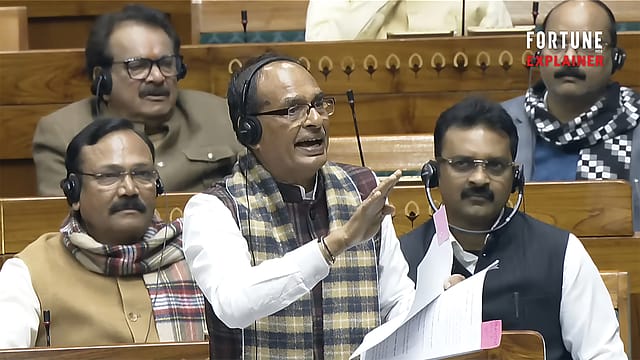
Amid strong protests from the opposition parties, Parliament passed the Viksit Bharat Guarantee for Rozgar and Ajeevika Mission (Gramin): VB-G RAM G Bill.
Introduced by the BJP-led NDA government, the VB-G RAM G bill has replaced 2005’s MGNREGA (Mahatma Gandhi National Rural Employment Guarantee Act) bill. In a strong criticism against the Bill, the opposition said that this new Bill kills the "soul and spirit" of the flagship social welfare programme introduced by the UPA government in 2005. Here is a detailed account of what the new Act seeks to achieve and how it is different from MGNREGA.
What is VB-G RAM G Bill?
Addressing Parliament, Minister of Rural Development Shivraj Singh Chouhan, who introduced the Bill, says that the new Bill seeks to provide a statutory guarantee of 125 days of wage employment in a financial year to every rural household whose adult members volunteer to undertake unskilled manual work.
Under MGNREGA, the government promised 100 days of work in rural areas and paid an unemployment allowance if work was not available. The new law increases this guarantee from 100 days to 125 days, while keeping the other two rules the same.
However, jobs under the new law will be created only through plans approved in advance. Critics say this moves the scheme away from responding to people’s immediate needs. Earlier, workers could approach their gram panchayat and ask for work. Now, they will get work only if it has already been planned.
The new law also groups all work into four areas: water security, basic rural infrastructure, livelihood-related assets, and climate resilience.
Critics have said that this curtails the scope of the work, which was earlier decided by panchayats according to local needs.
Payments: Under MNREGA, workers were paid within 15 days. Under the new VB-G Ram G scheme, wages will be paid every week. If payment is delayed beyond 15 days, workers will get compensation of 0.05% of the unpaid wages for each day of delay after the 16th day.
60-day no-work period: State governments will announce a 60-day period in advance during which no work will be taken up. This is meant to ensure that farm labour is available during peak sowing and harvesting seasons. States can notify different 60-day periods for different regions, depending on local climate and farming patterns.
Financial responsibility: Under MNREGA, the Centre funded the scheme fully. The new programme is classified as a centrally sponsored scheme, which means costs are now shared.
Funding is split into three categories: general states, hilly and North-Eastern states, and Union Territories. For most states and Union Territories, the Centre will pay 60% and states will pay 40%. For hilly and North-Eastern states, the ratio will be 90:10. In Union Territories without a legislature, the Centre will cover the full cost. Spending will be divided among wages, materials, and administrative costs. As before, states will continue to pay the unemployment allowance.
Flexibility during emergencies: In case of natural disasters or other exceptional situations, state governments can seek special relaxations, such as allowing additional types of work or higher wages.
Allocation of work: The Centre will now fix a state-wise work and funding limit for each financial year using set criteria. If a state spends more than this limit, it will have to bear the extra cost. Earlier, district officials prepared labour budgets based on expected demand for work in each district.
Why is the Opposition criticising the Bill?
Since the Union cabinet cleared the Bill, the Congress has questioned why the government replaced Mahatma Gandhi’s name with that of Lord Ram. Several party leaders have said the move is meant to erase Mahatma Gandhi’s name from history.
Other critics have raised concerns about the bill’s provisions, saying they remove the “soul and spirit” of the flagship welfare scheme launched by the UPA government in 2005.
Trinamool Congress MP Mahua Moitra accused the government of weakening Mahatma Gandhi’s legacy. She said the Bill goes against the true meaning of Ram Rajya by scrapping MGNREGA and giving the scheme a new name.