
India-New Zealand FTA clears key hurdle; Canada trade pact talks enter fourth round
ADVERTISEMENT
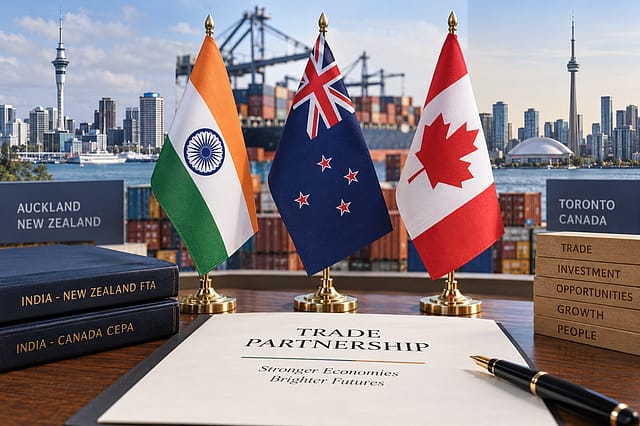
India’s trade engagement with New Zealand has moved closer to implementation after the country’s Parliament approved legislation to give effect to the India-New Zealand free trade agreement (FTA), even as New Delhi and Canada have begun the fourth round of negotiations for a proposed Comprehensive Economic Partnership Agreement (CEPA).
The New Zealand legislation was passed by a 93-29 vote, with support from the opposition Labour Party, paving the way for significant tariff reductions and expanded market access. The agreement, signed in April, will eliminate or significantly reduce tariffs on about 95% of New Zealand’s exports to India when fully implemented.
NZ FTA moves closer to implementation
New Zealand Trade and Investment Minister Todd McClay said the agreement would deliver “immediate and substantial” benefits to exporters. “From day one, 57 per cent of New Zealand’s exports to India will become duty-free. Once fully implemented, tariffs are eliminated or significantly reduced on 95 per cent of our exports,” he said.
McClay said the pact would open greater opportunities for New Zealand exporters in India, one of the world’s largest markets. “The India FTA opens the door for Kiwi exporters to one of the world’s largest and fastest-growing economies,” he said.
The agreement also provides for all Indian goods to receive duty-free access to the New Zealand market. New Zealand has committed to invest US$20 billion in India over the next 15 years. Two-way trade stood at US$2.29 billion in the year ended June 2026.
India-Canada CEPA talks gather pace
Meanwhile, India and Canada have commenced the fourth round of CEPA negotiations in New Delhi, with the five-day talks running from September 14 to 18. Discussions cover trade in goods and services, rules of origin and technical barriers to trade, among other areas. Both countries have set a target of raising bilateral trade to US$50 billion by 2030.
Bilateral trade between India and Canada declined 8.22% to US$7.95 billion in 2025-26 from US$8.66 billion in 2024-25. India’s key exports include pharmaceuticals, iron and steel, seafood, cotton garments, electronics and chemicals, while major imports include pulses, coal, fertilisers, paper and crude oil.
Wider push to expand trade
The latest negotiations follow the third round held in Ottawa in July. India and Canada have committed to concluding the CEPA negotiations by the end of 2026, with the proposed pact aimed at expanding market access and strengthening two-way trade and investment.
Together, the developments with New Zealand and Canada underline India’s continuing push to deepen trade ties through preferential market-access agreements, even as bilateral trade relationships remain at different stages of negotiation and implementation.