
India, Russia reaffirm $100 billion trade goal by 2030 as Jaishankar, Lavrov hold talks on energy, BRICS and West Asia
ADVERTISEMENT
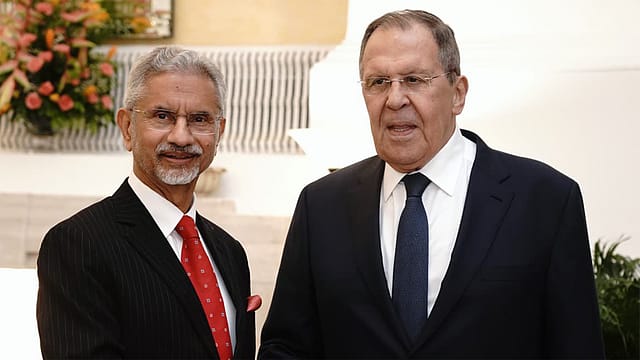
India and Russia reaffirmed their ambition to scale bilateral trade to $100 billion by 2030 as External Affairs Minister S. Jaishankar and Russian Foreign Minister Sergey Lavrov held wide-ranging talks in New Delhi focused on energy cooperation, BRICS coordination and escalating tensions in West Asia.
The meeting, held ahead of the BRICS foreign ministers’ conclave hosted by India, underscored the two countries’ continued efforts to deepen strategic and economic ties despite mounting geopolitical uncertainty and sustained Western sanctions on Moscow over the Ukraine conflict. The discussions also come at a time when India has emerged as one of Russia’s largest energy buyers, significantly reshaping bilateral trade flows over the last three years.
It may be recalled that last year, Union Minister of Commerce and Industry Piyush Goyal had stated that India and Russia aim to boost their bilateral trade to over $100 billion by 2030, up from the current $70 billion.
Energy trade continues to drive bilateral growth
“The goal which the leaders set to scale up bilateral trade for 2030 is $100 billion,” Lavrov said during the talks, reiterating Moscow’s intent to expand engagement with India across energy, investment and connectivity sectors.
India-Russia bilateral trade has witnessed a sharp jump since 2022, largely driven by India’s rising imports of discounted Russian crude oil following sanctions imposed by Western economies. According to government estimates, bilateral trade crossed $65 billion in FY25, compared with less than $15 billion before the Ukraine conflict, making Russia one of India’s top trading partners.
However, the trade relationship remains heavily skewed in Moscow’s favour due to India’s large-scale crude purchases. Both countries are now exploring mechanisms to diversify the trade basket through pharmaceuticals, agriculture, critical minerals, fertilisers, coking coal and infrastructure investments.
BRICS coordination gains importance
The Jaishankar-Lavrov meeting also assumed significance ahead of the upcoming BRICS engagements, with the grouping increasingly positioning itself as a counterweight to Western-led geopolitical and financial institutions.
Officials familiar with the discussions said the two ministers exchanged views on strengthening cooperation within BRICS, regional security developments and ongoing conflicts in West Asia, which have raised concerns over global energy supplies and shipping routes.
India has maintained a calibrated diplomatic stance on the Russia-Ukraine war, repeatedly calling for dialogue and diplomacy while continuing economic engagement with Moscow. Russia, meanwhile, remains a critical supplier of defence equipment, crude oil and fertilisers to India.