
India to outpace global slowdown with 6.5% growth: IMF flags resilience amid West Asia conflict
ADVERTISEMENT
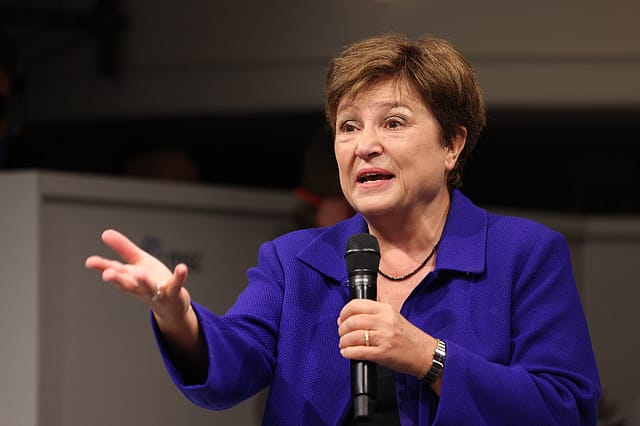
The International Monetary Fund (IMF) has reaffirmed India’s position as the fastest-growing major economy, projecting growth to hold steady at 6.5% through FY27 despite escalating geopolitical tensions and energy market disruptions.
Speaking at the IMF Spring Meetings, Managing Director Kristalina Georgieva underscored India’s economic resilience, even as global growth moderates due to the ongoing US-Iran conflict.
“Look at India today. India’s growth is more than two times higher than the average global growth. That is happening because the country has strong fundamentals,” she said.
The IMF has pegged global growth at 3.1% for the year, down from earlier estimates, highlighting the widening divergence between India and the broader global economy.
Georgieva attributed India’s outperformance to macroeconomic stability, robust domestic demand, and sustained policy reforms, noting that there are no immediate signs of a sharp slowdown in the country’s growth trajectory.
Policy discipline, reforms underpin resilience
The IMF chief pointed to structural improvements across emerging markets, including India, particularly in monetary and fiscal frameworks.
“Economies that have these strong fundamentals, have the dynamism like India does, they would be performing better,” she noted, highlighting the role of independent central banks, stronger fiscal oversight, and higher foreign exchange reserves.
Echoing this view, IMF Fiscal Affairs Director Rodrigo Valdes said India’s growth momentum is structural rather than cyclical, helping cushion fiscal pressures even in a volatile external environment.
The Fund also revised India’s FY25 growth upward to 7.6%, citing stronger-than-expected economic performance in recent quarters.
Risks persist, financial stability in focus
Despite the positive outlook, the IMF has cautioned that prolonged conflict in West Asia could weigh on global and regional growth, particularly through energy price shocks.
“We do not see a scenario under which there would be a dramatic development… one issue that we all need to be very watchful is financial stability,” Georgieva said, adding that current conditions appear stable but require close monitoring.
The IMF also reiterated its policy advice for governments to avoid broad-based fuel subsidies amid rising energy prices, recommending targeted cash transfers instead to protect vulnerable populations without distorting market signals.
Even as risks linger, India’s growth trajectory—backed by strong fundamentals and policy credibility—continues to stand out in an increasingly uncertain global economic landscape.