
India’s defence allocation jumps 219% in a decade, spending matches sprint
ADVERTISEMENT
India’s defence budget has expanded sharply over the past decade, with allocations rising 219% from ₹2.46 lakh crore in FY16 to ₹7.85 lakh crore in the budget estimates for FY27, according to budget documents. The steady increase in budget estimates, coupled with a pronounced jump in actual spending after the Covid-19 pandemic, signals a sustained push towards defence modernisation.
Steady rise in allocations, sharper post-pandemic spending
Government data reveals a clear upward trajectory in the last decade. Budget allocations went up from around ₹2.5 lakh crore in FY16 to over ₹3.3 lakh crore by FY20, reflecting a CAGR growth of 7.19% in allocations.
However, given the government’s impetus to defence indigenisation in the post-Covid era, especially in the backdrop of the Galwan Valley clash with China in June 2020, India’s defence push gathered a major momentum. By FY22, the defence outlay crossed ₹4.7 lakh crore and has now culminated in record ₹7.85 lakh crore provision for FY27, registering a CAGR growth of almost 11% during the period.
Importantly, the rise is not limited to headline budget announcements. Actual expenditure has also climbed steadily, with a sharp post-pandemic spike, in tandem with the overall capex story of the government in other sectors like highways and railways. Actual spending on defence rose from about ₹3.2 lakh crore in FY21 to nearly ₹4.6 lakh crore in FY22, and has continued to rise, crossing ₹6 lakh crore in subsequent years.
Budget 2026: Defence sector likely to bag mega allocation amid heightened global tensions
Experts are of the view that India’s defence thrust aligns with the broader strategic picture and capital expenditure on big ticket items. Speaking to Fortune India, former foreign secretary Kanwal Sibal pointed to the broader strategic picture and said, “For a long time, there has been a constant demand to spend more on defence in the context of very serious security challenges we have.”
In fact, instances of revised estimates exceeding the budget estimates have also come to the fore recently. This indicates improved fund utilisation and faster execution of procurement contracts.
For example, in FY22, against the budgetary estimate (BE) of about ₹4.78 lakh crore, the revised estimate (RE) was marginally higher at around ₹4.84 lakh crore. In FY23, the BE was ₹5.25 lakh crore, which was revised upward to ₹5.94 lakh crore in RE. Similarly this reflects additional provisioning during the year and stronger spending momentum.
Capital outlay moves in tandem with overall defence allocation
Capital outlay in defence has also gone up significantly in the last decade. Capital outlay, which covers new platforms, aircraft, naval assets, weapons systems and infrastructure, has risen from about ₹85,000 crore in FY16 to ₹2,19,000 crore in FY27.
The trend of actually either matching or exceeding the allocations is visible on the defence capex front too. For example, in FY24, against a capital allocation of about ₹1.8 lakh crore, actual spending was reported at close to ₹2.1 lakh crore. Golkale pointed to improved spending capacity within the ministry of defence. “The speed of execution and signing of contracts has increased. So there is better capacity to absorb funds, and therefore the allocation has gone up,” he said.
Budget 2026: Defence allocation jumps 15% to ₹7.8 lakh crore, modernisation gets big push
However, an important concern over here is the declining share of capital expenditure in the overall defence outlay over the past so many years. Defence capex as a percentage of the total defence outlay has come down from around 34.91% to 28%. “We need to spend more on defence,” Sibal said.
Strategic pressures, GDP ratios and the R&D debate
Seen in the context of share of defence allocations in GDP, India ranks low. “The United States and others spend more on defence while some countries in Europe have reached 5% of their GDP. In our case, it is around only 2%. This is not enough,” Sibal said.
India’s nominal GDP is estimated at over ₹300 lakh crore in recent years, and defence allocations in the range of ₹6–8 lakh crore translate to roughly 2% of GDP. While this ratio appears comparable to China’s officially stated figure, the difference in absolute terms is substantial given the size of China’s economy. “I don’t agree with the 1.7% figure about China. There are people who say that China’s actual defence expenditure is much higher than what it shows,” he added.
From a strategic standpoint, analysts argue that India’s unique threat environment requires sustained and possibly higher levels of investment. The country faces two nuclear-armed adversaries and must prepare for short, medium and long-term contingencies. Underscoring the complexity of the challenge, Gokhale said, “India has a peculiar challenge. It has two nuclear-armed adversaries. You have to arm for short, medium and long-term conflicts. Some of the old assumptions have gone out of the window,” he said.
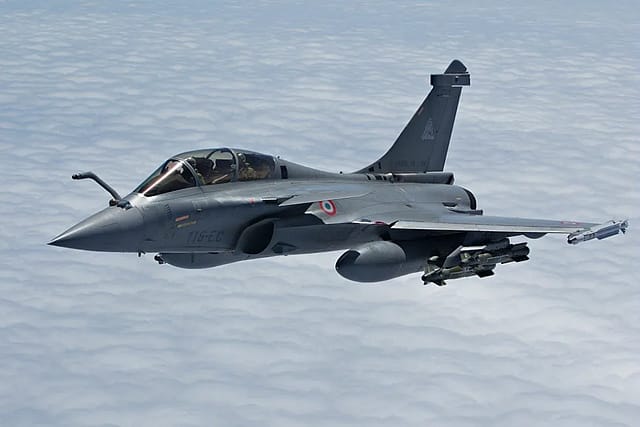
It may be noted that the government’s recently approved purchase of 114 Rafale fighter jets from France’s Dassault Aviation in a deal valued at ₹3.25 lakh crore. The clearance marks the largest defence contract in India’s history and highlights the scale of capital commitments underway.
The move will help bolster declining squadron strength, according to analysts. “This deal is not because of any one incident. The squadron strength has been steadily declining for over a decade. Had timely action been taken, this acquisition should have happened around 2012–13,” said Amit Cowshish, former Financial Advisor (Acquisitions) in the ministry of defence.