
India's trade deficit widens marginally to $25.04 billion in December; exports edge up
ADVERTISEMENT
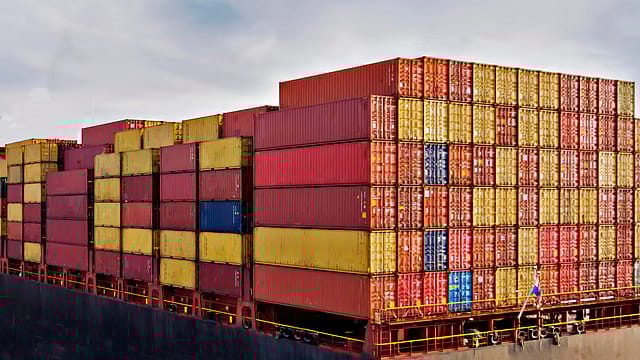
India's merchandise trade deficit has widened slightly to $25.04 billion in December, with the overall exports likely to cross $850 billion in the current fiscal, data released by the commerce department showed on Thursday.
Merchandise exports
Merchandise exports rose to $38.51 billion in December from $38.13 billion in the previous month while imports increased to $63.55 billion from $62.66 billion.
Services exports
On the services side, exports slipped marginally to $35.50 billion while imports were nearly flat at $17.38 billion, according to the data.
The Reserve Bank of India is scheduled to release detailed monthly services trade data about two weeks after the government’s initial estimates.
Exports to the US have grown, says commerce secretary
Commerce Secretary Rajesh Agrawal said exports to the US have grown on a year-on-year basis during the first nine months of the current financial year, adding that India’s total exports could exceed $850 billion in the fiscal year ending March. Exports to the US stood at $6.89 billion in December, slightly lower than $7 billion recorded a year earlier.
India’s efforts to diversify export markets towards China, Russia, and the Middle East—supported by incentives and proposed trade agreements, including with the European Union—have helped cushion shipments following higher US tariffs imposed on certain Indian goods in late August.
Meanwhile, India and the US are holding discussions on a bilateral trade agreement after talks collapsed last year amid communication gaps between the two sides.
Separately, inflation data released earlier this week showed mixed price trends. India’s retail inflation rose to a three-month high of 1.33% in December 2025, driven largely by higher prices of vegetables and protein-rich food items. Inflation had stood at 0.71% in November, with the previous peak of 1.44% recorded in September.
Food inflation, measured by the Consumer Price Index (CPI), remained in negative territory for the seventh consecutive month at (-)2.71%, although it moderated from (-)3.91% in November.
Wholesale price inflation, based on the Wholesale Price Index (WPI), rose to 0.83% in December from a contraction of 0.32% in November, according to data released by the Ministry of Commerce and Industry on Wednesday. The government attributed the uptick to higher prices of manufactured products, minerals, machinery and equipment, food products and textiles.