
MDR applies to merchants, not UPI users, clarifies FM Sitharaman
ADVERTISEMENT
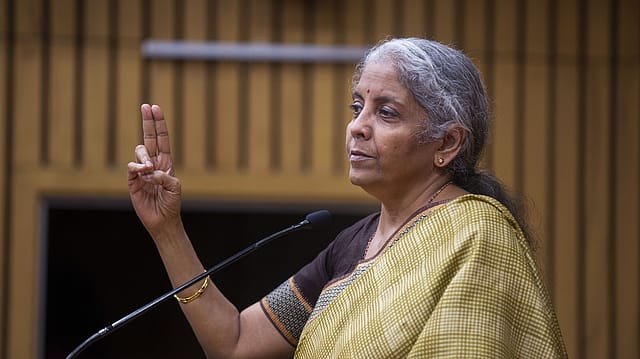
Finance Minister Nirmala Sitharaman on Thursday clarified that any Merchant Discount Rate (MDR) on digital payments would apply to merchants, not end customers, amid a political row over the government's proposed changes to the law governing electronic payment systems.
Responding to Congress leader Jairam Ramesh's criticism of the proposed amendment to the Payment and Settlement Systems (PSS) framework on X, Sitharaman said the MDR, if introduced, would help banks and fintech companies invest more in digital payments infrastructure, innovation and security.
"...Merchant Discount Rate (MDR) applies only to merchants and not to end users/customers. It will support banks and fintech companies in investing more in infrastructure, innovation and security. All users of UPI will reap the benefits of this investment," Sitharaman said in a post on X.
The finance minister also clarified that no decision has yet been taken on levying MDR on Unified Payments Interface (UPI) transactions. She said the UPI and Services Steering Committee, headed by the National Payments Corporation of India (NPCI), will consider the issue only after Parliament passes the Taxation and Other Laws (Amendment) Bill, 2026.
The clarification came after Congress general secretary Jairam Ramesh alleged, in a post on X, that the proposed legislation removes the statutory guarantee that has kept UPI transactions free of charges, paving the way for the future imposition of MDR on digital payments.
"The Taxation and Other Laws (Amendment) Bill, 2026, introduced by the Modi government, eliminates the statutory guarantee that had so far kept UPI transactions fee-free. It paves the way for imposing a Merchant Discount Rate (MDR), which could easily be applied in the future to all types of digital payments," he said.
Ramesh argued that any merchant charge would ultimately be passed on to consumers and questioned the government's claim that such a move is necessary to keep the UPI ecosystem financially sustainable.
He also said the Reserve Bank of India (RBI) had sufficient financial resources to support the country's digital payments infrastructure, citing the central bank's ₹2.86 lakh crore surplus transfer to the government in FY26. Ramesh further alleged that the amendment may have been prompted by criticism from the U.S. Trade Representative over India's zero-fee UPI and RuPay ecosystem.
The controversy follows the introduction of the Taxation and Other Laws (Amendment) Bill, 2026, in Parliament earlier this week. The proposed amendment seeks to give the Central government the flexibility to notify which digital payment modes or categories of transactions should continue to remain exempt from MDR and which could attract merchant charges in the future.
The amendment, however, does not immediately reintroduce MDR on UPI transactions. Instead, it removes the blanket statutory exemption, leaving any future decision on merchant charges to be notified separately by the government after the law is enacted.