
Kisan Morcha plans massive agitation from November 26
ADVERTISEMENT
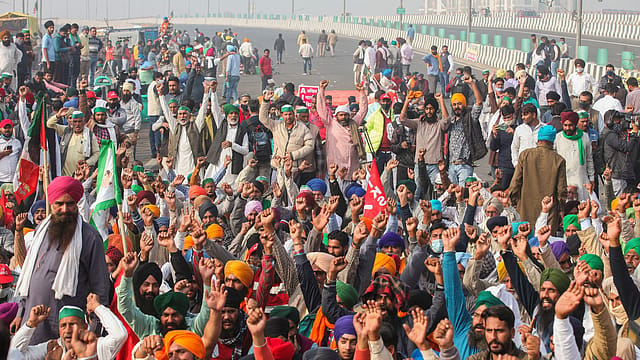
Almost five years ago, the Samyukt Kisan Morcha (SKM), a national coalition of farmer organisations, called off its agitation against the Centre after the government repealed three farm laws it had enacted and agreed to consider a set of additional demands raised by the farmers’ body.
Since then, the SKM has repeatedly complained that the government has failed to honour its assurances given to the farmers. However, it has not attempted a protest on the scale of its 2020-21 agitation, when thousands of farmers converged on Delhi’s borders and staged prolonged demonstrations in the national capital against the farm laws.
That may be changing. The size, scale, and scope of any fresh mobilisation remains unclear, but the possibility of another major farmer agitation appears to be is brewing. SKM leaders have themselves offered indications of their plans. The organisation has announced Maha Panchayats in one lakh villages on October 3. According to the SKM, these meetings will press for the implementation of the written assurances given to the organisation on December 9, 2021, while also seeking to build a broader worker-farmer platform to oppose Central government policies, including its FTA policy.
“On that day, SKM will release a list of 10 lakh farmer volunteers, including 2.5 lakh women farmers to restart the farmers’ struggle from November 26,” says P. Krishnaprasad, a member of the SKM National Coordination Committee. He added that the SKM National Council and General Body would meet in Karnal, Haryana, on October 12 to decide the form, spots and other details of a renewed farmer agitation, if, in SKM’s assessment, the Narendra Modi-led government continues to neglect what it calls the farmers’ “burning demands”.
The first and perhaps the oldest of these issues is the demand for a minimum support price (MSP) for agricultural produce based on the formula of farmers’ choice. While the government has maintained that it has been working towards doubling the farmers’ income through a combination of higher MSPs and other measures, farmer organisations have long demanded that MSP be calculated according to a specific formula recommended by a government appointed commission.
The formula, known as C2+50%, factors the comprehensive cost of cultivation—including the imputed rental value of land, interest on fixed assets and other costs—and adds 50% to that amount. The government’s existing MSP calculation, meanwhile, takes into account all actual paid out expenses incurred by the farmer in cash and kind along with the estimated value of family labour. Farmer organisations argue that the resulting MSP remains below what it would be under the C2+50% formula.
Another long-standing grouse is what farmer bodies describe as the government’s aggressive pursuit of Free Trade Agreements (FTAs) with other countries and trade blocs. While the government has said it remains sensitive to farmers’ concerns, the organisations point to instances where duty free or low duty imports of agricultural commodities have affected domestic prices, thereby hurting the interests of Indian farmers.
Besides these two issues, other demands include a comprehensive waiver of farm loans; policies to address the agrarian crisis, unemployment and distress out-migration; measures to tackle farmers’ and daily workers’ suicides; and the repealing of the four Labour Codes.
Recently these farmers bodies have clashed with the government over some other issues. On September 18, for instance, the SKM protested against the Union government’s move to release and facilitate multiplication of seeds of two gene-edited (GEd) rice varieties—DRR Dhan 100 (Kamala) and Pusa DST Rice 1—arguing that the move threatens India’s seed sovereignty and the rights of farmers.
In a statement, the SKM said the gene-edited rice varieties that the government is contemplating for release are based on patented technologies, while the extent of farmers’ seed-saving rights for these varieties remain undisclosed.
The SKM has also recently protested against higher sugar prices and the supply constraints it attributes to the diversion of sugar towards ethanol production. The farmers’ body alleges that the diversion enables sugar mills to earn higher margins from ethanol and has demanded legislation requiring the sugar industry to share with sugarcane farmers the additional profits generated from the diversion of sugar for ethanol production.
The SKM has sought to consolidate these demands through a memorandum submitted recently to the Prime Minister and elected representatives across the country, including CMs, MPs and MLAs. It has called on State and Central legislatures to enact laws to address its various demands.