
How Indian weddings are redefining opulence
ADVERTISEMENT
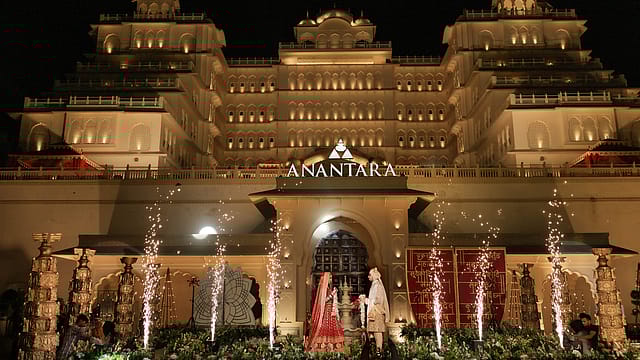
In November, Udaipur—long celebrated for its shimmering lakes, palaces, and cinematic charm—became the epicentre of a wedding unlike any India had seen. Netra Mantena, daughter of Orlando-based pharma magnate Rama Raju Mantena, and tech entrepreneur Vamsi Gadiraju exchanged vows in a sequence of events that have already become shorthand for India’s turbocharged wedding season.
Over three days, from November 21 to 23, the city transformed into a kaleidoscope of colour, culture, and couture blending Rajasthan’s royal elegance with contemporary spectacle. From the ornate corridors of the Jagmandir Island Palace, which floated like a jewel in the heart of Lake Pichola, to the sun-kissed terraces and palatial suites of luxury hotels, every corner was curated to perfection. The guest list read like a global “who’s who”: Jennifer Lopez, Justin Bieber, Hrithik Roshan, and Ranveer Singh, among others, cemented the event as one of the most high-wattage weddings India had seen.
Yet the Mantena–Gadiraju wedding was not merely about star power. It marked a larger national phenomenon: India is entering its largest-ever wedding season. According to the Confederation of All India Traders (CAIT), the country’s largest trade body representing 90 million traders, an estimated 4.6 million weddings are scheduled between November 1 and December 14.
The report forecasts more than ₹5.5 lakh crore in wedding spending during this window, noting that the economic ripple will touch over 30 ancillary sectors, from beauty professionals and florists to transport operators, designers, photographers, and digital creators. “This is not a seasonal spike,” said CAIT national secretary Praveen Khandelwal. “It’s a cultural and commercial phenomenon driven by pent-up demand, growing affluence, and a nationwide shift toward more elaborate, personalised celebrations.”
Analysts attribute this surge to a “post-pandemic recalibration” of consumer sentiment, where families are both emotionally and financially willing to invest in experiences that reflect personal taste, cultural identity, and social aspiration.

The Return of the Big Fat Indian Wedding
For hoteliers and wedding planners, the signs of resurgence were long visible. “Weddings are back, and they’re more colourful, emotional, and extravagant than ever. Couples are not just booking venues—they are curating experiences. From wellness breaks to cultural immersions, every touchpoint is designed to be unforgettable,” notes Vimal Verma, General Manager of Anantara Jewel Bagh Jaipur Hotel that has back-to-back bookings for weddings during the auspicious period.
At Anantara, preparations for the season began long before November. Courtyards were refreshed, menus were reimagined, and signature experiences tailored to each couple. Every element—from lighting schemes that shift subtly through the evening, to carefully curated music playlists and immersive décor storytelling—is designed to create a journey rather than just a series of events. It’s about crafting moments that guests will remember for a lifetime, not just a day, adds the hotelier.
Whether it’s a starlit phera on a sprawling lawn, a vibrant mehndi on the terraces, or a sangeet indoors with global cuisine, Verma says every detail is customised to reflect the couple’s story. The guest experience is everything—from warm welcomes to personalised cultural touches that feel “effortless yet extraordinary”.
A Pan-India Phenomenon
Indeed, the appetite for destination weddings has never been higher. Hotels across India—from Jaipur to Goa—report soaring demand for spaces that combine opulence with intimacy. Davinder Juj, General Manager at Eros Hotel New Delhi, shares that the combination of auspicious dates and post-Covid enthusiasm has created one of the strongest wedding cycles seen in years. The capital alone anticipates 450,000 weddings this season, part of a national total of 4.8 million.
“All our venues—from the Royal Ballroom to the poolside lawn—are operating at full capacity,” Juj says. “We’ve strengthened operational teams across housekeeping, banquets, and F&B, and ramped up inventories to ensure seamless execution.”
Technology plays a crucial role too—virtual venue tours, online payments, and a dedicated wedding consultant line have all streamlined the planning process. Couples expect a flawless experience, and every decision is geared towards anticipating their needs and exceeding expectations, whether it’s personalised menus, bespoke décor, or ensuring every guest feels welcomed and valued, Juj observes.
Hoteliers note that big weddings are more than revenue generators—they are “economic engines” with a single wedding employing 500–700 people across hospitality, lighting, logistics, and entertainment. “This isn’t just a luxury phenomenon, but a full-fledged ecosystem that sustains entire communities,” adds Verma.
The culinary arms of luxury hotels are now operating like research kitchens. “Clients don’t want large buffets—they want curated experiences,” elaborates Chef Rahul Ahuja, a Mumbai-based caterer whose team handled four celebrity weddings this year. “We’re doing
regional tasting menus that tell family stories, live fermentation bars, millet-led gourmet counters, artisanal cheese rooms, East Asian broths, vegan soufflés. Food is no longer a service—it’s theatre.”
Booming biz in Tier II towns
Tier II and III cities are scripting their own boom. In Lucknow, the newly restored Baradari has a waitlist for 2026. In Indore, venues are packed during the upcoming muhurat cluster. Surat’s wedding planners report budgets routinely crossing ₹5–7 crore for multi-day events. “Affluence is more democratic now,” said Nikita Chhabra of Indore Event Atelier. “People want tasteful grandeur. They reference Pinterest boards, Milan runway shows, Greek-style décor, Balinese textures. Their vision is global.”
Luxury wedding planners echo the sentiment. Pooja Singhania, founder of Marigold & Mirth, says inquiries for 2025 and 2026 are far exceeding the five-year average. “Weddings have evolved into immersive productions,” she explains. “Couples want couture-level décor, storytelling-driven events, and moments that are social-media ready. Udaipur delivers all of this effortlessly, with its palaces and culture providing the perfect backdrop.”
The New Rules of Grandeur
Couples themselves confirm the allure. Bengaluru-based newlyweds Pallavi Rao and Aditya Raman, who tied the knot in Udaipur earlier this year, describe the city as “both private and cinematic”. “We wanted our guests to feel transported, like entering another world,” Pallavi explains. “The palaces do half the work for you, giving us the freedom to focus on personal touches.”
This season, “big” is no longer merely a matter of guest numbers or budgets. CAIT’s data reveals a sharp uptick in spending on bespoke décor, artisanal florals, personalised hospitality, and high-concept entertainment. Culinary experiences are becoming travelogues in their own right.
“We’re doing live sushi bars next to Rajasthani chaat counters, Turkish grills alongside Hyderabadi haleem stations,” says Rohan Dalmia of Gastronomica Weddings. “Couples want food that tells the story of their journey—the cities they’ve lived in, the countries they’ve visited, the experiences they’ve shared.”
Fashion, too, is evolving. Jaipur designer Ritu Modi notes that brides increasingly request custom embroideries featuring family motifs or symbols meaningful to their personal story, while grooms embrace bold colours and textures in ways previously unseen. “It’s a season of originality,” Modi says. “Each wedding becomes a statement of personal and familial identity.”
Entertainment has undergone a similar transformation. Mumbai-based curator Veer Malhotra observes that international performers and immersive theatre acts are no longer limited to ultra-high-net-worth weddings. “Even mid-tier clients are booking global talent this year,” he says. “The Mantena–Gadiraju wedding has set a new aspirational benchmark.”
Travel planners now function as mobility managers for extended families. “We frequently coordinate 150- to 300-person itineraries,” said Priya Nair, senior consultant at FlyBeyond India. “We’ve arranged chartered flights for baraats, airport lounges with mehfil-style seating, and on-ground concierges who manage elderly guests. Travel is part of the celebration story now.”
Market analysts argue that the 2025 boom is not only emotional or aspirational—it reflects deeper structural shifts in the Indian consumer economy. “Weddings are one of India’s most resilient spending categories,” said consumer-sector expert Arvind Taneja. “What’s remarkable in 2025 is the breadth: affluent metros, rising-tier cities, NRI families returning home, and even middle-income households spending more on personalization. The multiplier effect is enormous.”
The Vendor Boom
The implications of this supercharged wedding season extends far beyond celebrity-studded invitations. It has ignited a boom for thousands of small and medium businesses that form the backbone of India’s nuptial economy. Florists, lighting technicians, décor artisans, photographers, logistics teams, and countless others are working at levels reminiscent of pre-COVID peaks.
“Every weekend is triple-booked,” says Mumbai-based floral designer Rhea Contractor of FleurLab. “We are sourcing blooms from Ecuador, hydrangeas from Holland, marigolds from Bengal, and mogra from Madurai. The demand for high-quality, large-scale work has never looked like this.”
Udaipur-based photographer Pranav Shah describes weddings as “mini-series productions”. “Clients now want a visual narrative that spans pre-wedding shoots, multiple ceremonies, and after-parties,” he says. “They want intimacy, glamour, aerial shots, and behind-the-scenes moments—every angle covered.”
The Emotional and Cultural Drivers
For India’s global diaspora, the pull of a majestic Indian wedding is even stronger. California-based Arjun and Megha Patel, who’re planning their nuptials in 2025 in Goa, were inspired after attending another destination wedding this year. “There’s nowhere else
in the world where tradition and spectacle blend so seamlessly,” Arjun says. “It’s like coming home, in the most celebratory way imaginable.”
Sociologists note that weddings are increasingly functioning as “instruments of personal branding and social storytelling”. Beyond rituals, they serve as elaborate digital narratives, social introductions, and public affirmations of family and status. Rising affluence and global exposure allow families to scale up, turning weddings into economic engines that ripple across industries, economies, and communities, they add.
The Mantena–Gadiraju celebrations exemplified this at a spectacular scale, but the emotional impulse runs across budgets and cities. As fireworks burst over Lake Pichola during the couple’s final night, illuminating palace domes and the glutinous water below, the symbolism felt larger than the event itself. It mirrored a broader national mood—a wedding ecosystem pulsing with sentiment, aspiration, and economic momentum.
If the season ahead reflects even a fraction of the ambition and artistry witnessed in Udaipur, then the big fat Indian wedding isn’t just getting bigger. It’s evolving into a cultural and commercial force of unprecedented scale, shaped as much by emotion as by opulence. And the real crescendo is only beginning!