
Domestic capital has strengthened India’s market resilience, says Sebi chief
ADVERTISEMENT
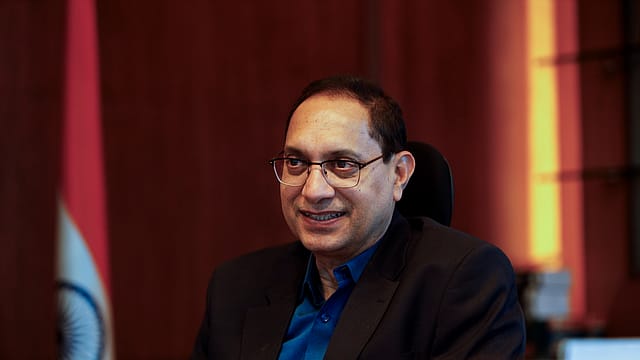
India’s capital markets have become more resilient over the past few years, driven by the steady growth of domestic capital and a reduced dependence on foreign institutional investors, Securities and Exchange Board of India (SEBI) chairman Tuhin Kanta Pandey said in a fireside chat with Prithvi Haldea, Advisor, AIBI, and Mahavir Lunavat, Chairman, AIBI in Mumbai.
Speaking on the evolution of India’s capital markets, Pandey said the economy’s scale and ambitions require capital from every possible source. “We have to have all kinds of capital in the size of our economy. And the way our aspirations are, we need all kinds of capital—domestic, foreign, retail, institutional, pension funds, insurance funds and mutual funds,” he said.
According to Pandey, what has changed structurally over time is the balance between these pools of capital. “What has happened over a period of time is that all the pools of capital are growing. But the over-dependence on FDIs has reduced. And that’s a good sign,” he said.
While foreign capital remains important and welcome, Pandey said Indian markets today are more stable and less vulnerable to global capital flows. “Our markets are more independent and stable, and not really subject to volatility just because some FDIs think,” he said, adding that foreign investors tend to look at opportunities “more globally, more opportunistically,” whereas domestic capital is naturally more aligned with developments within India.
Pandey said he sees no contradiction in domestic institutional investors overtaking foreign investors in ownership of Indian companies. “I don’t see any contradiction in even the FDI outflows for that matter,” he said, pointing out that foreign investors continue to participate in initial public offerings (IPOs) in “fairly large proportions.” According to him, domestic capital or domestic institutional investors are increasing in terms of percentage, surpassing the FDIs. “But in the IPOs, we've seen that FDIs continue to be there in fairly large proportions still. Although domestic mutual funds and domestic capital now have surpassed.”
On IPO markets
Addressing concerns that IPO markets are being used largely for promoter and private equity exits, Pandey said the data does not support that view. “To say that we are suddenly doing more of OFS and less of fresh issue doesn’t bear out with the fact,” he said. He noted that offers for sale (OFS) peaked in 2020, the Covid year, when 87% was for the OFS, but have moderated since. “In 2025, we have about 55% going for OFS and 45% for the fresh issue,” he said. In the SME segment, he added that the fresh issue is almost 75%
Pandey also highlighted the role of private capital in preparing companies for public markets. Early-stage companies, he said, are better suited to raising funds from private investors who are structured to absorb higher risk. “They invest in ideas. Two out of ten ideas may succeed,” he said, adding that once companies mature, public markets provide an appropriate platform for wider participation and capital formation. “In order to bring them to the capital markets you have to prepare for a public market, which would mean that you have to really teach them the disclosures, accounting…Because their responsibilities will jack up drastically.”
On regulation, Pandey said SEBI’s approach is to strike a balance between flexibility and investor protection. “We have to really strike a balance there,” he said, reiterating that SEBI does not take a prior view on valuations. “Valuation is more in the eye of the beholder,” he said, stressing that the regulator’s focus is on disclosures that investors find relevant and meaningful.
Pandey also underlined the growing importance of technology and investor behaviour in market regulation. “Technology is the heart of the capital market today,” he said, adding that cybersecurity has become a systemic issue rather than a firm-level concern. On investor behaviour, he cautioned against excessive focus on short-term listing gains. “That cannot be the sole objective,” he said. “You have to stay in the long term.”