
D-Street faces bumpy road after ₹7 lakh crore rout; crude surge, West Asia tensions to keep Sensex, Nifty on edge
ADVERTISEMENT
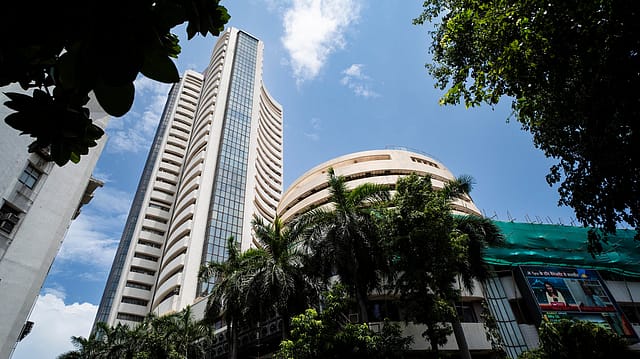
Nearly ₹7 lakh crore of investor wealth was wiped out in a single session on Monday as escalating tensions in West Asia and a sharp rally in crude oil prices triggered a broad-based sell-off on Dalal Street, clouding the near-term outlook for equities.
Market participants expect turbulence to persist, with crude price movements and geopolitical developments likely to dictate sentiment. Analysts caution that unless oil prices cool and clarity emerges on the geopolitical front, rallies may face stiff resistance, keeping markets on a volatile footing.
On Monday, the NSE Nifty declined 1.24% to close at 24,865.70 after slipping more than 2% intraday, while the BSE Sensex dropped 1,048 points to settle at 80,238.85. The total market capitalisation of BSE-listed firms eroded by ₹6.60 lakh crore in a single session, falling to ₹456.91 lakh crore.
The sell-off was largely driven by surging crude prices after coordinated U.S.–Israel strikes on Iran heightened fears of supply disruptions in the Middle East. Brent crude jumped more than 6%, stoking concerns over inflation, India’s import bill and potential pressure on the rupee.
On a year-to-date (YTD) basis, the Nifty50 has fallen nearly 5%, while the Sensex has declined almost 6% over the same period, including a correction of around 4% in February alone.
On March 2, foreign institutional investors (FIIs) were net sellers in the Indian cash market, offloading shares worth around ₹3,295.64 crore. In contrast, domestic institutional investors (DIIs) provided a strong cushion by infusing ₹8,593.87 crore into equities.
Surge in crude oil prices weigh on sentiment
Ajit Mishra of Religare Broking said the rising crude prices, triggered by U.S. and Israeli strikes on Iran and the risk of supply disruptions through the Strait of Hormuz, have raised concerns over inflation, currency pressure and India’s import bill.
“Investor sentiment deteriorated sharply after escalating tensions in the Middle East triggered a surge in crude oil prices and heightened global uncertainty. The spike in oil raised concerns about inflation, currency pressure and India’s import bill, which weighed on equities,” he said.
Volatility also increased as participants reduced exposure amid fears of further geopolitical escalation, Mishra added.
In a fresh development, shipping through the Strait of Hormuz, a strategic chokepoint handling about 20% of global oil shipments, has ground to a near halt amid Iranian attacks on oil tankers in the region.
Near-term trajectory to remain cautious
Siddhartha Khemka of Motilal Oswal Financial Services said the near-term trajectory is likely to remain cautious until clarity emerges on geopolitical developments.
“The near-term trajectory of the market is expected to remain cautious amid persistent geopolitical tensions, until clarity emerges, overall sentiment is likely to stay subdued,” he said.
Although domestic macro fundamentals remain relatively resilient, heightened global uncertainty is likely to keep investor positioning guarded, Khemka added.
He expects defence and upstream oil companies to attract attention amid expectations of higher strategic spending and elevated energy prices, while export-oriented sectors may face near-term headwinds due to global risk aversion and potential demand disruptions.
Long-term outlook intact
Despite near-term turbulence, Naval Kagalwala of Shriram Wealth maintained that the long-term India story remains intact. He said such global events have historically led to short-term volatility followed by stabilisation. Any correction could help rationalise valuations, with India continuing to stand out among the fastest-growing major economies.
“Any correction, if it plays out, could help rationalise valuations further in India, which continues to remain among the fastest-growing major economies…Near-term spillovers, if any, would largely be through spike in oil prices and certain other segments which rely on exports / imports,” he said.
He added that this is not an India-specific event, and spillovers would largely be through crude and trade channels. With OPEC considering production increases and alternative sourcing options available, supply-side pressures could moderate over time. Healthy domestic liquidity and strong retail participation may also provide support during corrections.
Key technical levels to watch
From a technical standpoint, analysts have flagged crucial support zones for the Nifty around 24,730–24,700 and for the Sensex near the 80,000 mark.
Sudeep Shah of SBI Securities said a decisive break below 24,700 could open the door to a deeper correction towards 24,550 and 24,400. On the upside, the 24,950–25,000 band remains a stiff resistance zone, and a sustained move above 25,000 is essential to regain bullish momentum.
Shrikant Chouhan of Kotak Securities described the current market texture as weak but oversold, suggesting that a technical bounce-back cannot be ruled out. He identified 24,750 for the Nifty and 80,000 for the Sensex as key support levels for short-term traders. If the indices hold above these zones, a recovery towards 25,000–25,075 on the Nifty and 80,500–80,700 on the Sensex is possible.
The Bank Nifty, which closed at 59,840 after trimming intraday losses, faces immediate support at 59,400–59,300 and resistance around 60,300–60,400, he added.
Holiday pause, but volatility likely to persist
With Indian markets closed on account of Holi today, global cues, particularly crude oil trends and persistent weakness in global equities, will set the tone for the next trading day.
Sustained selling across Asian markets suggests that Indian benchmark indices may mirror the regional weakness when markets reopen on Wednesday.
The bearish trend in the GIFT Nifty is also signalling a potential gap-down opening for tomorrow, as it was trading near the 24,734 mark, down approximately 258 points.
Until geopolitical clarity emerges and crude prices stabilise, analysts expect investor positioning to remain guarded, with heightened volatility and sector-specific action dominating the near-term market landscape.
(DISCLAIMER: The views and opinions expressed by investment experts on fortuneindia.com are either their own or of their organisations, but not necessarily that of fortuneindia.com and its editorial team. Readers are advised to consult certified experts before taking investment decisions.)