
Listing blues deepen: Clean Max debuts at 9.5% discount; 5 of 7 IPOs trade below issue price
ADVERTISEMENT
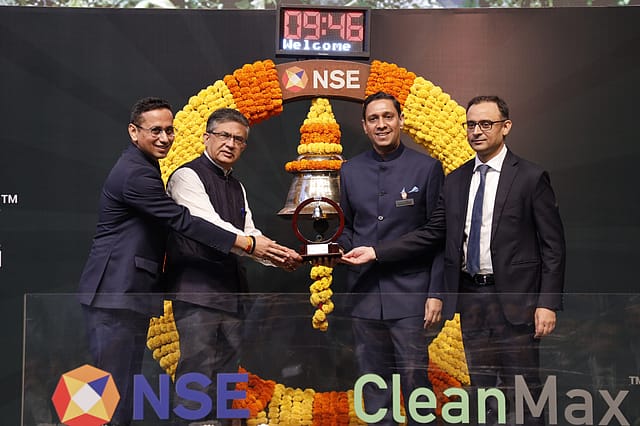
Renewable energy company Clean Max Enviro Energy Solutions made a weak stock market debut on Monday, listing at nearly a 10% discount to its initial public offering (IPO) price. The subdued start marks the fifth discount listing among the seven mainboard IPOs that have hit the domestic bourses so far in 2026, indicating a cooling appetite for new listings amid volatile market conditions.
Clean Max shares debuted at ₹960 apiece on the National Stock Exchange (NSE), an 8.83% discount to the issue price of ₹1,053. On the BSE, the stock listed at ₹952, reflecting a steeper discount of 9.57%.

Selling pressure intensified post listing, with the stock plunging as much as 27.65% to hit an intraday low of ₹761.80. Its market capitalisation slipped to ₹8,965 crore during the session.
The weak debut also coincided with a broader market downturn. Benchmark indices — the BSE Sensex and the Nifty 50 — fell up to 1.5% amid escalating geopolitical tensions in the Middle East and a spike in crude oil prices, further dampening investor sentiment.
“Listing gain investors should remain cautious due to limited upside visibility, while allottees may avoid panic selling if the discount is marginal and fundamentals remain intact. Fresh investors are advised to wait for post-listing price stability and demand support. Overall, the pre-listing outlook appears cautious to weak,” said Shivani Nyati, Head of Wealth at Swastika Investmart.
The Mumbai-headquartered company had raised ₹3,100 crore through its IPO, which itself saw muted demand, subscribing just 0.99 times overall. While qualified institutional buyers (QIBs) subscribed 2.99 times their allotted quota, retail participation remained extremely weak at 0.07 times, and non-institutional investors (NIIs) subscribed 0.57 times. The issue received 37,210 applications.
5 of 7 IPOs trade below issue price
Overall, five of the seven mainboard IPOs listed so far this year is currently trading below their issue price, signalling waning risk appetite and a more valuation-conscious investor base amid volatile market conditions.
Last month, MSME lending platform Aye Finance (₹1,010 crore) and data analytics firm Fractal Analytics Ltd. (₹2,833.90 crore) made weak debuts on the domestic bourses. Earlier in January, logistics firm Shadowfax Technologies Ltd. (₹1,907.27 crore) and global SaaS player Amagi Media (₹1,788.62 crore) Labs also listed at a discount to their issue prices.
Among the few outperformers, Bharat Coking Coal Ltd. (₹1,071.11 crore) has emerged as a standout, still up 39% over its issue price despite cooling from sharp listing-day gains of nearly 77%. Gaudium IVF and Women Health (₹165 crore) has managed to post marginal gains of around 1%.
So far this year, the average listing gain for mainboard IPOs cooled to around 8%, marking a steep decline from 49% average listing gain recorded in 2024 and is also lower than the 10.6% average seen in 2025.
Weakening IPO demand
Recent subscription trends indicate that IPOs are increasingly struggling to attract broad-based investor interest. Barring Bharat Coking Coal Ltd. (BCCL) and Amagi Media Labs, most mainboard issues this year have seen relatively muted response, signalling a clear shift in primary market appetite.
State-owned BCCL’s issue stood out with exceptional demand — subscribed 310.81 times by QIBs, 240.49 times by NIIs and 49.37 times by retail investors, resulting in an overall 143.85 times subscription. Amagi Media Labs also witnessed robust participation across categories, with QIB subscription at 33.13 times, NII at 38.26 times and retail at 9.54 times, taking the total to 30.24 times.
In contrast, Shadowfax Technologies, Fractal Analytics and Gaudium IVF & Women Health just about managed to close their books, largely on the final day of bidding. Meanwhile, Aye Finance and Clean Max Enviro Energy Solutions barely scraped through, with overall subscription hovering around the one-time mark.
Market participants attribute the softening demand to volatility in the secondary market. The equity benchmarks — BSE Sensex and Nifty 50 — have corrected nearly 5% so far in calendar year 2026, weighed down by uncertainty over the India–US trade deal, a sharp sell-off in IT stocks and escalating geopolitical tensions.
“Primary markets take cues from secondary markets. The ongoing volatility is a key reason behind the tepid demand in recent IPOs,” said Pranav Haldea, Managing Director, Prime Database Group.
Investor behaviour, too, appears to be evolving. “Returns are the single most important metric for IPO investors. HNIs are wary of shrinking allotments and gains, while retail investors chasing grey market premiums are turning cautious amid muted listing performance,” said Anil Sharma, Co-founder, IPOCentral.
(DISCLAIMER: The views and opinions expressed by investment experts on fortuneindia.com are either their own or of their organisations, but not necessarily that of fortuneindia.com and its editorial team. Readers are advised to consult certified experts before taking investment decisions.)