
IndiGo shares slide 4% after Q3 results; analysts stay bullish on long-term prospects
ADVERTISEMENT
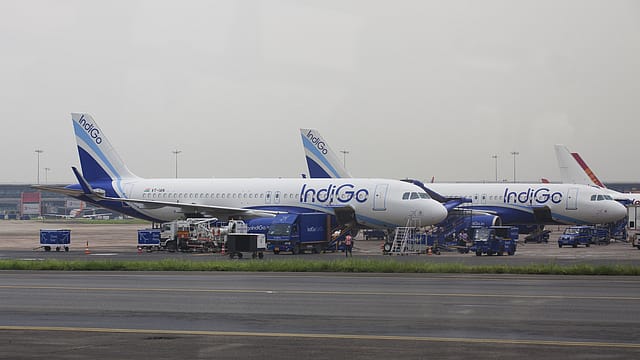
Ending a two-session gaining streak, shares of InterGlobe Aviation, the parent company of IndiGo , declined nearly 4% in early trade on Friday, weighed down by its Q3 earnings report. The low-cost carrier reported a 77.5% year-on-year (YoY) drop in its consolidated net profit to ₹549.8 crore for the quarter ended December 31, 2025, impacted by new labour codes and a massive flight disruption in December 2025.
Reacting to the Q3 numbers, shares of IndiGo dropped as much as 3.87% to ₹4,723.60 on the BSE, driven by strong volumes. The market capitalisation of the aviation heavyweight fell to ₹1.85 lakh crore, with over 1 lakh shares changing hands, compared with a two-week average of 0.61 lakh shares.
IndiGo‘s shares have fallen nearly 6% year-to-date, while the stock has lost over 18% in the past six months. The counter has delivered a positive return of 16% over the past one year. The airline’s stock is down 24% from its 52-week high of ₹6,225.05, touched on August 18, 2025. It had slipped to its 52-week low of ₹4,000 on January 23, 2025.
Dec flight crisis, new labour codes impact earnings
In its earnings report, released after market hours on Thursday, IndiGo, which commands nearly two-thirds of the country’s aviation market, saw its Q3 profit fall sharply to ₹549.8 crore, from ₹2,448.8 crore in the same period last year. However, revenue from operations grew 6.2% YoY to ₹23,471.9 crore.
The drop in profitability was largely attributed to two exceptional charges totalling ₹1,546.5 crore. These included a ₹969.3 crore provision for increased social security benefits under India’s new labour codes and a ₹577.2 crore hit related to operational disruptions in early December 2025, covering regulatory compensation, travel vouchers, and associated penalties.
During the quarter, the airline increased its capacity (ASK) by 11.2% to 45.4 billion, but its passenger load factor dipped by 2.4 percentage points to 84.6%. IndiGo continued its fleet expansion, ending the quarter with 440 aircraft, a net addition of 23 planes from the previous quarter. The fleet now includes the airline’s first A321neo XLR.
Analysts remain constructive on long-term outlook
Despite subdued Q3 earnings, brokerages remain broadly constructive on IndiGo’s medium- to long-term prospects, citing strong demand fundamentals, improving operational efficiency, and the launch of the A321XLR, the world’s longest-range narrow-body aircraft from Airbus, which is expected to enhance international route economics despite near-term volatility.
Motilal Oswal said near-term challenges such as reduced capacity, capped fares, rupee depreciation, and higher damp lease costs may weigh on performance, but IndiGo’s long-term growth strategy remains intact. The brokerage expects the airline’s revenue, EBITDAR, and adjusted PAT to grow at a CAGR of 12%, 13%, and 10%, respectively, over FY25–28, driven by recovery in grounded aircraft and sustained demand. It values the stock at 9x FY28E EBITDAR.
Elara Capital said Q3FY26 was operationally disrupted by a brief event in December, but core profitability was far stronger than what reported numbers suggest. IndiGo’s earnings, which fell 78% YoY, were impacted by exceptional items of around ₹1,500 crore and forex losses of about ₹1,100 crore, rather than demand weakness or margin pressure. Demand remained healthy through most of the quarter, supported by the festive season and peak travel trends.
The brokerage added that softness in passenger load factor and a 2% YoY moderation in yields was event-driven and not indicative like of a slowdown. It has marginally cut FY26–28 EBITDA estimates by about 2%, citing cost and currency assumptions.
Emkay Global highlighted that IndiGo’s revenue and EBITDA beat estimates, supported by better-than-expected yields and lower operating costs. However, exceptional items related to labour code implementation and operational disruption weighed on reported profits. It expects moderate ASK growth of 10% YoY in Q4FY26 and PRASK to decline 1–5% YoY on a high base. While cutting FY26 EBITDA estimates by 5%, the brokerage retained its FY27–28 forecasts, valuing the stock at around 22x Dec-27E EPS.
JM Financial flagged moderation in capacity growth, yields, and higher ex-fuel CASK in the near term, driven by rupee weakness and higher damp lease costs. It cut earnings sharply for FY26 but only marginally for FY27–28, and upgraded the stock to ADD from REDUCE, citing a sharp correction in the share price.
(DISCLAIMER: The views and opinions expressed by investment experts on fortuneindia.com are either their own or of their organisations, but not necessarily that of fortuneindia.com and its editorial team. Readers are advised to consult certified experts before taking investment decisions.)