
NSE IPO: Chauhan thanks Sebi chief, says domestic capital can cushion FPI exits
ADVERTISEMENT
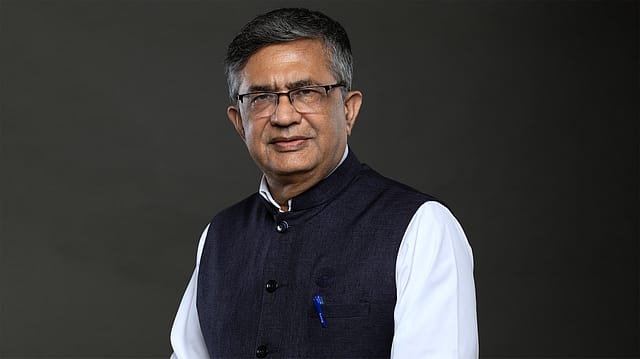
National Stock Exchange (NSE) managing director and CEO Ashishkumar Chauhan on Wednesday publicly thanked Securities and Exchange Board of India (Sebi) chairman Tuhin Kanta Pandey for clearing the way for the exchange’s long-awaited initial public offering (IPO), saying the regulator’s “practical approach” had helped resolve several “long-pending issues”.
“First of all, let me thank Sebi chairman Shri Tuhin Kanta Pandeyji for giving go-ahead to NSE’s IPO,” Chauhan said at the 23rd FICCI Capital Markets Conference in Mumbai.
“And also resolving all long-pending issues. We’ll remain eternally grateful, sir, for your practical approach,” he added.
SEBI had issued a no-objection certificate (NOC) for the NSE IPO on January 30, removing a major regulatory hurdle for the proposed listing after years of delays. The clearance allowed NSE to move ahead with preparations for its public offering.
‘Domestic capital provides depth to the market’
While the NSE IPO was the most direct market signal in Chauhan’s address, the exchange chief used the occasion to speak about a much larger shift underway in India’s capital markets — the growing role of domestic savings.
Chauhan said foreign portfolio investors were net sellers of $19.77 billion in Indian equities in FY26, while domestic institutional investors recorded $95.8 billion of net equity inflows, which he described as their “highest annual inflow on record”.
“Foreign capital flows will naturally respond to valuations, interest rates, currencies, commodity prices and geopolitical developments,” Chauhan said.
“But a large domestic pool of saving gives India greater capacity to absorb these shifts while deep and liquid markets give global investors confidence in entry, execution, hedging and exit.”
“The two forms of capital therefore reinforce one another,” he said. “Domestic capital provides depth to the market. Global capital brings diversification, risk-bearing capacity and international participation. A mature financial system needs both.”
The growing participation of households is already changing the composition of India’s financial savings. Chauhan said equity and mutual funds accounted for 15.2% of annual household financial savings in FY25, compared with 1.8% in FY12.
Total household equity holdings have crossed ₹90 lakh crore, growing at nearly 32% annually between April 2020 and June 2026, while mutual fund assets under management have risen from around ₹15.2 lakh crore a decade ago to more than ₹85 lakh crore.
Corporate bonds remain the next big opportunity
Chauhan also flagged the corporate bond market as an area where India needs to move beyond scale and build greater depth and liquidity.
Outstanding corporate bonds have increased from around ₹17.5 lakh crore in FY15 to ₹59 lakh crore in FY26, while annual issuances have risen from ₹4.9 lakh crore in FY16 to ₹9.1 lakh crore in FY26.
But at around 17% of GDP, Chauhan said the market “remains modest relative to India’s financing needs”.
“The next stage is to translate this growth into greater depth and liquidity,” he said, pointing to electronic execution, RFQ platforms, repo and securities lending as key parts of the market architecture.
He said the next generation of financial infrastructure must “reduce frictions across the entire financial lifecycle while making the system more resilient, intelligent and inclusive”.
Chauhan also pointed to the broader expansion of India’s investor base. More than 13 crore unique investors now participate in the securities market, while NSE has over 26 crore accounts.
“India’s capital markets have built remarkable scale over the last three decades,” Chauhan said. “The next phase is about adding depth to that scale through deeper corporate bonds, greater access to global capital markets and technology that strengthens both efficiency and trust.”
Concluding his address, Chauhan said India now saves more than $1 trillion annually and has the capacity to finance a larger share of its own growth.
“How do we collectively work together to ensure that markets are the vehicle by which India is able to channelise its savings into productive capital, wealth creation and job creation that matters,” he said.