
SBI shares tank 11% in two sessions post Q4; here’s what is dragging PSU bank stock lower
ADVERTISEMENT
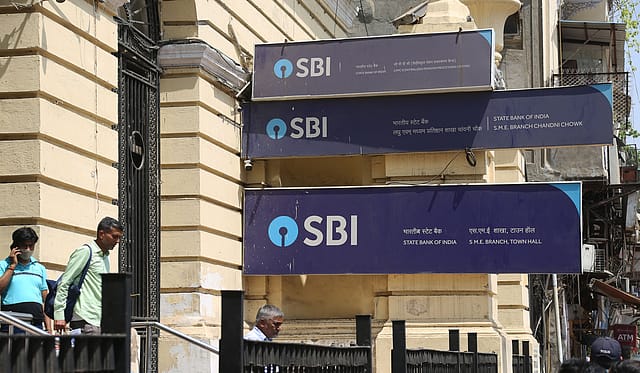
Shares of State Bank of India (SBI) continued its losing streak on Monday, falling nearly 11% in two sessions amid heavy selling pressure after the country’s most valued state-owned lender released its March quarter earnings report. Investors turned cautious over contraction in net interest margins (NIMs), weaker net interest income (NII) growth and softer treasury performance despite healthy loan growth and stable asset quality.
On Monday, SBI shares declined as much as 4.36% to hit an intraday low of ₹975 on the BSE, dragging its market capitalisation to ₹9.05 lakh crore. The PSU bank stock opened slightly lower at ₹1,009.95 against Friday’s closing level of ₹1,019.55.
On Friday, SBI’s share price ended 6.62% lower as investors reacted negatively to its March quarter earnings report.
SBI shares hit a 52-week high of ₹1,234.80 on February 24, 2026, and a 52-week low of ₹755.25 on May 9, 2025. The PSU stock has delivered a positive return of 22% over the past one year, while it gained nearly 3% in the last six months. The banking heavyweight has delivered a flat return in calendar year 2026, while it has lost nearly 8% over the past one month.
Why SBI shares are falling post Q4
For the fourth quarter ended March 31, 2026, SBI reported a 5.6% year-on-year (YoY) rise in standalone net profit to ₹19,683.75 crore, compared with ₹18,642.59 crore in the same period last year. Total income for the quarter came in at ₹1,40,411.77 crore, lower than ₹1,43,876.06 crore in Q4 FY25.
On the asset quality front, SBI reported gross NPAs of 1.49% as of March 31, 2026, improving from 1.82% a year earlier. Net NPAs stood at 0.39%, unchanged from the December quarter and lower than 0.47% a year ago, while the provision coverage ratio (PCR) stood at 74.36%. PCR, including AUCA, came in at 91.97%.
For the full year, SBI posted a standalone net profit of ₹80,032.01 crore, up from ₹70,900.63 crore in FY25. However, the annual number was boosted by an exceptional gain of ₹4,593.22 crore arising from the divestment of a 13.18% stake in Yes Bank in September 2025.
According to domestic brokerages, SBI’s operating performance remained below expectations during the quarter, largely due to the impact of repo rate transmission, MCLR cuts, a rising share of lower-yielding corporate loans and increased exposure to EBLR-linked loans. The bank’s reported NIM declined sharply by around 18 basis points sequentially in Q4, while domestic NIM exited the quarter at around 2.9%, below the psychologically important 3% mark.
According to Axis Securities, the pressure on margins stemmed from the impact of December 2025 rate cuts, a 5 bps MCLR reduction, and the migration of corporate loans from MCLR-linked pricing to T-bill-linked pricing. Although the brokerage retained its ‘Buy’ rating with a target price of ₹1,285, it made minor cuts to NII estimates for FY27 and FY28 due to limited support from improvement in the cost of funds.
Similarly, Motilal Oswal Financial Services said SBI reported a mixed quarter, impacted by NIM compression and weaker treasury profits amid rising bond yields. The brokerage trimmed its FY27 and FY28 earnings estimates by 3–5% owing to lower margin assumptions, although it maintained a ‘Buy’ rating with a target price of ₹1,300.
JM Financial also termed the operating performance “sub-par”, highlighting that pre-provision operating profit (PPOP) declined due to muted NII, treasury losses and higher operating expenses. The brokerage noted that while loan growth remained strong at 17% year-on-year and asset quality stayed resilient, investors are likely focusing more on the outlook for margins and earnings growth in FY27. It retained a ‘Buy’ call with a revised target price of ₹1,200.
Despite the near-term concerns, analysts largely remain constructive on SBI’s medium-term outlook due to its strong credit growth trajectory, stable asset quality and manageable exposure to geopolitical risks linked to the West Asia conflict. The management also reiterated its guidance for credit growth of 13–15%, domestic NIM above 3% across cycles, and credit costs below 50 bps for FY27.
(DISCLAIMER: The views and opinions expressed by investment experts on fortuneindia.com are either their own or of their organisations, but not necessarily that of fortuneindia.com and its editorial team. Readers are advised to consult certified experts before taking investment decisions.)