
Three decades of Nifty50: 11 original members stand tall in the 24,000-point journey
ADVERTISEMENT
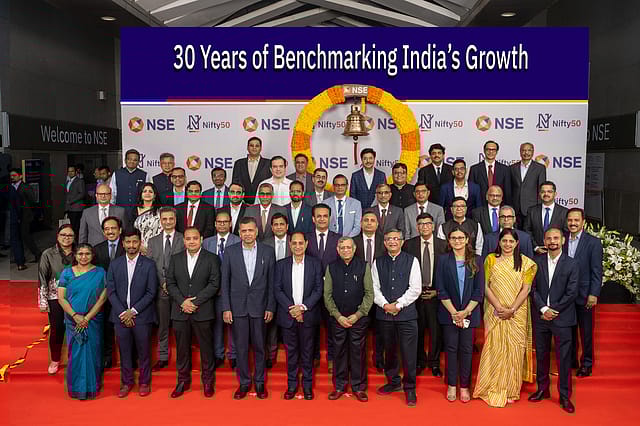
The Nifty50 has completed three decades as India’s benchmark equity index, evolving into one of the most widely tracked gauges of the country’s economic and corporate performance. The milestone comes at a time when global stock markets, including Indian equities, are facing heightened volatility as crude oil prices have surged past $115 per barrel amid escalating geopolitical tensions in West Asia, triggered by intensifying military conflict involving the United States, Israel, and Iran.
Launched on April 22, 1996 with a base date of November 3, 1995 and a base value of 1,000, the index was designed to track the performance of 50 large and liquid companies listed on the National Stock Exchange of India (NSE). Over time, it has become a key gauge of investor sentiment and a barometer of the broader Indian economy.
The NSE itself was established in 1992 to modernise India’s capital markets and provide an efficient, transparent electronic trading platform. As the country’s largest stock exchange, its flagship index - the Nifty 50 - is widely viewed as a reflection of the performance of India’s leading businesses.
The index is managed by NSE Indices Limited, earlier known as India Index Services & Products Limited, a wholly owned subsidiary of NSE Strategic Investment Corporation Limited. Constituents of the index are selected based on criteria such as market capitalisation, liquidity and trading activity.
Long-term wealth creation
Over the past 30 years, the index has delivered strong long-term returns. From November 1995 to February 2026, the Nifty50 total return index (TRI), which includes dividends, generated a compound annual growth rate (CAGR) of 12.74%, while the price return index (PRI) delivered 11.23% annually.
The growth trajectory highlights the scale of wealth creation in India’s equity markets. An investment of ₹1 lakh at the index’s inception would be worth roughly ₹37 lakh today. During the same period, the combined market capitalisation of companies in the index expanded from about ₹1.26 lakh crore in 1995 to nearly ₹200 lakh crore by 2025, representing over 54% of the free-float market cap on the NSE.
Since its launch, the Nifty50 has evolved significantly, yet 11 companies have remained part of the index throughout its 30-year journey. These include Reliance Industries, Grasim Industries, HDFC Bank, ICICI Bank, State Bank of India, Larsen & Toubro, Tata Steel, Tata Motors, Hindalco Industries, Hindustan Unilever, and ITC.
The Nifty 50 represents companies across 13 sectors of the economy, offering diversified exposure to India’s corporate landscape. Financial services currently dominate the index with a weight of about 37.68%, followed by oil, gas & consumable fuels (10%), information technology (8.84%), and automobile companies (6.96%).
Milestones in the index journey
The rise of the Nifty50 from 1,000 points to over 24,000 has been marked by several milestones and phases of consolidation.
The index took 333 trading sessions to move from its base level to the first 1,000-point milestone. The journey from 1,000 to 2,000 points was slower, requiring nearly 2,819 trading sessions as the Indian equity market matured. Later phases saw faster growth, although some ranges took longer as markets consolidated.
For instance, the move from 6,000 to 7,000 points took about 1,608 trading sessions, reflecting a period of slower growth. Another key milestone came on July 25, 2017, when the index crossed the 10,000 mark-more than two decades after its inception.
The pace accelerated in the following years. The Nifty crossed the 20,000 mark on September 11, 2023 and moved to 21,000 in just 60 trading sessions. The benchmark continued its upward trajectory and touched a record high of 26,178.75 on September 27, 2024.
Volatility and market shocks
Like most global indices, the Nifty50’s journey has included periods of sharp volatility driven by economic and geopolitical events.
One of the most significant downturns occurred during the Covid-19 pandemic, when markets saw steep declines in March 2020 amid fears of a global economic shutdown. On several trading days during that period, the index recorded sharp single-day losses ranging between about 5% and nearly 13%.
Markets later rebounded strongly as economic activity resumed and liquidity improved. Between 2020 and 2021, the Nifty recorded several sharp gains as investor confidence returned.
Geopolitical tensions have also influenced movements in the Nifty50 over the years. In early 2022, the index witnessed heightened volatility following the Russia-Ukraine War, as global inflation fears and uncertainty over energy supplies rattled markets. At times, however, positive geopolitical developments and policy announcements have also triggered sharp market rallies.
More recently, amid escalating tensions in West Asia, the Nifty50 has come under pressure, tumbling 1,150.60 points, or about 4.57%, over the five sessions since February 27 to close at 24,028.05 on March 9.
The decline forms part of a broader technical correction, with the index now down more than 10% from its record highs in January, as geopolitical uncertainty in the Middle East and surging crude oil prices weigh on investor sentiment. The recent sell-off has been driven largely by a spike in oil prices, with Brent crude oil briefly touching $120 per barrel, its highest level in nearly four years.
A foundation for India’s investment ecosystem
Beyond tracking market performance, the Nifty50 has become the backbone of India’s passive investment ecosystem. It underpins a wide range of financial products, including index funds, exchange-traded funds (ETFs) and derivatives, making it one of the most actively traded index derivatives globally.
Ashishkumar Chauhan, MD and CEO of the NSE, said, “Over the past 30 years, the Nifty 50 has evolved far beyond being a market benchmark. It reflects the dynamism of India’s corporate sector and the growth of the country’s capital markets.”
He added that the index has played a transformative role in the development of India’s derivatives market and now underpins a wide range of products such as index funds and exchange-traded funds (ETFs).
He said the exchange remains committed to strengthening the index ecosystem and providing transparent and innovative benchmarks that allow investors to participate in India’s growth journey.
Srinivas Injeti, Chairman of the NSE, said the Nifty50 has evolved from a market benchmark into a symbol of India’s economic momentum.
“What began in the mid-1990s as a scientific index to anchor credibility in a newly liberalising economy has today become a trusted barometer of enterprise, resilience and investor confidence,” he said. The transparent benchmarks such as the Nifty 50 will continue to channel household savings into enterprises as India moves toward becoming a Viksit Bharat, he added.