
Grade A mall supply fails to keep pace with leasing demand in H1 2026; vacancy falls to 16-year low: ANAROCK
ADVERTISEMENT
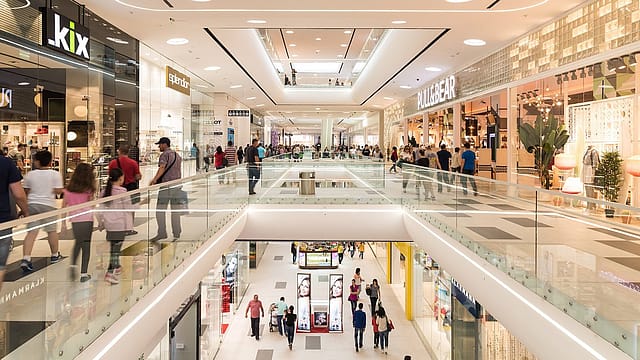
India's organised retail real estate market continues to grapple with a shortage of Grade A mall space, with leasing demand significantly outpacing new supply during the first half of 2026, according to ANAROCK Research.
The top seven cities recorded gross leasing of around 4.1 million sq. ft. of Grade A mall space in H1 2026, while new completions stood at just 0.9 million sq. ft., meaning retailers leased nearly 4.5 times the fresh supply added during the period.
ANAROCK said the widening gap reflects a structural supply constraint that has persisted for years, with demand consistently exceeding the pace of new mall development. "The supply problem is cumulative and escalating. Over the past 16 years, India's top seven cities have witnessed a persistent mismatch between Grade A retail supply and leasing demand," said Anuj Kejriwal, CEO – Retail and CEO – Europe, Middle East & Africa, ANAROCK Group.
"While new mall completions have fluctuated sharply, leasing demand has steadily absorbed available Grade A space, pushing vacancy rates lower. Retailers' biggest challenge today is not attracting shoppers but finding quality spaces to operate from," he added.
Demand continues to outstrip supply
The imbalance has widened over the past few years. In 2023, the top seven cities added 5.3 million sq. ft. of Grade A mall space against 6.5 million sq. ft. of gross leasing. New supply dropped sharply to 1.1 million sq. ft. in 2024, while leasing remained steady at 6.5 million sq. ft.
Although new completions recovered to 5.2 million sq. ft. in 2025, leasing surged to a record 13 million sq. ft., further tightening the market.
In H1 2026, both leasing and new supply moderated from the exceptionally strong levels seen last year. Leasing declined 24% year-on-year, while new completions fell 57%, partly due to geopolitical uncertainties that delayed mall deliveries and prompted some retailers to defer expansion plans. Despite the slowdown, demand continued to substantially exceed supply.
Delhi-NCR leads new supply
Among the top seven cities, Delhi-NCR was the only market to witness new Grade A mall completions during H1 2026, adding 0.9 million sq. ft. of fresh supply while recording 1.26 million sq. ft. of leasing.
Other major markets, including Mumbai, Bengaluru, Hyderabad, Pune, Chennai, and Kolkata, recorded leasing activity but saw virtually no new Grade A mall completions, forcing retailers to compete for existing premium retail space.
Why Grade A malls remain scarce
According to ANAROCK, the shortage is not merely a result of insufficient development activity. Building a Grade A mall requires large, contiguous land parcels in prime catchment areas, significant upfront capital, long approval timelines, anchor tenant commitments and detailed consumer demand analysis. "The availability of suitable land is itself a constraint in established urban markets, while rising land costs, financing conditions and construction schedules continue to delay project delivery," Kejriwal said.
He noted that the sharp fall in new supply in both 2024 and H1 2026 highlights how difficult it is to rapidly expand the Grade A retail pipeline even when retailer demand remains strong.
Vacancy falls to lowest level since 2010
The sustained demand has pushed vacancy levels in Grade A malls to their lowest level in 16 years.
According to ANAROCK, vacancy fell to 6.7% in H1 2026, the lowest since 2010. Before the pandemic, vacancy had peaked at 21.5% in 2011, while the highest post-pandemic level was 15.5% in 2021.
In contrast, Grade B and Grade C malls continue to report significantly higher vacancy levels, ranging from 8% to 35%, indicating that the shortage is concentrated in professionally managed, institutionally owned premium retail assets rather than overall retail space.
Opportunity for developers
ANAROCK said the combination of low vacancy, robust retailer demand and rising experience-led consumption presents a significant opportunity for developers and institutional investors to build high-quality malls in India's major consumption centres.
However, unless the pace of Grade A mall development accelerates, retailers are likely to face longer wait times for prime locations, rising occupancy costs and intensifying competition for established malls, the report said.