
“You can’t tell people no dinner today,” Eastern Staple founder on running a food business amid LPG disruption
ADVERTISEMENT
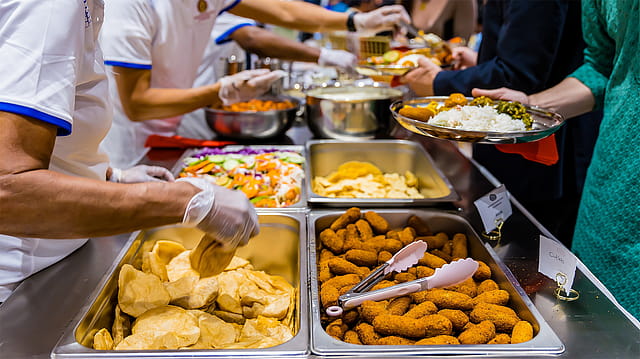
When commercial LPG supply disruptions hit different parts of India, most food businesses chose to scale down operations.
For Susmita Chakravarty, that wasn’t viable.
Kolkata-based Eastern Staple serves 2,000–2,500 meals daily to hostel students, medical staff and corporate employees—many of whom depend on it as their primary source of homely food. “You cannot tell a child, ‘No dinner today because gas didn’t come,’” she tells Fortune India.
Cutting gas, not output
Eastern Staple operates two base kitchens spanning about 6,500 sq. ft., supplying 11 cafeterias and hostel contracts.
Before the disruption, the kitchens consumed 10–12 LPG cylinders a day. That has now been reduced to 7–8 cylinders through operational changes rather than demand cuts.
“We didn’t change the menu fundamentally—we changed how we cook,” Chakravarty says.
Tawa-heavy items such as rotis, parathas and rolls have been temporarily removed. The kitchens have shifted toward pressure-cooked, one-pot formats, with pre-cooked vegetables and standardised base gravies to reduce fuel intensity. Even biryani has been adapted into a faster format instead of traditional dum cooking.
Costs surge, margins hold
Finances have taken a hit too.
“Expenses have gone up almost three times,” she says.
Despite that, the business continues to operate with positive unit economics. Eastern Staple expects to close FY26 with revenue of around ₹1.8 crore and margins of 12–15%, up sharply from about ₹20 lakh in the previous year.
A controlled B2B model
Eastern Staple’s operating model has also shaped how it has navigated the disruption.
The company has largely stayed away from food delivery aggregators, choosing instead to operate full-service cafeterias within institutions. Today, it runs 11 such facilities, supported by 52 full-time employees across kitchens and operations.
Production is centralised across two base kitchens, with individual cafeterias handling final service through smaller on-site teams. This structure allows for tighter control over both costs and consistency—an advantage in a constrained input environment.
Bulk B2C orders continue, but remain secondary to its institutional focus.
No infrastructure fallback
One of the key constraints remains the absence of commercial PNG infrastructure in Kolkata.
Without access to piped gas, commercial kitchens remain dependent on LPG, leaving limited alternatives during supply disruptions. For operators like Eastern Staple, this effectively turns a supply issue into an operational problem that must be solved internally.
Built out of necessity
Chakravarty did not start out as a food entrepreneur.
A school teacher by profession, she began cooking during the pandemic after offline classes shut down. What started as a small WhatsApp menu in July 2020 quickly gained traction—growing from a handful of orders to a steady base over the following months.
For nearly a year, the business ran out of her home kitchen before transitioning into a commercial setup in 2023. Institutional contracts followed, first through a school canteen and later through corporate cafeterias.
Even as costs rise and supply remains uncertain, the company is moving ahead with expansion.
Eastern Staple plans to enter Odisha first, followed by Hyderabad, with groundwork expected to begin around Durga Puja this year.