
Tariff shock, global disruptions fail to dent Vahdam India’s growth trajectory, says Bala Sarda
ADVERTISEMENT
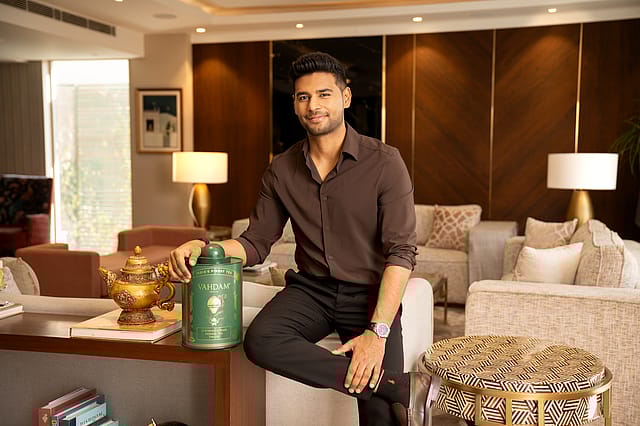
Amid a sharp spike in US tariffs last year and rising global cost pressures linked to the ongoing West Asia conflict, Vahdam India managed to stay profitable while scaling its business to ₹350 crore in FY26, up 31% year on year (YoY). Founder Bala Sarda told Fortune India that the company absorbed a temporary tariff hit of up to 50% and did not pass on higher logistics and input costs to consumers, betting instead on long term market share and brand building as it pushes towards ₹500 crore plus revenue in FY27. Excerpts:
How severe was the impact of US tariffs on your margins?
It was a direct impact on our P&L. We are a vertically integrated brand. We source herbs directly from farmers across 25 states in India. We have our own 125,000 square feet facility in Noida where everything under the brand is packed by us. We do not rely on third party players except in a few cases. Our own entities import the products into the US, Canada, Europe and the UK. There is no middleman.
At the peak, tariffs hit 50%. Earlier, for almost 10 years, tariffs were zero. Then they became 10% in April (2025), moved to 25%, and unexpectedly went up to 50%. For about two to three months, we were paying 50%.
We absorbed that entirely. We did not increase prices because we were building relationships in retail. We had just gone live with partners like Walmart and were expanding across markets. Increasing prices at that stage would have been difficult.
There was a big outflow, we took a direct hit of a few million dollars on our P&L. But now, because these are agri products, tariffs have been brought back to zero. Since November 15, they have been zero again. That helped us stabilise, and because we held prices, we were also able to increase market share in some markets.
Do you expect any further impact from trade deals?
Not really. Even without a formal trade deal, the US has already moved agri products that are not produced domestically to zero tariffs. All our products fall into that category. Even when the India US trade discussions were happening, spices, herbs and teas were among the first categories mentioned for zero duty. So for us, it is already resolved.
What impact is the West Asia conflict having on your business?
There has been an impact across the board. Sea freight now has a surcharge. Air freight costs have increased significantly. Packaging costs have gone up. Over time, this will also lead to higher agri input costs because fertilisers and other inputs become more expensive.
So there is definitely an increase in input costs end to end. But compared to what we saw with tariffs, this feels manageable. As a brand, we have dealt with these kinds of challenges before, so the impact should be minimal.
Will you pass on these costs to consumers?
No, we will absorb them for now. We believe these are temporary, even if they sustain for a while. So we are not planning to increase prices or reduce discounts at this stage.
You’ve reported strong numbers this year. What’s working for you and where is the business headed?
We closed approximately ₹350 crore in revenue with about ₹8 crore in PAT, even though we had US tariffs, which were a significant outflow. But despite that, we were profitable. That was a one off event, and now tariffs have gone down to zero. So on a tariff adjusted basis, the business is fairly profitable as well.
We are on track to do around ₹525 crore this year, broadly in the ₹500 crore to ₹550 crore range. The growth is coming from three core triggers. One is going deeper with our distribution in existing markets. The products, brand and overall proposition have been in place for a while and are now starting to compound.
To give you an example, out of the ₹350 crore revenue last year, about 19%, roughly ₹70 crore, came from offline in the US. We sell in Walmart, Costco, and we are launching in Target nationally next month, along with thousands of other stores. The brand has done extremely well there, and online continues to grow through our usual channels.
So one is going deeper in our current markets, which are primarily North America and the UK and Europe. Second is innovation. We are a brand that takes Indian herbs and botanicals and offers them in different formats. Earlier it was largely teas, and most of our teas do not actually have tea in them. They are concoctions of herbs like turmeric, ginger, ashwagandha, tulsi, giloy and neem.
Now we have expanded into supplements, the same herbs in formats like capsules, effervescents and gummies. Effervescent gummies will be launched later this year. We are going back to aggressive innovation here.
Third is India. We have finally curated the right set of products for the Indian market across herbal infusions and supplements. We launched this as a separate business unit a couple of months back, and it has started to scale extremely well because the brand was already known. Now that we have the right product, we are trying to scale that up. These three triggers define how we see the next few years and our journey to ₹500 crore next year and ₹1,000 crore beyond that.
What exactly are you offering in India and what kind of traction are you seeing?
Broadly, we operate in herbal infusions, green teas and herbal supplements. If you look at it from a consumer lens, these are preventive wellness problems like sleep, antioxidants, gut health. We use Indian herbal botanicals and offer them in different formats.
If someone wants a lighter dosage, they can have something like a turmeric ginger infusion in a tea bag. If someone needs a stronger dosage, like an athlete dealing with inflammation, they can take turmeric curcumin in capsule form with a higher concentration.
That is how we look at the consumer. If you go to our website, you will see these three broad categories. Year on year, we have doubled the India business, though the base is smaller. Based on the last two to three months, we are on track to reach a ₹100 crore run rate this financial year. That is roughly one and a half times what we were doing last year.
Can you break down your revenue geographically?
Around 55% of our revenue comes from North America, the US and Canada. Another 30% comes from the UK and Europe. So about 85% of our business comes from these core markets.
We ship to over 150 countries, but those contribute about 5%. India is currently at 5 to 7%, but we expect it to scale up to 15 to 20% by the end of this financial year.
Are you seeing margin trade offs as you scale the supplements business?
No, actually the opposite. Every new format we are entering is margin accretive. Supplements are high trust categories with high repeat rates. Margins are higher, repeat purchases are higher, and the total addressable market is larger than tea.
Tea is a much larger category, but supplements offer better economics. These are also harder categories to crack because trust is critical. That allows for some premium pricing. So overall, this segment is already improving our margins.
What are your plans for India expansion, especially offline?
We are very clear that we do not want to enter offline retail in India right now. With D2C, marketplaces, Amazon and quick commerce, we can access what used to be general trade and reach a ₹150 crore run rate.
We want to follow the same playbook as our global business. Go online first, identify winning products, and once we reach scale, then expand offline. That is at least 18 months away.
We do have one experience store in Khan Market. That was more of a brand experiment. A lot of foreigners visit that area, and it is close to our headquarters. It helps us interact with consumers, test products and build experiences. But we are not looking to expand physical retail right now.
Any plans to raise capital or go public?
No plans at the moment. We are profitable, cash flow positive and have a strong balance sheet. We do not intend to raise more capital right now.
The focus is on growing sustainably over the next three years with our current strategy across India, North America and Europe, and across teas, infusions and supplements. Once we get closer to our next milestone, we will evaluate options, but for now, the plan is clear.