
India pursuing five-layer AI strategy to build inclusive global hub: Ashwini Vaishnaw
ADVERTISEMENT
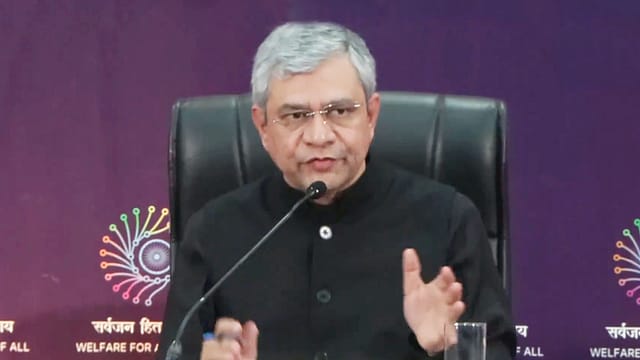
India is rolling out a comprehensive five-layer artificial intelligence strategy aimed at democratising access to technology and positioning the country as a trusted global AI hub, Union IT Minister Ashwini Vaishnaw said on Thursday at the AI-India Impact Summit, which was attended by delegates from 118 countries.
Calling it the “first AI summit in the Global South and the biggest AI summit so far,” Vaishnaw said the government’s approach reflects Prime Minister Narendra Modi’s vision of ensuring that the benefits of technology reach the masses through large-scale deployment and accessibility.
“AI is a foundational technology transforming how we work, learn and make decisions,” Vaishnaw said, adding that India is building capabilities across all layers of the AI stack to deliver real-world solutions in healthcare, agriculture, education, logistics, finance and other sectors.
Five-layer AI framework
The minister outlined that India’s strategy begins with the application layer, where the government expects the largest return on investment and direct societal benefits through practical AI solutions.
The model layer focuses on technological sovereignty, with emphasis on smaller, specialised models that can address more than 90% of use cases at lower cost. Several sovereign multimodal and multilingual models were launched during the summit, reflecting India’s linguistic and cultural diversity, he said.
At the compute layer, Vaishnaw said the government treats computing power as a public good. Under a public-private partnership, a common compute platform already provides startups, researchers, academia and students access to 38,000 GPUs at affordable rates, with another 20,000 GPUs set to be added.
The infrastructure layer includes policy measures announced in the Union Budget to attract global data to be stored and processed in India, which the minister said is expected to drive significant investments in data centres in the coming months.
The fifth energy layer underlines India’s clean power push, with Vaishnaw noting that more than 50% of the country’s installed power generation capacity now comes from renewable and clean sources, supported by grid upgrades and nuclear sector reforms to ensure reliable base-load energy.
PM Modi calls for safeguards and inclusion
In his address, Prime Minister Modi stressed that AI must empower people rather than reduce them to “mere data points,” calling for democratisation of the technology, particularly across the Global South.
He warned that deepfakes and fabricated content can disrupt society, emphasising the need for global standards, watermarking, and authenticity labels to help distinguish original content from AI-generated material.
PM also outlined India’s MANAV vision for AI development — centred on moral and ethical use, accountable governance, national sovereignty, accessibility and legitimacy — and said AI should act as a “multiplier, not a monopoly.”
“The direction in which we take AI today will determine our future,” PM Modi said, urging stakeholders to ensure human control remains central even as AI capabilities expand.