
Neysa considering a possible IPO in the next 24-36 months, says CEO Sharad Sanghi
ADVERTISEMENT
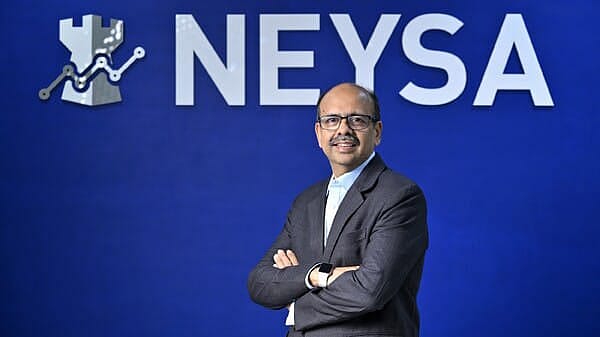
Having recently raised $1.2 billion from private equity giant Blackstone and other equity investors such as Teachers’ Venture Growth, TVS Capital, 360 ONE Assets, and Nexus Ventures, 3-year-old AI cloud and infrastructure startup Neysa is looking at turbo charged growth trajectory. In a conversation with Fortune India, Neysa’s Co-Founder and Chief Executive Officer, Sharad Sanghi spoke about competing with hyperscalers , compute hardware market challenges and the company’s IPO plans. Edited experts from the interview
Fortune India: As a huge part of the AI investment that we are seeing today is being done infrastructure side, how do you see the cost of compute playout in the coming days?
Sharad Sanghi : I'll tell you, the compute cost, as new and newer GPUs came out we thought would , for example, the Hopper series from NVIDIA, H100, H200, we thought once the Blackwells come out, those prices will come down, but actually what's happened is, memory prices have shot through the roof. There's a huge memory crunch today. Both flash memory and high bandwidth memory, there's a huge, huge crunch. So, as a result, GPU prices have gone up. In the last four months, they've gone up by 40%, and that's more a demand supply issue. What happens in the future is difficult to predict, but what our thought was, that once the next generation of GPU, (the older ones become cheaper) but because, the demand is so much more than supply, even the older GPUs are pretty expensive, and the costs have actually gone up and not come down.
Given that we are seeing several hyperscalers committing capital towards data center capacity building and expansion in India, as a new entrant how do you see the competition landscape for Neysa ?
Sharad Sanghi: So, in terms of competition, It's mainly the hyperscalers. But the reason we can compete with them is one, we are AI focused. Two, they are a cookie cutter model, we are more flexible. For example, one of India's largest private banks wanted a private cloud setup that is securely connected to the network. Now, this is something the hyperscalers couldn't offer. For them, you had to use wherever they're located, using whatever they could offer, they could not air gap the setup for them and give it.
We do offer white glove services to our customers. So, for example, if there's a startup or an enterprise that needs help in fine tuning their models or doing quantisation or, adjusting context windows, seeing the performance, adjusting the performance to improve the performance, etc. That is something that we offer free of cost to our customers, which most of the hyperscalers don't. So, there is the flexibility, the white glove service and the price, because we are AI focused on pricing, and we've optimised, built it for the Indian environment and we are able to compete with these.
How exactly is Neysa looking at the Sovereign AI opportunity in India?
Now, what we are trying to go after is two kinds of demand. One is India as a builder and a large consumer of AI services in India. It's also a large builder of AI services and not only for India, but also for export. Now, when it comes to India being a consumer, we're the second largest AI consumer in the world and there - we are targeting not only Indian companies who are offering these services, but also global companies who are trying to offer these services. When it comes to India as a builder you see a lot of training and fine tuning that's happening and then a lot of Indian companies that are using our infrastructure for the same. So we're seeing both happening there.
So, we're targeting all of that. Now because of that, a lot of demand has come to India. So, we are effectively targeting built in India for India, built abroad for India and built abroad for abroad. So,we're going after all of that. But from a sovereignty perspective, there are issues on regulations, for example, the banking and finance sector, the government sector and especially the current geopolitical scenario, the government doesn't want to be dependent, they want to feel we need to have our own stack. And I think other than the chip layer, where have just started on semiconductor mission, and that will take some time, that is the only layer in my opinion that we are not self-sufficient .
Given the changing geo-political equations , and huge global demand for GPUs, do you see any impact on your growth plans ?
Great question. So far, the geopolitical tensions, other than the fact that you cannot give GPUs to certain countries, has not impacted us so far. When we started, the GPU wait time was six months; it came down to two-three weeks, now it's again gone up to three, four months. It's not so much because geopolitical, it's just because the hyperscalers and frontier labs are consuming all the GPUs that exist and there are few fabs of TSMC that, are completely chock-a-block and so therefore, there is an allocation that NVIDIA, AMD or Google does on a per country basis and depending on who the customer is. But right now, we are seeing, for whatever we are ordering; about three months lead time. So we have two kinds of customers, one is the bulk bare metal consumers where we need to do thousands of GPUs and the second is our public cloud offering where we need a few hundreds of GPUs, a few thousand but not like tens of thousand and so for the public cloud is very simple,. We have looked at the utilisation, we know the lead time, and so we plan and schedule accordingly. For the bare metal compute, we do it against orders and we won't speculatively buy it.
Given that your current investment also has a debt component, could you give some colour on the debt discharge terms and globally with AI infrastructure companies commanding eye popping valuations , what are your thoughts on looking at an IPO?
Currently, $ 600 million is committed in equity and $600 million in debt , (debt payment) It will be over a period of time, more like a term loan. If we need more, then we'll have to raise more, but right now, we have these long-term contracts with our clients, which are anywhere from three to five years. Typically, we'll take a five-year tenure on debt. We share the contract with the debt company to give them comfort that we can pay them. I think we would it's natural that we will look at an IPO soon, but we want to first execute. I think IPO is a certain possibility in the next two to three years.