
Tim Cook’s 15-year Apple tenure ends: How Jobs’ successor built a $4-trillion giant—and made Buffett billions
ADVERTISEMENT
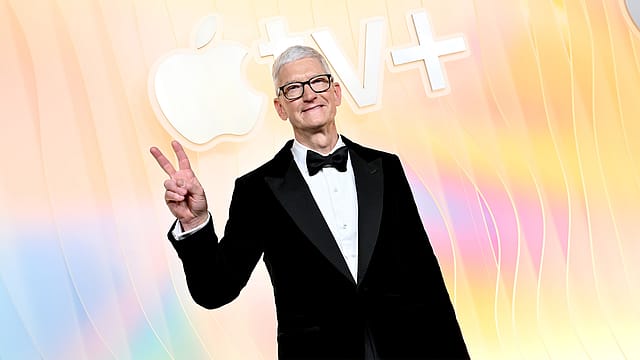
Tim Cook’s 15-year tenure as Apple CEO comes to an end today, closing one of the most consequential leadership chapters in the technology industry.
Cook became Apple CEO in August 2011, succeeding co-founder Steve Jobs. From September 1, John Ternus, Apple’s senior vice president of Hardware Engineering, takes over as CEO, which the company had first announced in April 2026.
Cook joined Apple in 1998 and became CEO in 2011. During his tenure, Apple introduced new product categories including the Apple Watch, AirPods and Apple Vision Pro, while expanding its services portfolio across products such as iCloud, Apple Pay, Apple TV and Apple Music. He also oversaw the expansion of Apple’s existing product lines.
Apple said its market capitalisation had grown from approximately $350 billion when Cook became CEO to $4 trillion, representing an increase of more than 1,000%. Annual revenue had nearly quadrupled, from $108 billion in fiscal 2011 to more than $416 billion in fiscal 2025.
The company also substantially expanded its global footprint during Cook’s tenure. Apple now operates in more than 200 countries and territories and has more than 500 retail stores worldwide. The company said the number of countries where customers can visit an Apple Store has more than doubled since Cook became CEO. Its workforce has grown by more than 100,000 employees, while its active installed base has risen to more than 2.5 billion devices.
Services became a $100 billion business
One of Cook’s biggest strategic shifts was the expansion of Apple’s services business.
Apple said in its April announcement that Services had grown during Cook’s tenure into a business generating more than $100 billion annually--$109.2 billion to be exact.
The category now spans a broad ecosystem, including Apple Music, Apple TV, iCloud, Apple Pay, Apple Arcade and Apple Fitness+, giving Apple a recurring revenue stream alongside its hardware businesses.
Cook also played a key role in building Apple’s wearables business. Apple said the category, which includes the Apple Watch and AirPods, had become a major part of the company and had helped underpin its work in areas such as health and safety.
From Intel to Apple Silicon
Another defining change under Cook was Apple’s decision to take greater control over the technology inside its products. In 2020, Apple announced its transition away from Intel processors in the Mac to Apple-designed silicon. The first M1-powered Macs were launched later that year. The move allowed it to own more of its primary technology and deliver gains in power efficiency and performance across its products.
That emphasis on controlling more of Apple’s technology was consistent with the operational approach Cook had brought to the company since long before he became CEO.
When he joined the company in 1998, he was made the senior vice president of Operations and was responsible for reshaping Apple’s manufacturing and supply chain. He later became executive vice president of Worldwide Sales and Operations.
In 2009, when Steve Jobs' health was declining and his leave from work increased, in an email to the employees, he entrusted Cook to handle the company operations.
"In order to take myself out of the limelight and focus on my health, and to allow everyone at Apple to focus on delivering extraordinary products, I have decided to take a medical leave of absence until the end of June.
I have asked Tim Cook to be responsible for Apple’s day to day operations, and I know he and the rest of the executive management team will do a great job. As CEO, I plan to remain involved in major strategic decisions while I am out. Our board of directors fully supports this plan," the email read.
Steve Jobs’ medical leaves, Cook took responsibility for Apple’s day-to-day operations, giving him direct experience running the company before Jobs eventually resigned as CEO in August 2011. Jobs recommended Cook as his successor.
Buffett’s Apple bet became one of Berkshire’s biggest wins
Berkshire Hathaway’s investment in Apple is another way to measure the scale of value created during Cook’s tenure.
Warren Buffett’s conglomerate began buying Apple shares in 2016, five years after Cook became CEO. Berkshire initially built its position gradually and continued buying through 2018. By the middle of that year, it had accumulated more than 1 billion Apple shares on a split-adjusted basis, representing about 5.2% of Apple, at a total cost of roughly $36 billion.
The investment went on to become one of Berkshire’s most valuable holdings. Berkshire subsequently sold a large portion of its Apple stake, but the shares it retained continued to generate substantial gains.
At the end of 2025, Berkshire’s remaining Apple holding had a reported cost basis of $6.255 billion and a market value of $61.962 billion, implying an unrealised gain of about $55.7 billion on the remaining stake. Berkshire also received $280 million in Apple dividends during 2025.
But those figures do not represent Berkshire’s total profit from Apple. They cover only the shares Berkshire still held at the end of 2025. Buffett said in a March 2026 CNBC interview that Berkshire had made more than $100 billion in pre-tax profits from its Apple investment, including gains from shares it had already sold. He also acknowledged that Berkshire had sold some of its Apple shares too early.
“I sold it too soon, but I bought it even sooner,” Buffett said.
The timing of Berkshire’s investment is significant. Buffett began buying Apple after Cook had already spent five years at the helm, meaning the investment was effectively a bet on the company Cook was building rather than simply on the Apple that Jobs had left behind.
And Buffett has been explicit about the distinction.
“Tim Cook has done better with the hand. Steve Jobs — he couldn’t have done what Steve Jobs did — but Steve Jobs handed him a hand that Steve would not have done as well,” Buffett said in the same CNBC interview.
“Tim was a fantastic manager, and he’s a good guy, and somehow he gets along with everybody in the world,” he added.
A $4 trillion company, and a different set of challenges
Cook leaves Apple significantly larger than the company he inherited.
Its revenue has risen from $108.2 billion in fiscal 2011 to $416.2 billion in fiscal 2025, while its Services business has crossed $100 billion in annual revenue. Its installed base has surpassed 2.5 billion devices and its market capitalisation has grown by trillions of dollars.
But the next phase will bring a different set of challenges. Apple remains heavily dependent on the iPhone, while its manufacturing network remains closely tied to China despite a growing production presence in India and Vietnam. Artificial intelligence is another major test, with Apple under pressure to demonstrate that it can translate its enormous installed base and hardware-software integration into an advantage in the AI era.
That challenge will now fall to Ternus. Cook, meanwhile, moves into the executive chairman role after 15 years as CEO.