
What is Benjamin Netanyahu’s ‘hexagon of alliances’? What does it mean for India
ADVERTISEMENT
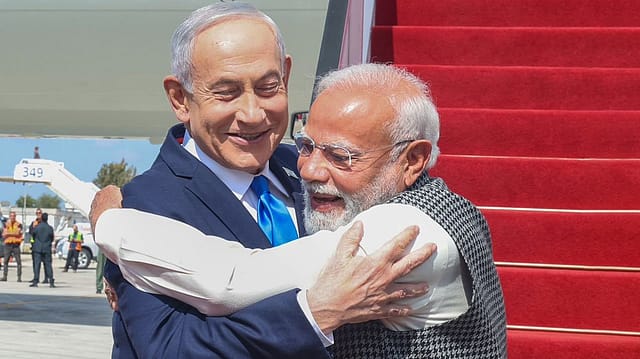
As Prime Minister Narendra Modi began his two-day visit to Israel on Wednesday, his Israeli counterpart Benjamin Netanyahu outlined an ambitious geopolitical vision that could potentially reshape alignments across West Asia and beyond.
"In the vision I see before me, we will create an entire system, essentially a 'hexagon' of alliances around or within the Middle East," Netanyahu said ahead of Modi’s visit. Calling India a "global power" and PM Modi a "personal friend", he said ties between the two countries have "grown tighter".
The remarks set the tone for a visit that blends symbolism with strategy. But what exactly is this proposed “hexagon,” and where does India fit into it?
What is the ‘hexagon’ of alliances?
According to Netanyahu, the “hexagon” would include India, Arab nations, African nations, Mediterranean countries such as Greece and Cyprus, along with other Asian partners.
Though still loosely defined, the description broadly aligns with the vision of the India-Middle East-Europe Economic Corridor, or IMEC. The corridor aims to boost connectivity, trade flows, and infrastructure integration between India, the Middle East, and Europe.
Netanyahu framed the alliance in strategic terms. The grouping, he said, would form an axis of countries that agree on the “reality, challenges, and goals” in countering what he described as radical forces, specifically the Shia and Sunni axes. He said cooperation among these nations, despite differing perceptions, could deliver strong outcomes and ensure their "resilience and future".
The idea suggests a blend of economic integration and security coordination, though details remain unclear.
India’s role as a “global power”
Netanyahu’s description of India as a “global power” signals how central New Delhi is to the proposed framework. India’s growing economic weight, its expanding defence ties with Israel, and its improving relations with Gulf states make it a key player in any cross-regional architecture.
At the same time, India has traditionally avoided rigid bloc politics. Even as it has deepened defence and technology cooperation with Israel, it has maintained engagement with major powers across the spectrum, including the US, Russia, and China.
India also maintains longstanding ties with Iran and is deepening strategic and economic cooperation with Saudi Arabia. That balancing act gives New Delhi leverage but also limits how far it may align with any explicitly anti-axis formation.
Andreas Krieg, associate professor of security studies at King's College London, told Al Jazeera that Netanyahu's alliance "risks hardening regional polarisation, giving Israel's rivals (Iran, but also Turkiye and others) an easy narrative of encirclement, and making some would-be partners more cautious about being seen too close to Israel."
He added that India’s priorities lie in defence cooperation, advanced technology, and trade, rather than becoming embedded in Israel’s broader regional ambitions.
A politically significant visit
This marks PM Modi’s second visit to Israel, following his 2017 trip that was widely described as “historic” as it was the first by an Indian Prime Minister. During the current visit, he is expected to participate in an innovation event in Jerusalem and visit Yad Vashem with Netanyahu.
On Wednesday evening, Prime Minister Modi also addressed the Knesset, Israel’s parliament, a rare gesture that reflects the warmth in bilateral ties. Former President Pranab Mukherjee had addressed the Knesset in 2015, during the first visit by an Indian head of state to Israel.
"India deeply values the enduring friendship with Israel, built on trust, innovation and a shared commitment to peace and progress," PM Modi wrote on X ahead of his visit.
The visit follows months of intense diplomatic engagement. External Affairs Minister S. Jaishankar and Commerce and Industry Minister Piyush Goyal have both travelled to Israel recently, while Israeli ministers and business delegations have visited India. Israel’s participation at the AI Impact Summit in New Delhi underlined growing convergence in areas such as artificial intelligence and emerging technologies.
For India, the visit is aimed at consolidating defence and technology cooperation while advancing economic corridors such as the IMEC. For Israel, it is also about embedding India within a broader regional strategy. How far that vision evolves from rhetoric into reality will depend on how effectively New Delhi balances ambition with strategic autonomy.