
Zelenskyy holds positive talks with US envoys as new 20-point peace plan goes to Moscow
ADVERTISEMENT
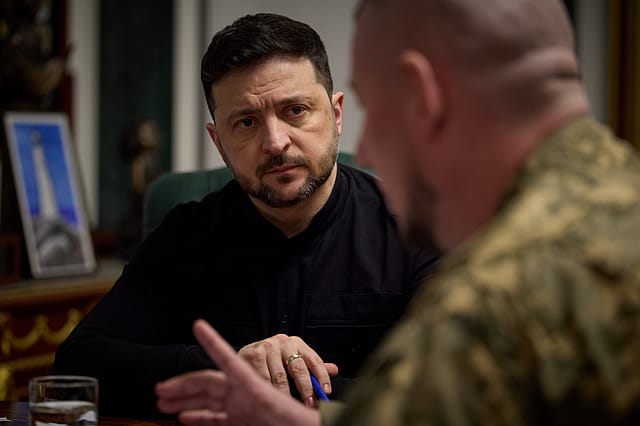
Ukrainian President Volodymyr Zelenskyy said on Thursday that he had “discussed certain substantive details” in what he described as “a very good conversation” with US envoys Steve Witkoff and Jared Kushner. The main goal of the talks was to find a way to end Russia’s war against Ukraine.
Zelenskyy said the meeting produced some useful ideas that “can work towards a lasting peace.”
In a post on X, he wrote, “We discussed certain substantive details of the ongoing work. There are good ideas that can work toward a shared outcome and lasting peace.”
He thanked the two envoys for their “constructive approach, the intensive work, and the kind words.”
“We are truly working 24/7 to bring closer the end of this brutal Russian war against Ukraine and to ensure that all documents and steps are realistic, effective, and reliable,” he added.
They also agreed that Ukrainian negotiator Rustem Umerov would speak again with the envoys on Thursday.
Zelenskyy’s post came a day after he said that Ukraine had managed to secure some small concessions in the latest version of a US-led draft plan aimed at ending the war, which began nearly four years ago.
The 20-point peace plan
The peace plan, which has 20 points and was agreed on by US and Ukrainian negotiators, is now being reviewed by Russia. Kremlin spokesperson Dmitry Peskov said Moscow is examining the information given to President Vladimir Putin by his representative, Kirill Dmitriev, after talks with US officials in Miami over the weekend. However, Russia has so far not shown readiness to drop its demands, including full Ukrainian withdrawal from the eastern territories.
Zelenskyy admitted on Wednesday that he disagreed with some parts of the draft document. But he said Ukraine succeeded in removing certain conditions, such as an immediate withdrawal from Donetsk or accepting Moscow-controlled territories as Russian.
Timeline and twists
In February 2022, Russia began its full-scale invasion of Ukraine. It clearly sets off a chain of diplomatic reactions.
Notably in the same month, on 28 Feb, the first peace talks took place in Belarus, mere days after the invasion had started.
After that on March 29, The teams from Ukraine and Russia meet at Istanbul and exchange initial proposals for the draft. Nothing is concluded.
Further during Apr-May, draft documents are exchanged among the teams in an attempt to reach an agreement on ideas concerning Ukraine's neutrality and guarantees for its security.
These talks disintegrate in the latter part of April with no resolution, with hostilities resuming.
2023-24
There were occasional diplomatic talks and peace plans from the West, but no direct talks between Russia and Ukraine that could lead to concrete actions. There were peace plans from Western allies for peace and reconstruction after the war.
2025
Jan-Feb: Rumors emerge of peace initiatives proposed by US officials, potentially including initial negotiations between Trump, Putin, and Zelensky.
March 2: There is a large global summit on Ukraine in London in an effort to prepare plans for a peace settlement.
Late March: A naval truce proposal surfaces between Russia and Ukraine in Saudi Arabia. The goal of this proposal is to ease tensions related to the Black Sea. It faces challenges concerning implementation.
Apr: The United States gives Russia and Ukraine what it proclaims to be its ‘final’ peace proposals. The negotiations remain continuous without any concrete outcome.
May 15-16: Ukrainian and Russian leaders have direct talks in Istanbul. This is significant, although major breakthroughs on a ceasefire and peace treaty are not reached. Both parties manage to come to a big exchange of prisoners (1,000 from each side), which is quite significant but not particularly indicative of a peace treaty.
May: There is a second round of direct negotiations in early June, where both camps submit written proposals for peace. However, there is still no agreement on a cease-fire.
Mid-2025: According to the Kremlin, a time frame for holding peace-talks has not been set, as both parties are exchanging draft copies of ideas for negotiations.
Late 2025
Dec 2025: Ukraine and the U.S. develop a new plan for peace with 20 points with the aim of stopping the war and submit this draft for review to Moscow. Moscow indicates that it is considering the draft and taking into consideration their interests regarding the Ukrainian military and security issues.
Ongoing: Indirect dialogue is going through representatives or diplomats. The Ukrainian negotiator is still holding dialogue sessions with US diplomats, while Russian leadership continues examining peace offers. All this happens while fighting in the conflict continues.