The FAQs are AI-generated, and Fortune India is not responsible for its content or any associated copyright issues.
AIDA seeks 2–2.5x incentives for flex-fuel vehicles in CAFE-III, flags policy imbalance with EV push
/ 2 min read
Distillers’ body urges lifecycle emission accounting and alignment with ethanol blending goals amid energy security concerns
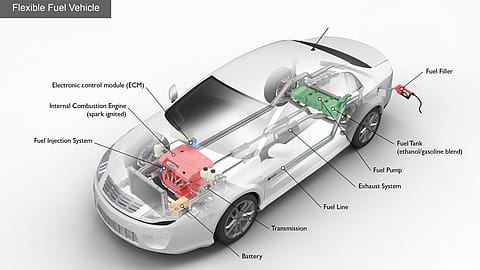
Flex-fuel vehicles are internal combustion engine cars designed to run on varying blends of petrol and ethanol — ranging from standard E20 to higher blends such as E85 — without requiring major engine modifications. | Credits: Alternative Fuels Data Cente (AFDC)
India’s ethanol industry has flagged a “strategic imbalance” in the draft fuel efficiency regulations, with the All India Distillers’ Association (AIDA) urging the government to significantly enhance incentives for Flex-Fuel Vehicles (FFVs) under the proposed Corporate Average fuel Economy (CAFE) III norms.
In a letter dated April 22 to the Ministry of Petroleum & Natural Gas, the association said the current framework disproportionately favours Battery Electric Vehicles (BEVs) and Plug-In Hybrid Electric Vehicles (PHEVs), while underplaying ethanol-based mobility solutions.
Flex-fuel vehicles are internal combustion engine cars designed to run on varying blends of petrol and ethanol — ranging from standard E20 to higher blends such as E85 — without requiring major engine modifications. The government has been actively promoting such vehicles as part of its broader biofuel strategy, especially as geopolitical tensions in West Asia continue to expose India’s vulnerability to crude oil supply disruptions and price volatility.
Calls for higher credits, policy parity
AIDA has specifically recommended increasing the Volume Derogation Factor (VDF) for standalone FFVs from the proposed 1.1 to 2.0–2.5, arguing that the existing level does not adequately reflect their contribution to emissions reduction and energy security.
The body cautioned that such underrepresentation could create a policy misalignment, especially at a time when India has made significant investments in scaling ethanol production and adoption. It added that flex-fuel vehicles offer an “immediately deployable” and cost-effective decarbonisation pathway without the infrastructure challenges linked to rapid electrification.
Push for technology-neutral approach
Beyond incentives, AIDA has called for a broader rethink of the compliance structure under CAFE-III. It has urged policymakers to adopt a technology-neutral, portfolio-based approach that gives equal weight to electrification, hybridisation and ethanol-powered solutions.
Such an approach, the association noted, would allow a more resilient transition by diversifying pathways rather than implicitly prioritising a single technology. This is particularly relevant in India’s context, where cost sensitivity and infrastructure readiness remain key constraints.
Recommended Stories
Aligning auto policy with ethanol roadmap
AIDA has also stressed the need to align CAFE-III norms with the government’s Ethanol Blended Petrol (EBP) programme, including targets beyond E20. According to the association, regulatory coherence across sectors is critical to fully realise the benefits of the biofuel push.
Additionally, it has recommended incorporating lifecycle—or well-to-wheel—emissions into regulatory calculations, highlighting that ethanol derived from domestic feedstocks can deliver meaningful carbon savings beyond tailpipe metrics.
The industry body argued that a more balanced framework would not only accelerate decarbonisation but also reduce crude import dependence and support rural incomes linked to the biofuel value chain.
With the CAFE-III norms set to shape India’s auto strategy for the rest of the decade, AIDA’s intervention underscores rising pressure from the ethanol ecosystem to secure a stronger foothold alongside electrification in the country’s clean mobility transition.
RANK
COMPANY NAME
REVENUE
(INR CR)
(INR CR)
{{#current-rank}} {{current-rank}} {{/current-rank}} {{^current-rank}} {{rank}} {{/current-rank}} {{name}} {{#revenue}} {{revenue}} {{/revenue}} {{^revenue}} {{noi}} {{/revenue}}