The FAQs are AI-generated, and Fortune India is not responsible for its content or any associated copyright issues.
Tata Motors bets on Sierra.ev, Avinya for premium push; multiple SUV, BEV rollouts in the pipeline
/ 4 min read
The carmaker is looking to strengthen its position in India’s fast-growing SUV market while defending its leadership in the domestic electric passenger vehicle segment amid rising competitive intensity.
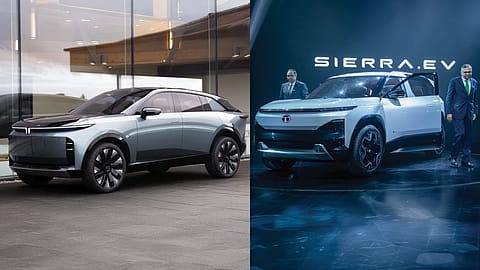
The Sierra.ev and Avinya are expected to spearhead Tata Motors’ next phase of premiumisation as the automaker sharpens focus on higher-margin SUVs and next-generation electric mobility.
Tata Motors Passenger Vehicles (TMPV) is preparing a broad-based product offensive centred around the upcoming Sierra.ev and the Avinya range as it seeks to strengthen its foothold in India’s fast-growing Sport Utility Vehicle (SUV) market and retain leadership in the domestic electric car segment, according to sources privy to the company’s plans.
“The company is increasingly looking to strengthen its presence in higher-margin SUV and premium EV segments as competition intensifies across both internal combustion engine and electric vehicle categories,” people aware of Tata Motors’ product strategy said. “The focus is now shifting beyond scale to portfolio differentiation, premiumisation and defending market share in electric mobility.”
In response to Fortune India’s queries, Tata Motors declined to comment on specific FY27 product launch plans, stating that the company would “not be commenting on which products we will be launching in FY27 ahead of time” and that stakeholders should refer to its earlier public disclosures on future products and strategy.
The renewed product push comes amid intensifying competition in both the SUV and EV segments. SUVs now account for over 60% of India’s passenger vehicle sales, while electric vehicle penetration is steadily rising as automakers expand portfolios across price points.
Tata Motors currently commands roughly 13% share of India’s passenger vehicle market and has outlined ambitions of raising that to 16% by FY27 and eventually 18-20% by FY30 through an expanded SUV and EV lineup.
Sierra.ev, Avinya to spearhead premiumisation
At the centre of Tata Motors’ upcoming product strategy is the Sierra.ev, which is scheduled to be launched in the the near term, following the earlier introduction of the model in its ICE avatar. Positioned between the Curvv.ev and Harrier.ev in Tata Motors’ electric SUV portfolio, the Sierra.ev is expected to be priced in the ₹20 lakh-₹30 lakh range (ex-showroom), according to industry estimates.
The model is expected to compete with midsize electric SUVs from Mahindra, Hyundai, MG Motor and Maruti Suzuki, while also taking on higher variants of the BYD Atto 3 and Mahindra BE 6 in certain trims.
“The Sierra.ev is likely to become one of Tata Motors’ most strategically significant launches as the EV market evolves toward premium SUVs and higher-value offerings,” people aware of the company’s plans said.
Alongside the Sierra.ev, Tata Motors is also preparing the Avinya range, which is expected to underpin the company’s long-term premium EV ambitions, according to people aware of the company’s future product plans.
“The objective is to create a more premium and technology-led EV portfolio that can cater to customers looking beyond mass-market electric mobility,” sources familiar with the matter said.
Industry estimates suggest Avinya models could be priced upwards of ₹40 lakh, allowing Tata Motors to compete more directly with premium electric SUVs and crossovers from Hyundai, Kia, BYD and global luxury manufacturers expanding their EV portfolios in India.
{{#most-powerful-women-snapshot-individual.slug}} {{/most-powerful-women-snapshot-individual.slug}} {{^most-powerful-women-snapshot-individual.slug}} {{/most-powerful-women-snapshot-individual.slug}} {{#showRanking}} {{current-rank}} {{/showRanking}} {{#photo.0.url}}
{{name}}
It may be recalled that TMPV had already announced plans to invest ₹33,000-35,000 crore in its passenger vehicle business, including EVs, over the next five years as it expands its product portfolio and technology capabilities.
EV leadership faces rising pressure
Tata Motors remains India’s largest electric passenger vehicle manufacturer by volumes, though its dominance has narrowed over the past year as rivals accelerate launches.
Electric passenger vehicle sales in India crossed 1.07 lakh units in FY25, marking an 18% year-on-year increase, according to industry estimates. Tata Motors retained leadership with nearly 53% market share during the fiscal, though this was significantly lower than the over-70% share it commanded until recently.
The company is estimated to have sold more than 92,000 electric passenger vehicles in FY26, with EVs contributing roughly 14% to Tata Motors’ total passenger vehicle volumes during the year. Tata Motors currently sells EVs across multiple price bands, ranging from around ₹8 lakh to over ₹30 lakh (ex-showroom).
The homegrown carmaker has cumulatively sold more than 2.5 lakh EVs in India so far. However, competitors such as Mahindra & Mahindra, JSW MG Motor, Hyundai Motor India and Maruti Suzuki are scaling up EV investments aggressively across mass-market and premium segments.
Facelifts and powertrain upgrades in focus
Apart from all-new BEVs, Tata Motors is also expected to roll out upgrades and facelifts across its existing SUV lineup.
Sources have indicated that the Tiago, Punch.ev, Nexon, Harrier and Safari are likely to receive updates over the medium term, including design revisions, feature additions and powertrain enhancements. The Harrier and Safari are also expected to gain new TGDi petrol engines as Tata Motors seeks to diversify beyond diesel-powered offerings in the premium SUV segment, as per sources.
According to S&P Global Mobility, EVs currently account for nearly 4-4.5% of India’s total passenger vehicle sales, though penetration is expected to rise steadily over the next five years as charging infrastructure expands and automakers widen product portfolios.
“India’s EV market is entering a more mature phase where product differentiation, technology, software integration and brand positioning will become increasingly important alongside pricing,” said Puneet Gupta, Director, S&P Global Mobility, adding, “Automakers that can combine scale with aspirational products and a strong SUV portfolio are likely to be better positioned as EV adoption accelerates over the next five years.”
Follow Fortune India
Frequently Asked Questions
NEXT STORY