Economic Survey 2026: SHANTI Act positions nuclear power as key to India's clean, secure energy transition
/ 2 min read
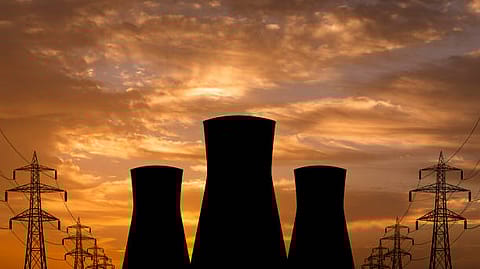
To accelerate capacity addition, The government announced a Nuclear Energy Mission in the Union Budget 2025–26, allocating ₹20,000 crore to develop at least five indigenously designed and operational small modular reactors by 2033. | Credits: Getty Images
Economic Survey 2026: SHANTI Act positions nuclear power as key to India's clean, secure energy transition
The SHANTI Act, highlighted in the Economic Survey 2026, positions nuclear power as a cornerstone of India's clean energy transition, addressing intermittency and energy security concerns. With over 8.7 GW installed capacity, nuclear energy is set to play a crucial role in India's shift towards a reliable and sustainable energy mix, supported by a ₹20,000 crore investment in small modular reactors.
This summary is AI-generated, and Fortune India is not responsible for its content or any associated copyright issues.
India currently has an installed nuclear power capacity of over 8.7 gigawatts, even as the country works towards building a cleaner and more reliable energy mix.
To accelerate capacity addition, The government announced a Nuclear Energy Mission in the Union Budget 2025–26, allocating ₹20,000 crore to develop at least five indigenously designed and operational small modular reactors by 2033. | Credits: Getty Images
The government’s push to expand nuclear power through the Sustainable Harnessing and Advancement of Nuclear Energy for Transforming India (SHANTI) Act is a major step towards addressing concerns of intermittency and energy security in India’s clean energy transition, the Economic Survey 2025–26 said on Thursday.
Nuclear power capacity
Tabled in Parliament, the survey said India currently has an installed nuclear power capacity of over 8.7 gigawatts (GW), even as the country works towards building a cleaner and more reliable energy mix. It underlined that nuclear energy is among the cleanest sources of power and can overcome the intermittency challenges associated with renewables such as solar and wind.
“Nuclear is one of the cleanest forms of energy, capable of overcoming the concerns of intermittency and energy security associated with other renewable sources of energy like solar and wind power,” the pre-Budget document said.
The survey noted that nuclear power can also provide dependable energy for heavy industries that face technological limitations in adopting renewables. In addition, nuclear energy can support the production of hydrogen for use in transport and industrial processes.
Nuclear Energy Mission
To accelerate capacity addition, the government announced a Nuclear Energy Mission in the Union Budget 2025–26, allocating ₹20,000 crore to develop at least five indigenously designed and operational small modular reactors by 2033.
As part of this push, India enacted the SHANTI Act in December 2025. The Act consolidates and amends key legislations, including the Atomic Energy Act, 1962, and the Civil Liability for Nuclear Damage Act (CLNDA), 2010, to open the sector to private companies and state governments—participation that was earlier restricted.
New framework
The new framework also introduces a graded liability structure under the CLNDA without diluting compensation for victims, addressing a long-standing concern for potential investors. It enables private participation across plant operations, power generation, equipment manufacturing, and research and innovation in the peaceful use of atomic energy.
The Economic Survey added that a credible and orderly transition away from fossil fuels will depend on the timely availability of reliable non-fossil energy sources such as nuclear power, alongside a clearly defined pathway for peak emissions.
Follow Fortune India
NEXT STORY