The FAQs are AI-generated, and Fortune India is not responsible for its content or any associated copyright issues.
India Inc. braces for turbulence as leaders warn of oil shock, global uncertainty at CII Summit
/ 3 min read
Union Minister Ashwini Vaishnaw said India was passing through a crucial technology “inflection point” and urged investors to continue backing the country despite global volatility.
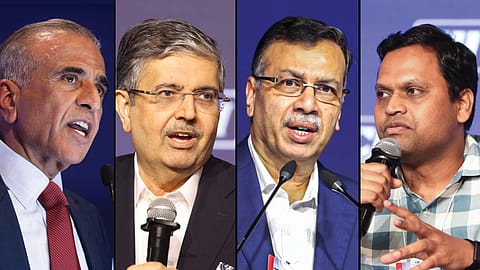
(From left), Sunil Bharti Mittal, founder and chairman, Bharti Enterprises; Uday Kotak, Kotak Mahindra Bank founder and director; Dr. Sanjiv Goenka, Chairman, RP-Sanjiv Goenka Group; and Pratyush Kumar, co-founder of Sarvam AI. | Credits: Sanjay Rawat
India Inc., policymakers, and industry leaders struck a cautious note at the CII Annual Business Summit 2026, warning that rising geopolitical tensions, supply chain disruptions, and energy market volatility could create fresh economic challenges for the country in the coming months.
Kotak Mahindra Bank founder and director Uday Kotak warned that India could soon face a major oil shock as the impact of the ongoing Middle East conflict begins to reflect in global energy prices.
“We will begin to see it. We have not seen the impact of the Middle East war in terms of energy price transmission in the last two months. It is coming and it is coming big. And the consumer has not felt the pressure,” Kotak said, adding that India must prepare itself for “tough times”.
Commerce and Industry Minister Piyush Goyal urged Indian companies to prioritise domestic industry over overseas suppliers and move beyond “business as usual” amid rising global uncertainty. Addressing the summit, Goyal said Prime Minister Narendra Modi was sending a “wake-up call” to both industry and citizens as geopolitical risks intensify globally.
The minister’s remarks come against the backdrop of continuing conflicts in West Asia, which have disrupted global trade flows and raised concerns over supply chain resilience and energy security.
Union Minister Ashwini Vaishnaw said India was passing through a crucial technology “inflection point” and urged investors to continue backing the country despite global volatility. He described the current phase as “very turbulent times” but maintained that India remained well-positioned to emerge stronger over the long term.
Labour and Employment Minister Mansukh Mandaviya said the Centre has fully operationalised the four new labour codes, describing them as reforms aimed at balancing worker welfare with ease of doing business. He stressed that industry and labour must evolve together to support future economic growth.
Maharashtra Chief Minister Devendra Fadnavis said the world was witnessing “simultaneous disruptions” ranging from geopolitical fragmentation and technological upheaval to energy transition and supply chain realignment, creating “deep uncertainty” around global growth. He added that India now has the opportunity to shape the next phase of change.
Principal Secretary to the Prime Minister Shaktikanta Das assured industry leaders that reforms would continue despite external headwinds. “There hasn’t been, and there won’t be, any reform complacency. Policy consistency and timely, calibrated reforms will continue,” he said while urging businesses to “think boldly, innovate fearlessly and invest strategically”.
Sustained private investment despite uncertain environment
Industry leaders also called for sustained private investment despite the uncertain global environment. Sunil Bharti Mittal, founder and chairman of Bharti Enterprises, urged businesses to “double down” on investments and job creation rather than delay expansion plans amid the West Asia crisis.
“These are difficult times. As a country, we had been moving at a fantastic speed, growing at 6-7% year-on-year. But situations have developed that are beyond anybody’s control,” Mittal said.
RANK
COMPANY NAME
REVENUE
(INR CR)
(INR CR)
{{#current-rank}} {{current-rank}} {{/current-rank}} {{^current-rank}} {{rank}} {{/current-rank}} {{name}} {{#revenue}} {{revenue}} {{/revenue}} {{^revenue}} {{noi}} {{/revenue}}
Dr. Sanjiv Goenka, Chairman of the RP-Sanjiv Goenka Group, lauded the thrust provided by the central government in the field of education in the country. Goenka said the achievements made by the ministry of education, such as the National Education Policy (NEP) and others, speak volumes about the central government’s vision.
On the consumer front, Shashwat Goenka, vice chairman of RP-Sanjiv Goenka Group, said Indian consumers were becoming increasingly selective in their spending patterns. While consumers remain highly price-sensitive for daily essentials, they are willing to spend significantly on premium experiences and aspirational products, he noted.
The summit also focused on India’s ambitions in artificial intelligence and renewable energy. Pratyush Kumar, co-founder of Sarvam AI, said India must urgently build sovereign AI capabilities and trusted infrastructure if it wants to shape global technology rules rather than merely follow them.
Meanwhile, Devansh Jain, executive director of INOXGFL Group, said India’s renewable energy ambitions would require lower dependence on imported clean energy technologies and significantly higher foreign direct investment to strengthen long-term energy security and manufacturing leadership.
Frequently Asked Questions
NEXT STORY