Just scratching the surface of how AI can be deployed: Babak Hodjat
/ 3 min read
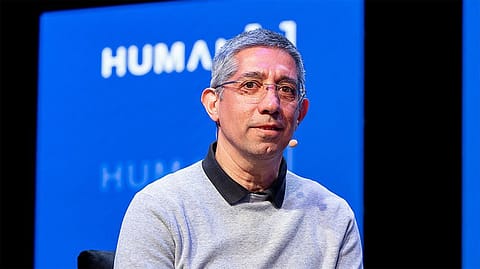
Babak Hodjat, Chief AI Officer at Cognizant.
Just scratching the surface of how AI can be deployed: Babak Hodjat
Babak Hodjat, Chief AI Officer at Cognizant, emphasises that while AI is advancing, it requires careful engineering and contextual implementation. He believes IT services firms are well-positioned to lead in AI deployment, stressing the importance of domain-specific customisation and responsible use. Despite AI's rapid evolution, Hodjat notes its limitations and the need for agile adaptation in enterprises.
This summary is AI-generated, and Fortune India is not responsible for its content or any associated copyright issues.
The leading computer scientist, however, sees data security and the non-deterministic nature of current LLMs as persistent challenges, but remains optimistic about the role IT services companies can play in the AI era.
Babak Hodjat, Chief AI Officer at Cognizant.
Babak Hodjat, a leading computer scientist and now Chief AI Officer at Cognizant, believes it is “naive” to assume that artificial intelligence can seamlessly do everything on its own. Hodjat, whose patented AI technologies have been used by Apple for its digital assistant Siri, said that while AI capabilities are advancing rapidly, the technology still requires careful engineering and contextual implementation.
His remarks come at a time when global IT services and SaaS stocks have been under pressure in recent weeks amid rapid AI advancements and concerns over the long-term relevance of traditional services firms. However, Hodjat argued that as AI evolves into a more structured engineering discipline, IT services companies are well positioned to adapt and lead. He said such firms can play a critical role in designing, deploying, and maintaining AI-driven systems. For AI to deliver meaningful results, he stressed the importance of domain contextualisation — tailoring AI systems to specific industry needs — while ensuring safety, reliability, and responsible deployment.
“In fact, what's happening is that the building blocks in the enterprise is going to be agentic. So, you have massively multi-agentic systems that must be built, connected, made reliable, and that's the job of IT services companies,” Hodjat told Fortune India. While with AI technology, things could be done faster, the incremental demand to do more, he believes, will offset any losses.
Agents and large language models still face fundamental limitations
While the current breed of off-the-shelf AI systems may be grabbing headlines, Hodjat points out that agents and large language models still face fundamental limitations.
He said, “They don't learn on the job, they have to be fine-tuned. They are notoriously unreliable when it comes to being deterministic. There is a science to how you put them together and how you build them and how you tailor them, and when you think about different companies having different processes that basically is unique to them and differentiates them, every single implementation is different.”
Even as AI systems grow more powerful by the day, “we’re far from a point where they can autonomously run a business straight out of the box,” he added.
AI evolution v/s industry adoption and safety
While AI LLM firms such as Anthropic, OpenAI, and Google continue to roll out model updates in rapid succession, leaders of major Indian IT services companies have flagged persistent challenges in enterprise-level AI adoption. Although enterprises appear increasingly open to integrating AI, Hodjat said the real gap lies between expectations and execution — specifically, aligning what businesses believe AI can do with the careful design required to ensure reliable, safe, and scalable deployment within enterprise environments.
“What it is forcing us to do is to be more agile, and I think the expectation from clients is also for us AI builders to be more agile, to adopt these technologies and bring them in on existing projects as well as new ones. So, I think if there's a structural change, it's that agility that's expected,” Hodjat said.
At the same time, concerns around AI, both within firms and the technology itself, largely centre on data security and the non-deterministic nature of these systems. For enterprises that expect software to be available 100% of the time and completely error-free, the current state of the technology has yet to reach that level.
“There is also concern around the infiltration of multiple agentic systems into an enterprise — how to monitor them all, ensure the organisation as a whole remains secure and interoperable, and measure the risks these systems may pose. There is a need for a more centralised registry and a structured process for introducing and safeguarding AI agents,” Hojat said, adding that current expectations of AI technology are very high relative to the risks it can present.
With a technology as new as AI, and with humans still learning how to command and effectively harness it, he sees enterprises are very much in a transition phase. “I do think it will take time and effort for us to get ahead of this. And as we do, it will flourish more and more. There are so many areas where AI can be deployed. We’re just scratching the surface right now,” he added.
Follow Fortune India
NEXT STORY