LPG crunch amid West Asia tensions puts weddings and events industry under stress
/ 4 min read
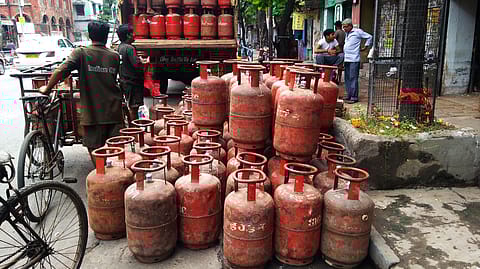
Across cities, caterers and hospitality operators say weddings scheduled in March are proceeding largely as planned, though operational adjustments are increasingly being made behind the scenes. | Credits: Getty Images
LPG crunch amid West Asia tensions puts weddings and events industry under stress
India's $100 billion wedding industry is feeling the impact of West Asia's geopolitical tensions, as disruptions in LPG supply chains force caterers and hotels to adapt. While weddings proceed as planned, operators are optimizing energy use and adjusting menus to manage fuel availability, ensuring celebrations continue smoothly despite the challenges.
This summary is AI-generated, and Fortune India is not responsible for its content or any associated copyright issues.
Hotels and caterers tweak menus, shift to induction cooking and manage rising fuel costs as disruptions in LPG supply ripple through India’s celebration economy.
Across cities, caterers and hospitality operators say weddings scheduled in March are proceeding largely as planned, though operational adjustments are increasingly being made behind the scenes. | Credits: Getty Images
India’s sprawling wedding economy—estimated to be worth over $100 billion—is beginning to feel the ripple effects of the geopolitical tensions in West Asia. Disruptions in global fuel supply chains following the Israel–US–Iran conflict have tightened the availability of commercial LPG cylinders used by caterers, hotels and banquet kitchens, forcing the industry to adapt even as the wedding season continues.
Across cities, caterers and hospitality operators say weddings scheduled in March are proceeding largely as planned, though operational adjustments are increasingly being made behind the scenes.
“India’s wedding and social celebrations segment continues to remain steady so far, and we are not seeing any disruption to wedding-related travel or event bookings across our hotels,” says Nikhil Sharma, managing director and chief operating officer, South Asia, Radisson Hotel Group.
Large hospitality chains say advance planning and diversified kitchen infrastructure have helped them cushion the immediate impact of LPG supply constraints.
“Our culinary teams are optimising LPG consumption by increasing the use of electric and induction-based cooking equipment, expanding live counters supported by alternative energy sources, and adjusting select preparation processes to ensure uninterrupted service,” Sharma says. “These measures allow us to maintain the scale and quality expected of wedding celebrations while continuing to deliver a consistent guest experience.”
Caterers adjust menus and cooking formats
While large hotel chains have the flexibility to shift cooking operations across different energy sources, standalone caterers and wedding kitchens—heavily dependent on commercial LPG cylinders—have been forced to rethink menus and food preparation strategies.
In several cities, caterers are reducing the number of live food stations, shifting some cooking to induction-based setups, and adjusting menu formats to manage fuel availability. The immediate financial impact on weddings remains limited, but the uncertainty around supply has made caterers cautious about accepting large-scale orders.
The additional cost, when it arises, is relatively modest compared with overall wedding budgets. In situations where caterers have to procure commercial cylinders at significantly higher prices due to supply constraints, the cost of a wedding could rise by roughly ₹5,000 to ₹10,000 depending on the scale of the event.
Wedding planning platform WedMeGood says the current wedding calendar has remained largely unaffected so far.
“Most weddings in March are continuing with limited disruptions, if any,” a spokesperson for the platform says. However, concerns are growing around the April–June period, when several wedding destinations in South India and hill stations host a large number of ceremonies.
Families planning weddings in those regions are closely monitoring the situation as LPG availability remains uncertain.
{{#most-powerful-women-snapshot-individual.slug}} {{/most-powerful-women-snapshot-individual.slug}} {{^most-powerful-women-snapshot-individual.slug}} {{/most-powerful-women-snapshot-individual.slug}} {{#showRanking}} {{current-rank}} {{/showRanking}} {{#photo.0.url}}
{{name}}
Why the crisis is emerging now
India consumes about 31.3 million tonnes of LPG annually, with nearly 87% used by households, while the rest is consumed by commercial establishments such as restaurants, hotels and catering kitchens. The country also relies heavily on imports to meet its energy needs.
Around 62% of India’s LPG demand is met through imports, and nearly 85–90% of these imports come from Middle Eastern countries such as Saudi Arabia and Qatar, largely transported through the Strait of Hormuz. With the ongoing conflict disrupting this key global shipping route, energy supply chains have come under pressure.
While the government maintains that domestic cooking gas supplies remain secure, the disruption has already begun affecting commercial LPG distribution, raising concerns among businesses that depend on bulk cylinders for large-scale cooking.
The effects are being felt not just by large events but also by everyday celebrations.
Anindita Sen, a Delhi resident, says a family celebration had to be abruptly altered due to the disruption. “We’d booked a Domino’s outlet to celebrate our daughter’s third birthday this weekend. But just a couple of days before the birthday party, the outlet informed us that they’ve shut down temporarily.”
Travel costs add another layer of pressure
The impact of geopolitical tensions is also being felt through rising fuel prices, which are affecting travel logistics—an essential component of India’s large, multi-day wedding celebrations.
“The current geopolitical tensions in the Middle East and the pressure they are putting on global fuel and LPG supplies are beginning to show up in industries that depend heavily on movement, and India’s wedding ecosystem is one of them,” says Reeva Sakaria, founder of mobility platform Yatri.
Indian weddings often involve hundreds of guests travelling between airports, hotels and event venues over multiple days. Rising fuel costs can significantly increase the cost of transportation for organisers.
“With hundreds of guests, families and vendors moving between hotels, homes and event spaces, there’s naturally a lot of travel across the city. When fuel prices rise, even simple things like airport pickups or venue transfers become more expensive, and people start looking for alternatives instead of relying on private vehicles,” Sakaria says.
In cities such as Mumbai, she notes, public transport networks are emerging as an important alternative.
“Local trains, metros and buses can often make moving between functions far easier. Moments like these remind us why strong public transport systems matter—they give people reliable options and help large events run smoothly even when travel costs fluctuate.”
Rising CNG prices could reshape urban mobility
The broader implications extend beyond weddings. If fuel prices continue to rise, urban commuting patterns could shift significantly, affecting vendors, guests and service providers who rely on city travel.
“If CNG prices continue to rise, it will inevitably influence how people commute in cities like Mumbai,” Sakaria says. “For many daily commuters, relying on private vehicles could become significantly more expensive, pushing them to rethink how they travel across the city.”
Integrated public transport systems could offer a solution. “Local trains, metro lines and buses working together as a connected network make commuting more efficient and affordable,” she adds.
Digital mobility platforms are also helping commuters navigate multiple transport modes more easily.
Industry adapts as peak wedding months approach
For now, the wedding industry—spanning hospitality, catering, logistics, décor and travel—appears to be absorbing the shock rather than passing it on to consumers in a significant way.
Hotels are shifting cooking infrastructure to alternative energy sources, caterers are recalibrating menus and operations, and transport planners are relying more on public transit networks.
However, the next few months will be crucial. If LPG supply disruptions persist into the peak wedding months in several parts of the country, the industry may be forced to make deeper adjustments.
Until then, India’s famously extravagant wedding celebrations appear determined to continue—albeit with a little more operational ingenuity behind the scenes.
Follow Fortune India
NEXT STORY