Nayara Energy hikes petrol price by ₹5 per litre, diesel by ₹3
/ 3 min read
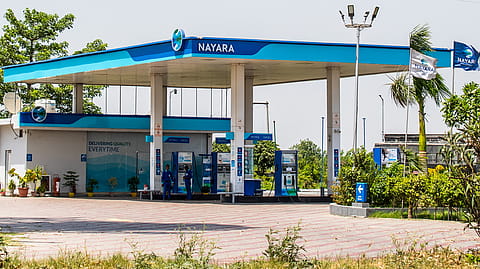
State-owned fuel retailers, who control about 90% of the market, continue to keep rates on freeze. | Credits: Shutterstock
Nayara Energy hikes petrol price by ₹5 per litre, diesel by ₹3
Nayara Energy, India's largest private fuel retailer, has increased petrol prices by ₹5 per litre and diesel by ₹3, reflecting the surge in global oil prices due to the Middle East conflict. This move comes as private retailers face mounting losses, unlike state-owned firms that receive government support to maintain price freezes.
This summary is AI-generated, and Fortune India is not responsible for its content or any associated copyright issues.
Nayara Energy, which operates 6,967 of India's 102,075 petrol pumps, has decided to pass on part of the increase in input costs to consumers, two sources with direct knowledge of the matter said.
THIS STORY FEATURES
State-owned fuel retailers, who control about 90% of the market, continue to keep rates on freeze. | Credits: Shutterstock
Nayara Energy, India's largest private fuel retailer, on Thursday raised petrol prices by ₹5 per litre and diesel by ₹3 a litre, passing on part of the recent surge in global oil prices following the war in the Middle East, sources said.
Fuel marketing companies in India have been under strain as retail petrol and diesel prices remained frozen despite a nearly 50% surge in international oil prices since February 28, when the United States and Israel launched military strikes against Iran, triggering sweeping retaliation from Tehran.
Nayara Energy, which operates 6,967 of India's 102,075 petrol pumps, has decided to pass on part of the increase in input costs to consumers, two sources with direct knowledge of the matter said.
A company spokesperson did not immediately offer any comment on the story.
Jio-bp, the fuel retailing joint venture of Reliance Industries and BP Plc that owns 2,185 outlets, has, however, so far not raised prices despite incurring heavy losses on sale of petrol and diesel.
State-owned fuel retailers, who control about 90% of the market, continue to keep rates on freeze.
Sources said while Nayara, majority-owned by Russia's Rosneft, hiked petrol price by ₹5 per litre and diesel by ₹3, the effective rate increase differs from state to state depending on the incidence on local taxes like VAT. In some places, the increase is as high as ₹5.30 per litre for petrol.
"Private fuel retailers in India receive no government compensation to offset losses from holding back price increases, unlike state-owned firms that are supported for acting as "good corporate citizens", sources said, adding that mounting losses have left them with little choice but to raise retail prices.
Retail petrol and diesel prices have been frozen since April 2022, with state-run Indian Oil Corporation (IOC), Bharat Petroleum Corporation Ltd (BPCL), and Hindustan Petroleum Corporation Ltd (HPCL) absorbing losses when crude prices are high and making profits when rates are low.
The three retailers last week hiked the price of premium or higher-grade petrol price by ₹2 per litre and the rate of bulk diesel sold to industrial users by about ₹22 a litre.
However, the price of normal petrol and diesel remains unchanged.
{{#most-powerful-women-snapshot-individual.slug}} {{/most-powerful-women-snapshot-individual.slug}} {{^most-powerful-women-snapshot-individual.slug}} {{/most-powerful-women-snapshot-individual.slug}} {{#showRanking}} {{current-rank}} {{/showRanking}} {{#photo.0.url}}
{{name}}
Premium 95-Octane petrol price in Delhi has been increased from ₹99.89 per litre to ₹101.89. Alongside, bulk or industrial diesel prices were hiked from ₹87.67 per litre to ₹109.59 in the national capital.
International oil prices touched $119 per barrel earlier this month on intensifying Iran war, before pulling back to around $100 a barrel.
A litre of normal petrol in Delhi continues to cost ₹94.77 while the same grade diesel comes for ₹87.67 a litre.

Normal petrol typically has an octane rating of 91-92 and is suitable for standard engines, offering adequate performance for everyday driving. Premium petrol, on the other hand, has a higher octane rating of 95-98, making it ideal for high-performance or high-compression engines.
The government has maintained that petrol and diesel are deregulated commodities whose pricing is independently decided by oil marketing companies.
India imports 88% of its crude oil needs and roughly half of its natural gas requirement. These mostly come via the Strait of Hormuz. Following the US and Israeli attacks on Iranian government, military and nuclear facilities, Iran warned shipping away from the strait, and insurers withdrew coverage, effectively halting tanker movements.
Prices had risen to $119 per barrel in June 2022 in the aftermath of Russia's invasion of Ukraine. That year, oil companies had nominal profits, but in FY24, they posted record ₹81,000-crore profit, helping make up for past dent in margins.
This year, the three companies have posted ₹23,743 crore profit in the December quarter alone.
Follow Fortune India
NEXT STORY